


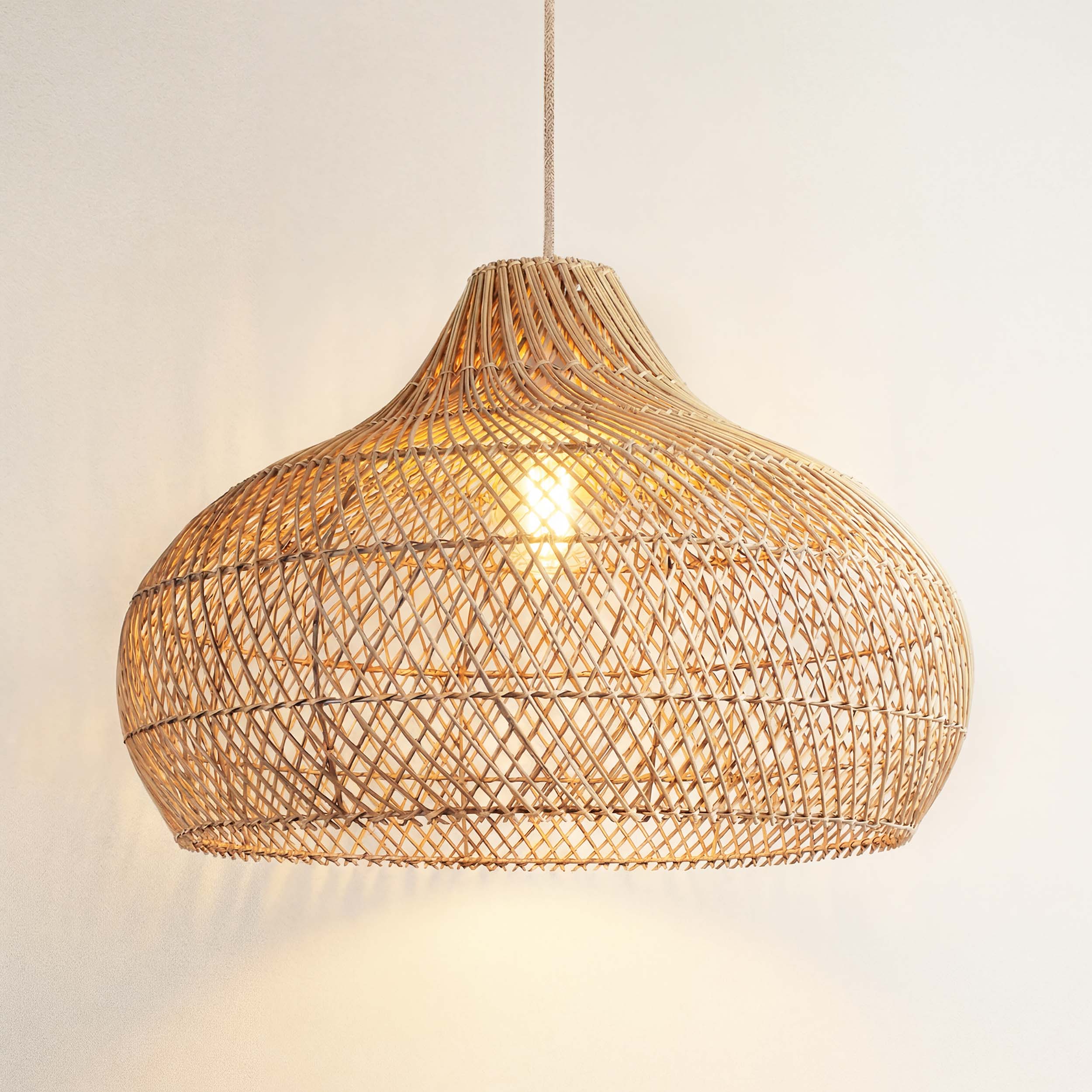
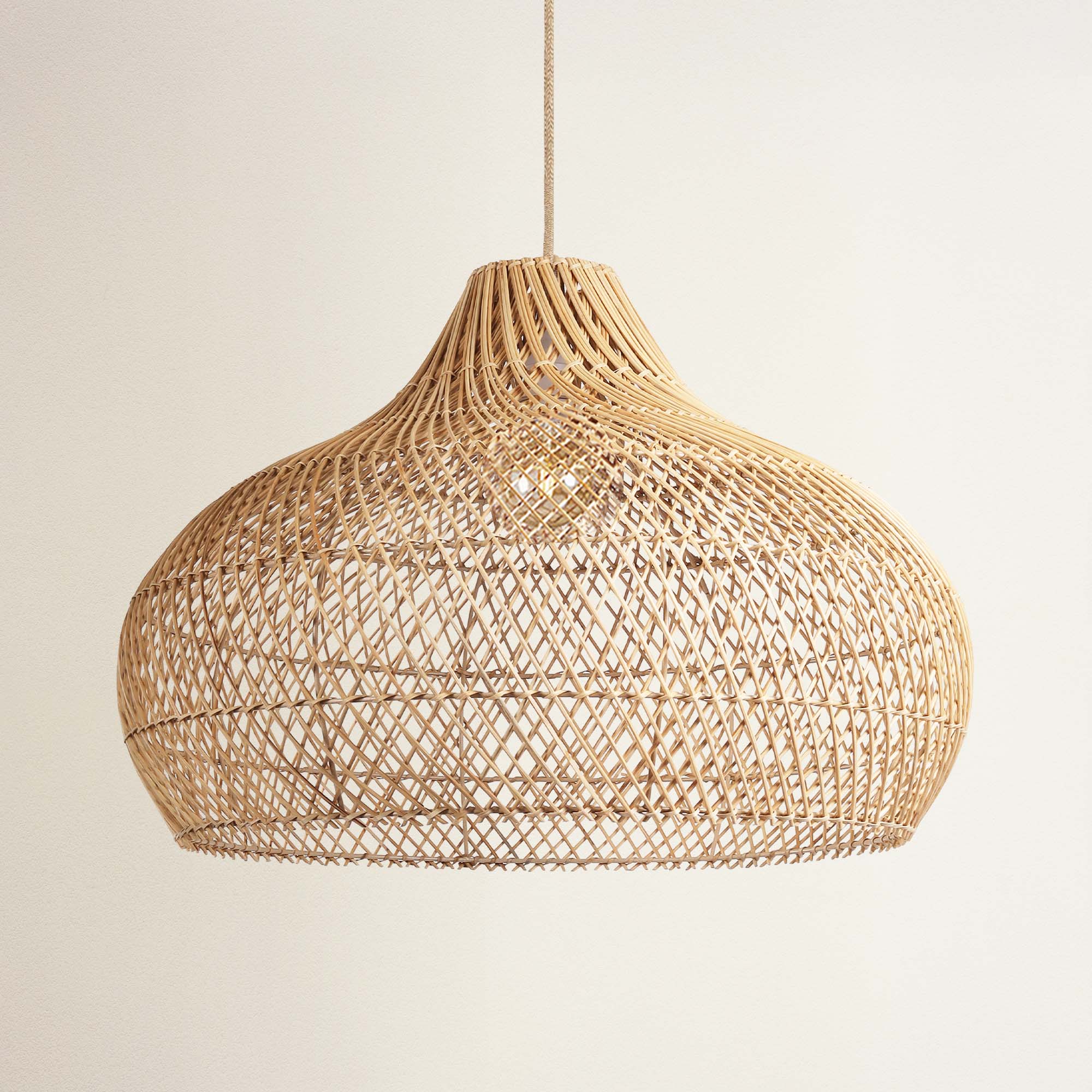
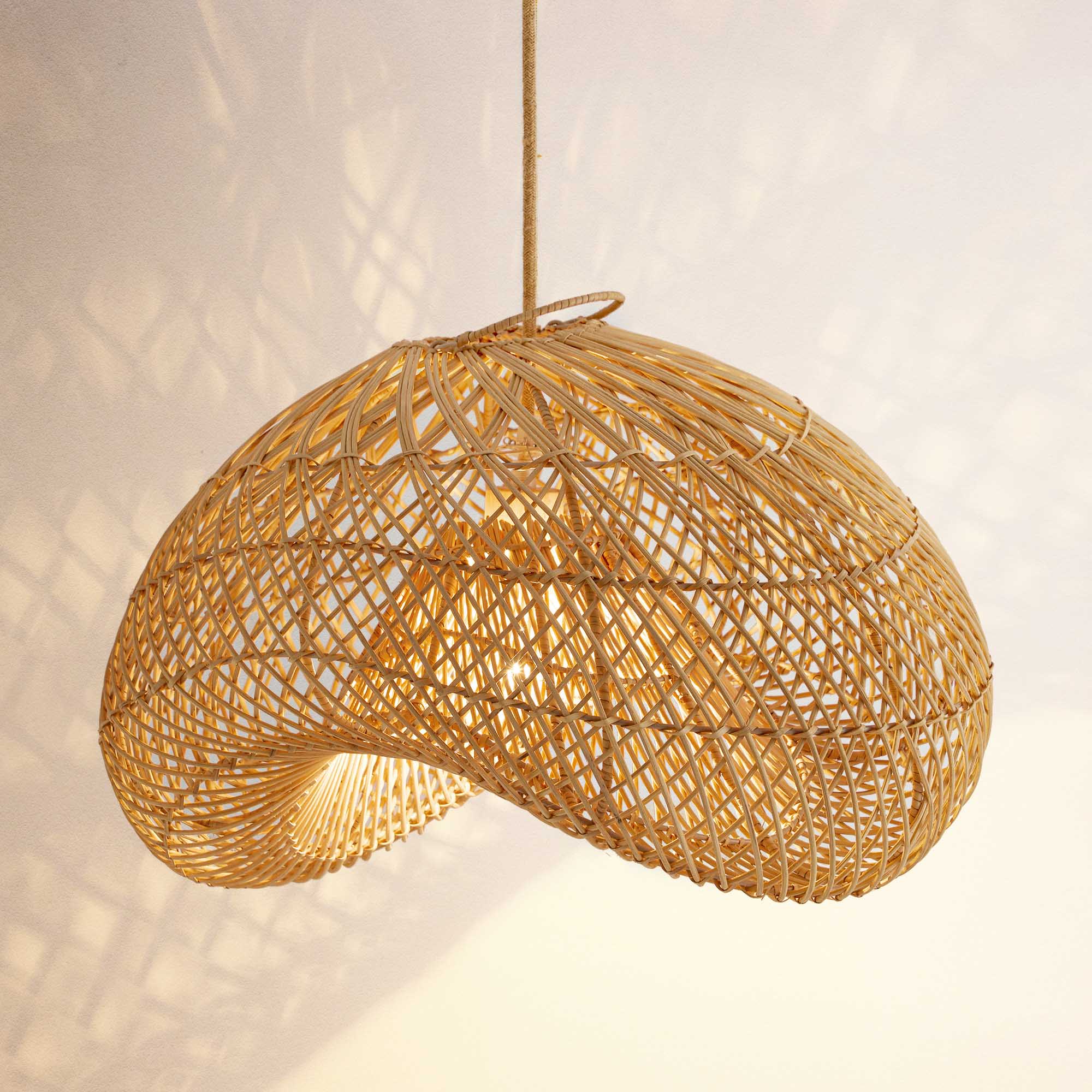
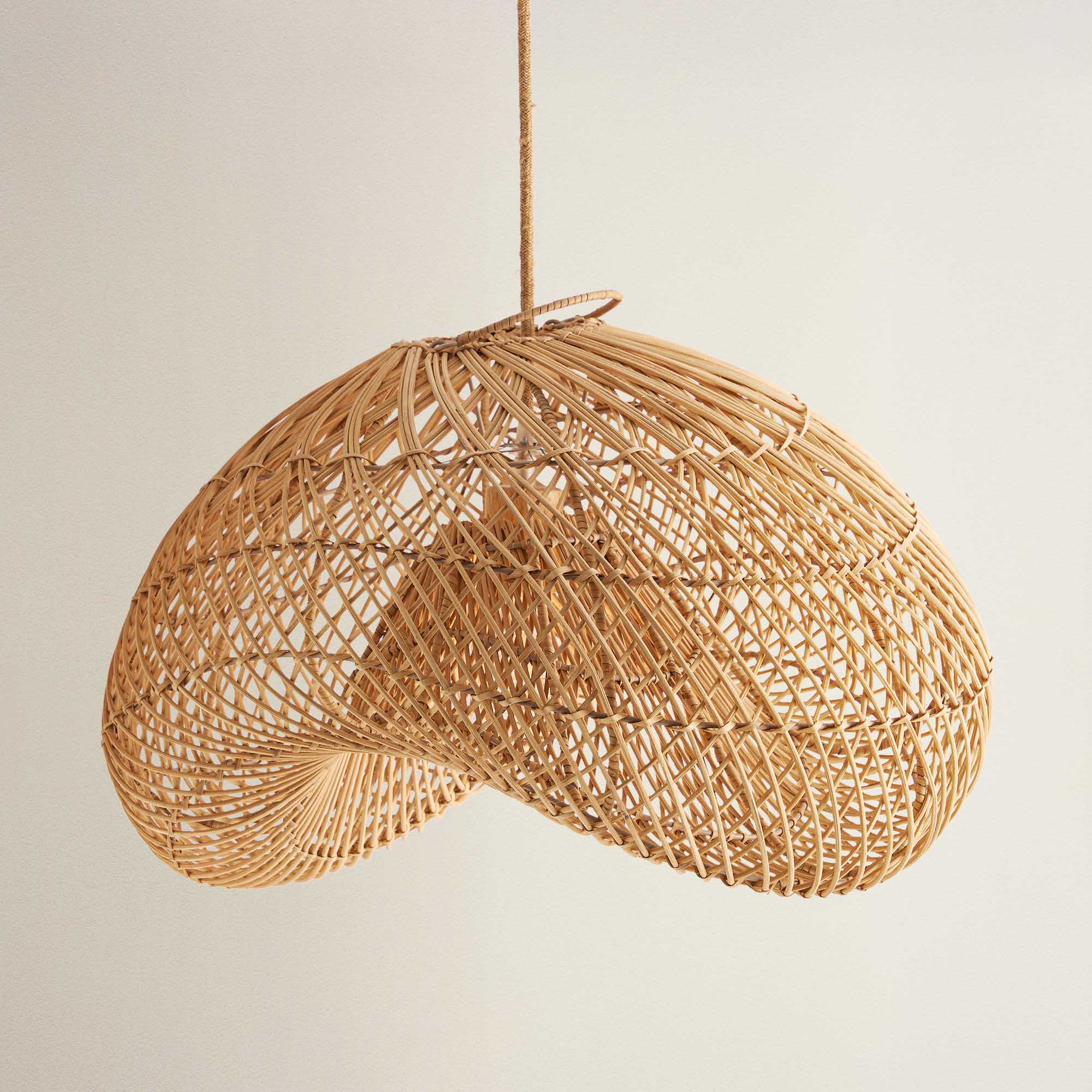
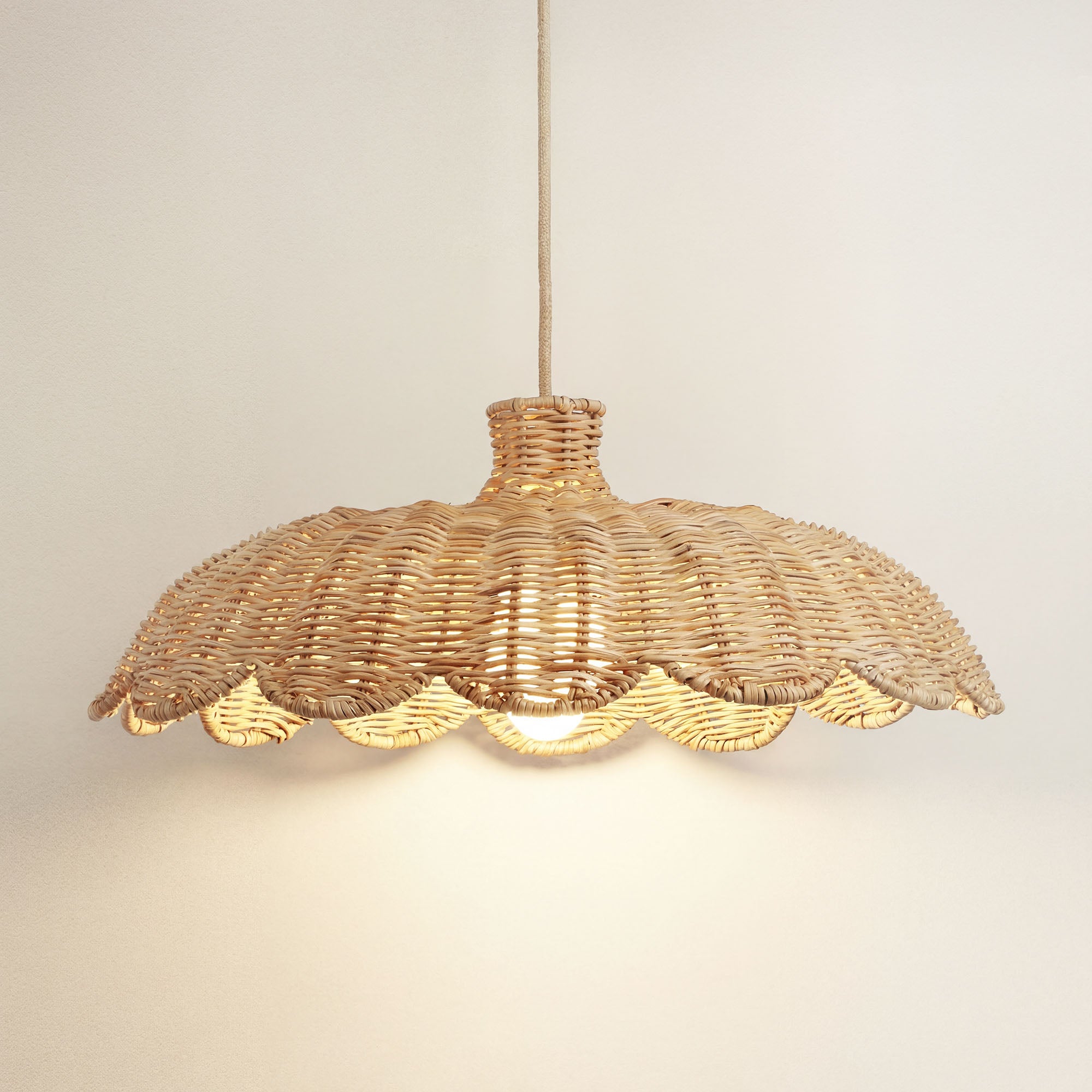
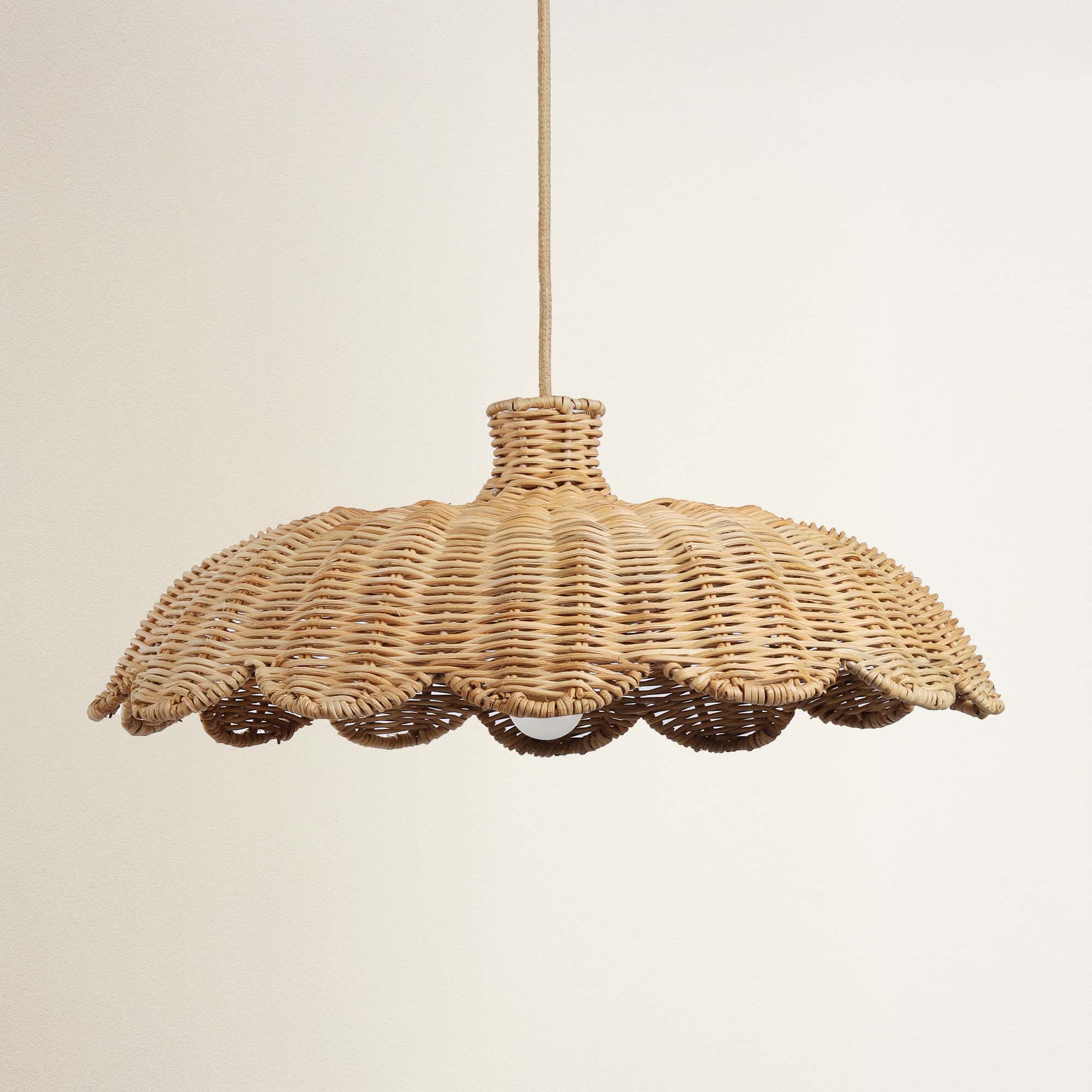
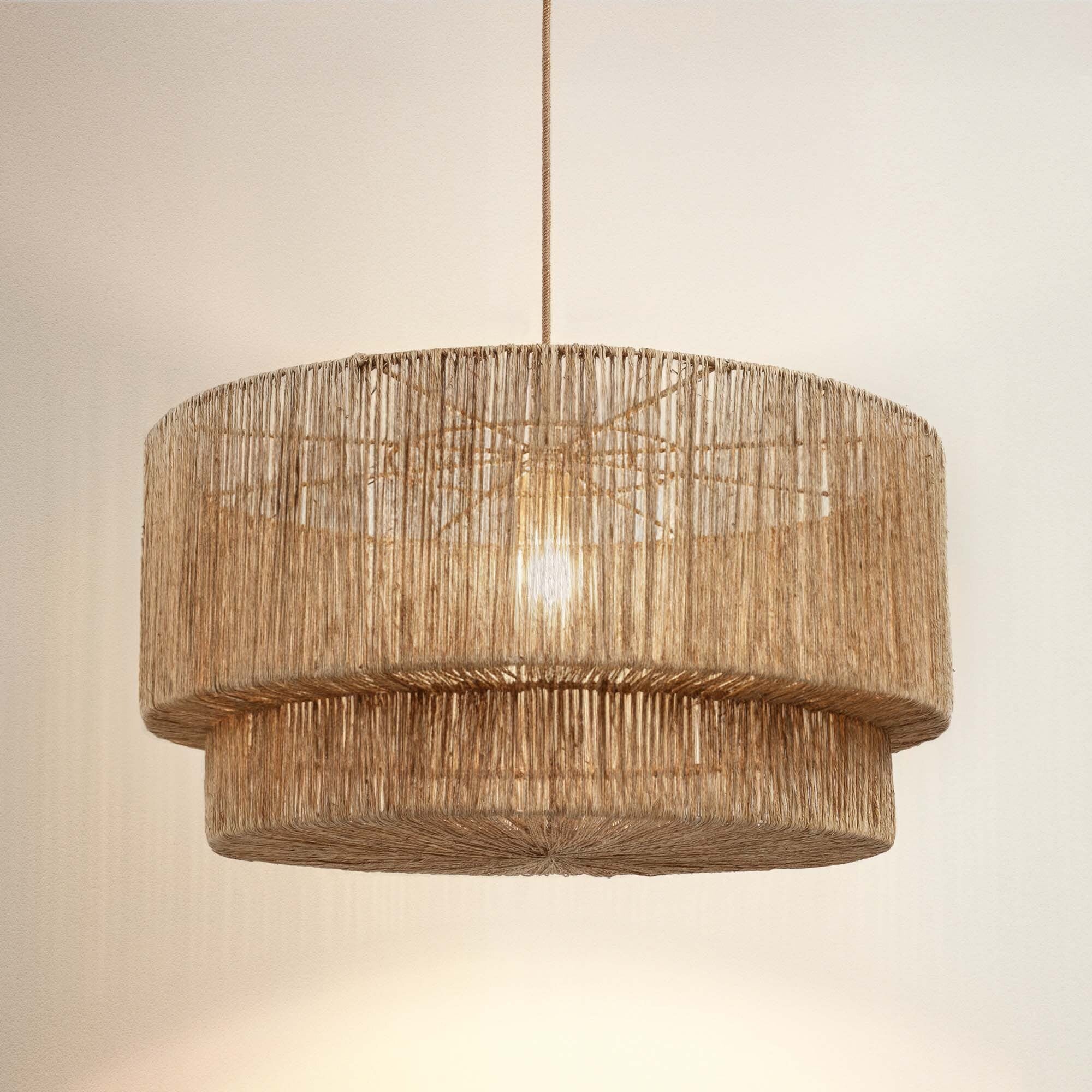
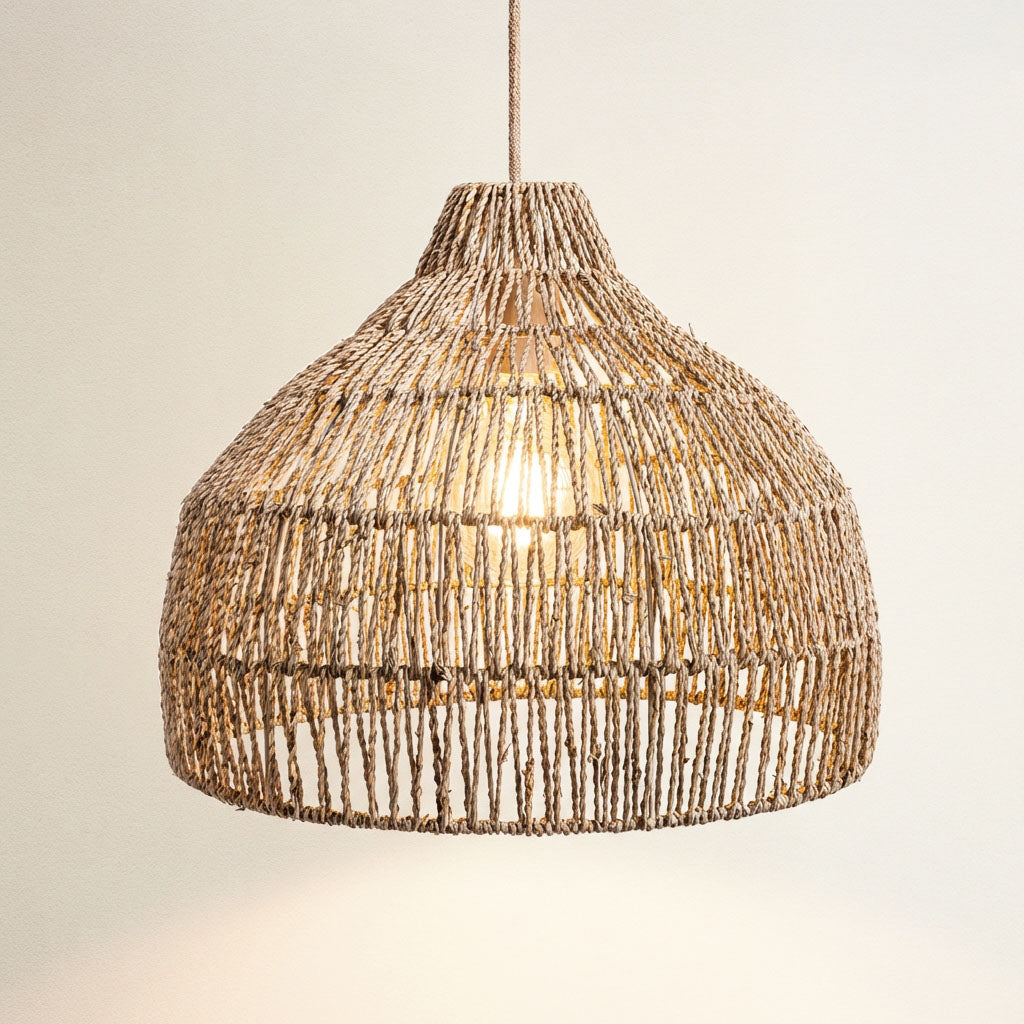
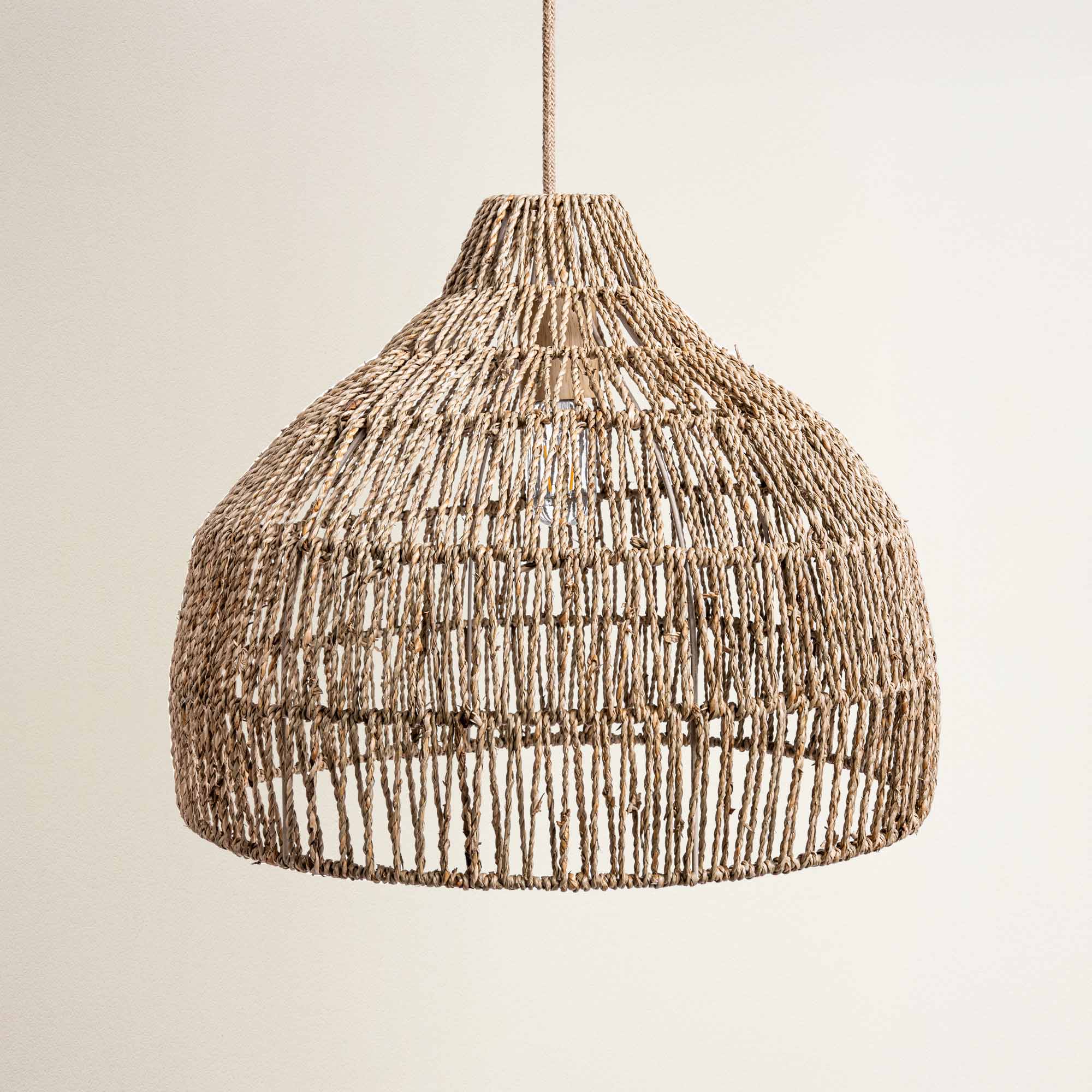
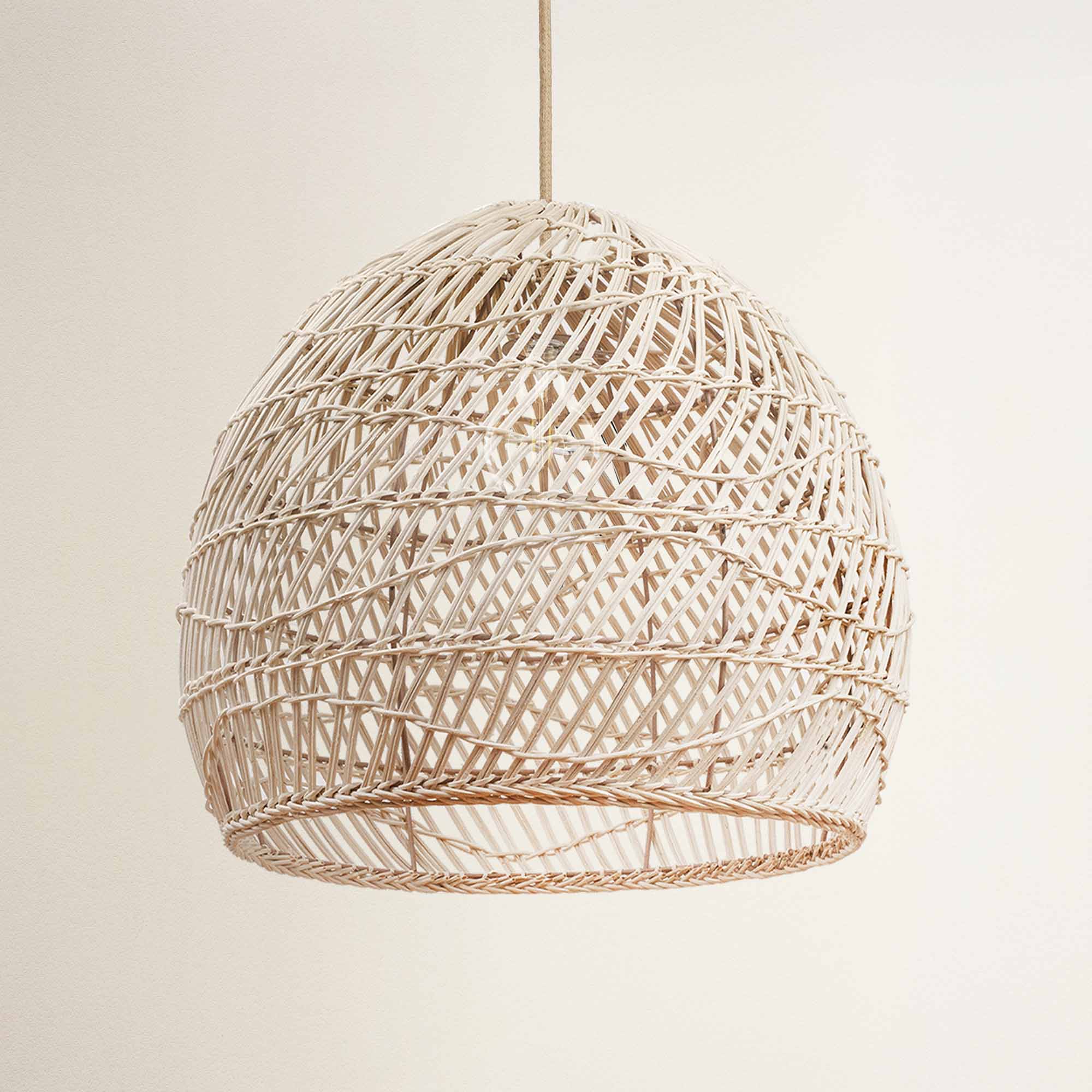
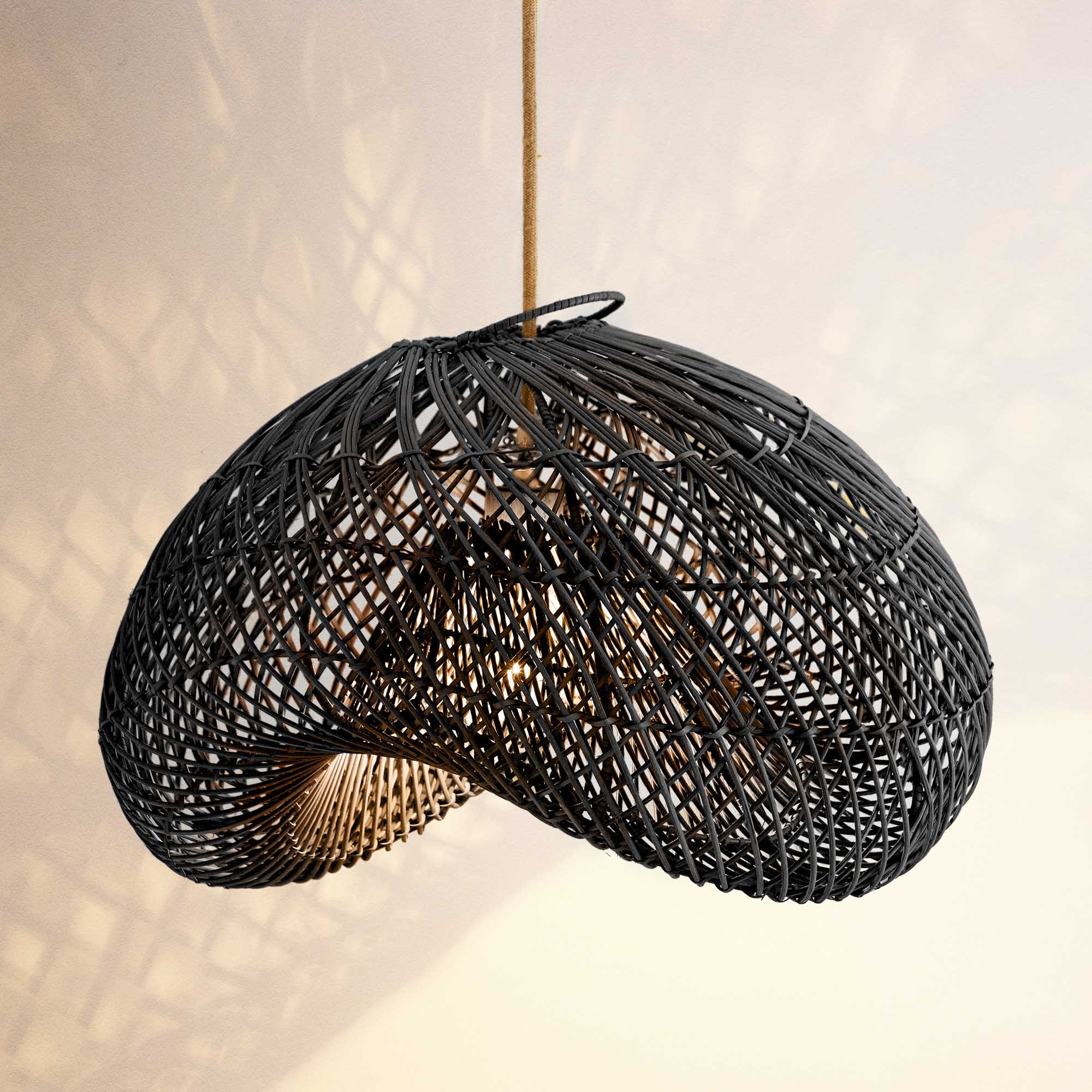
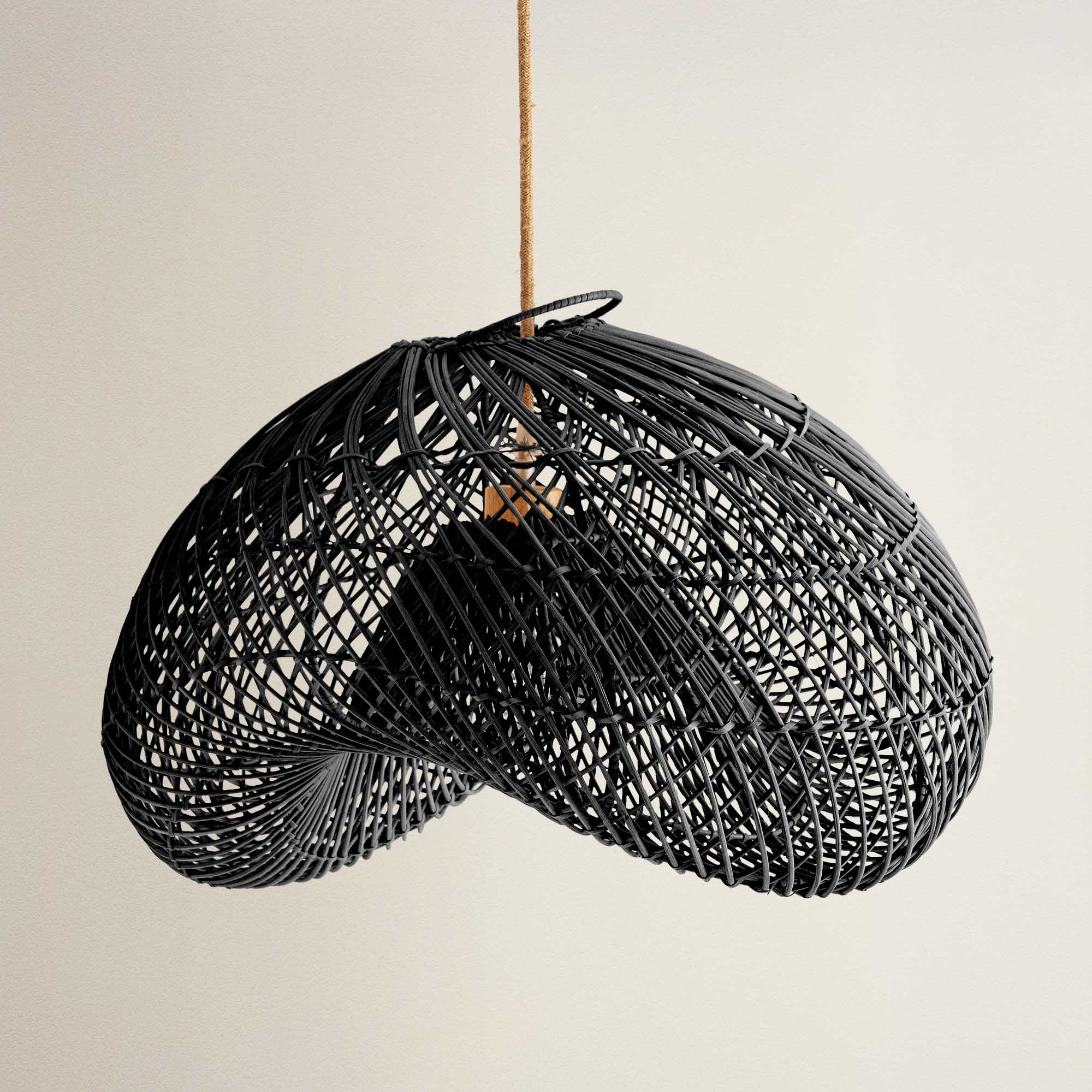
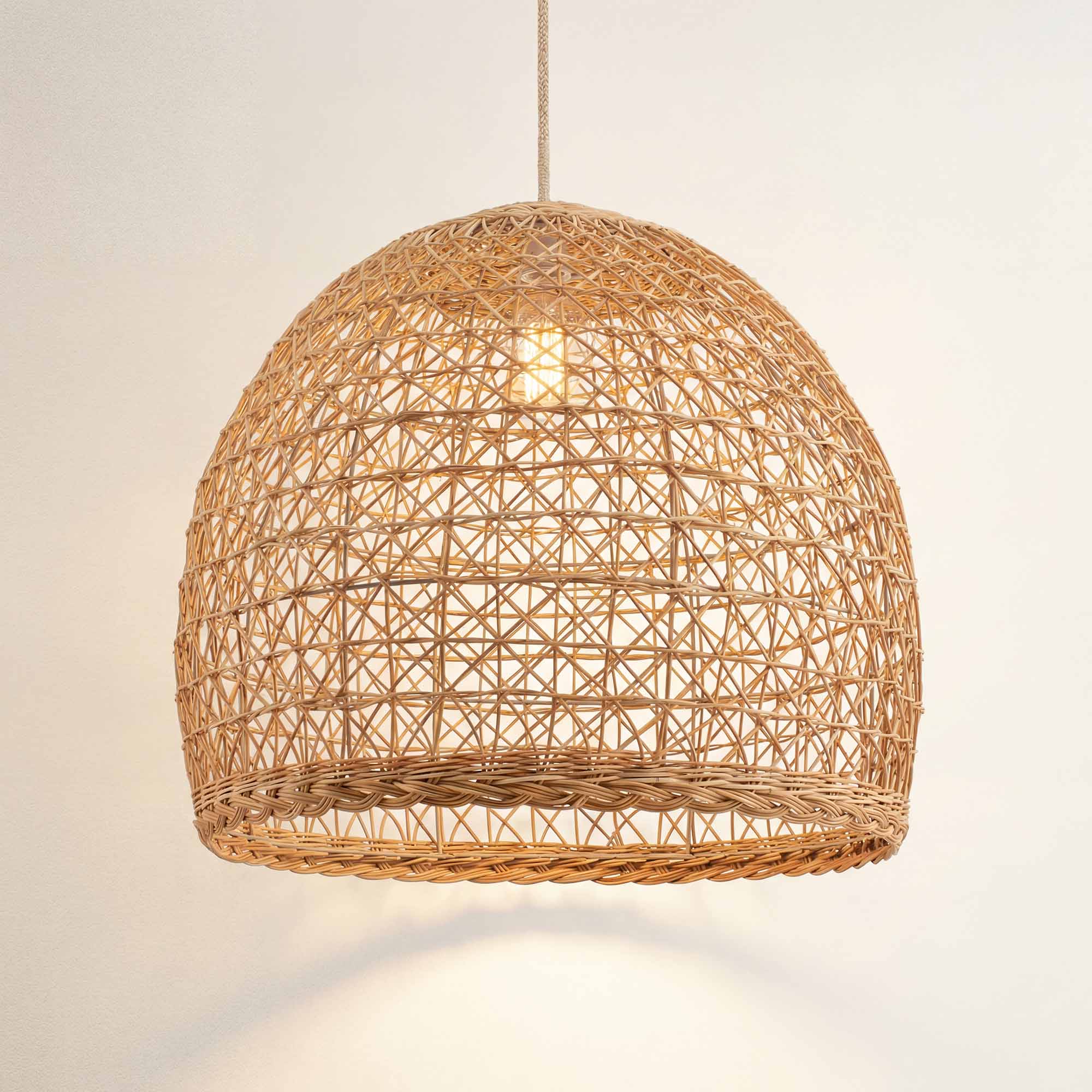
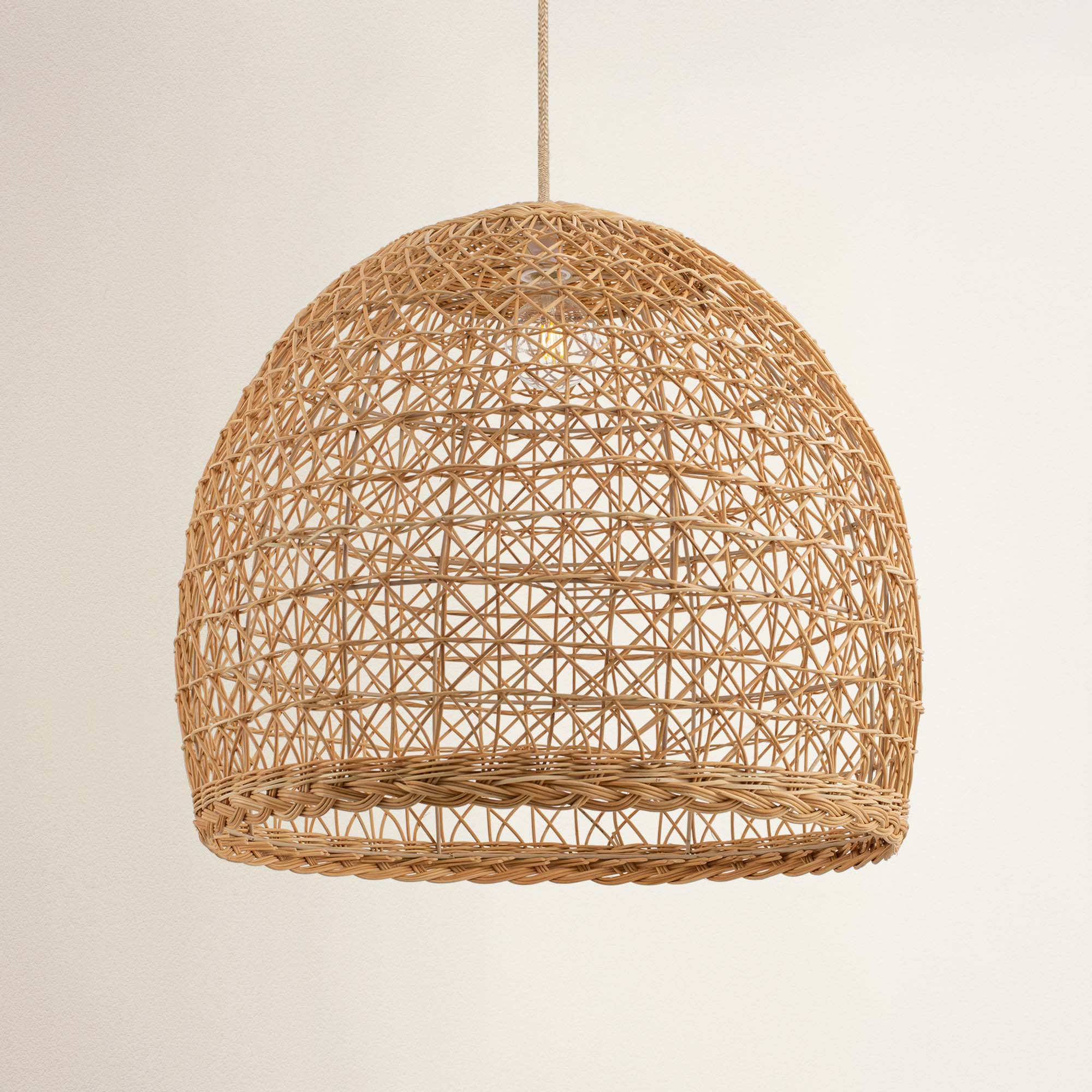
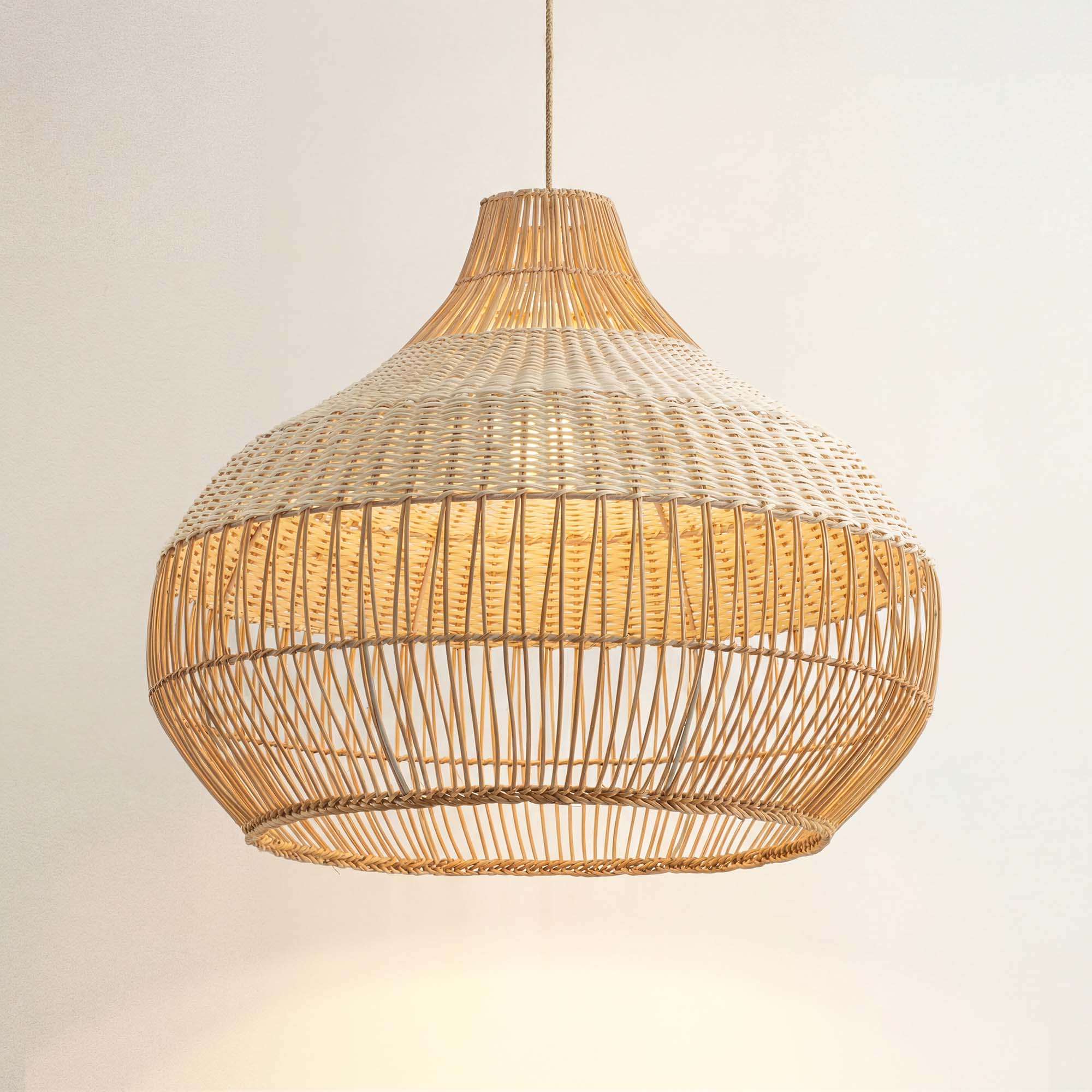
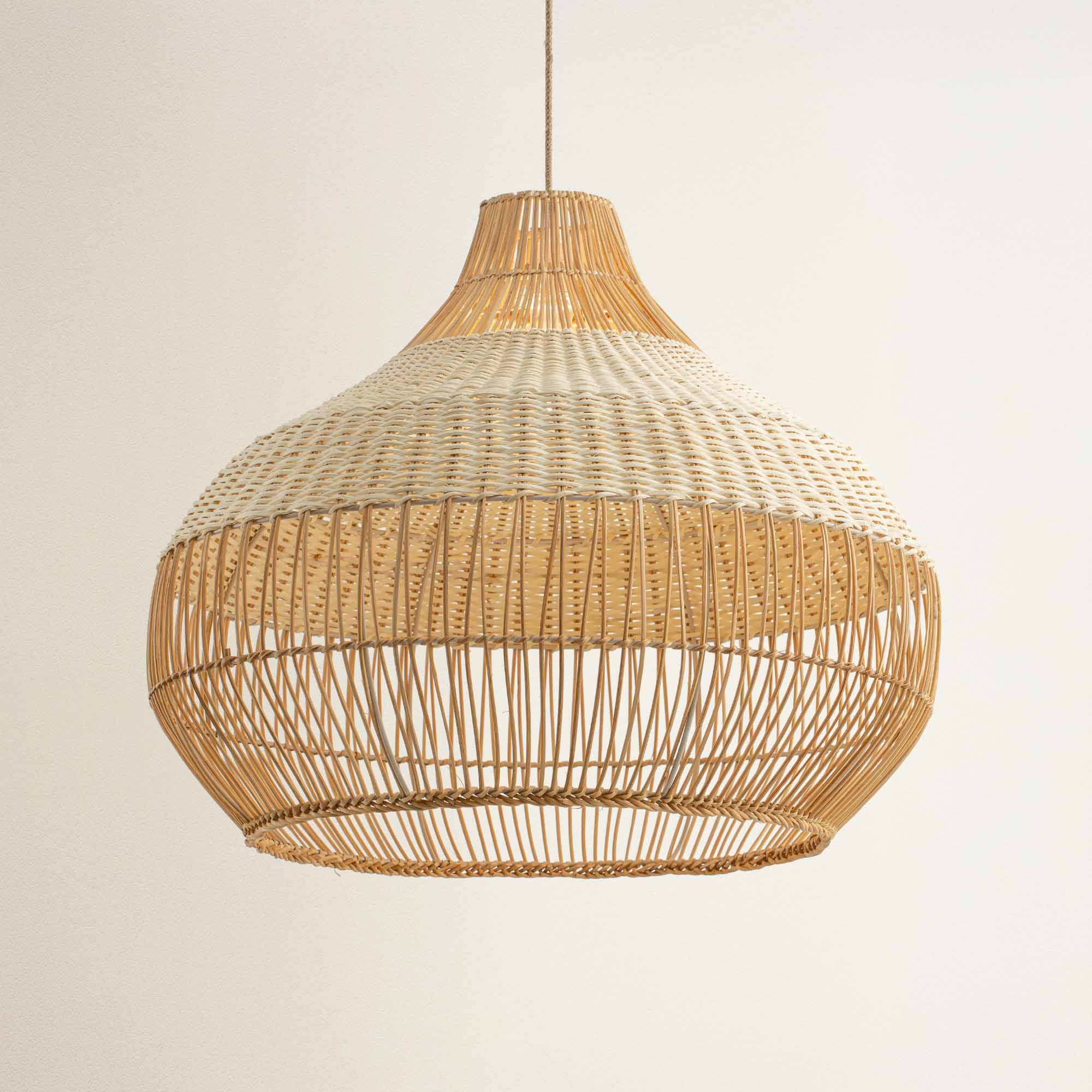
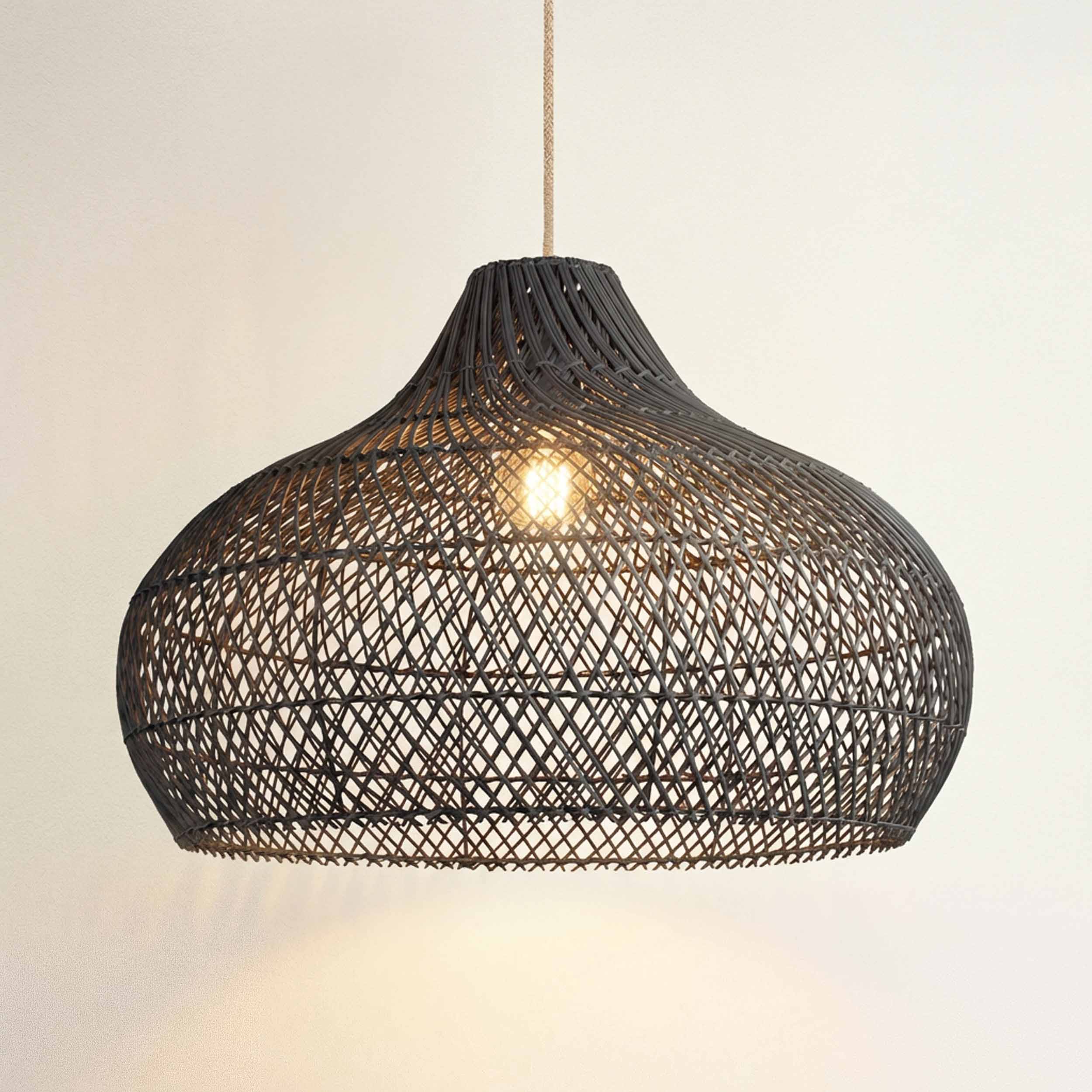
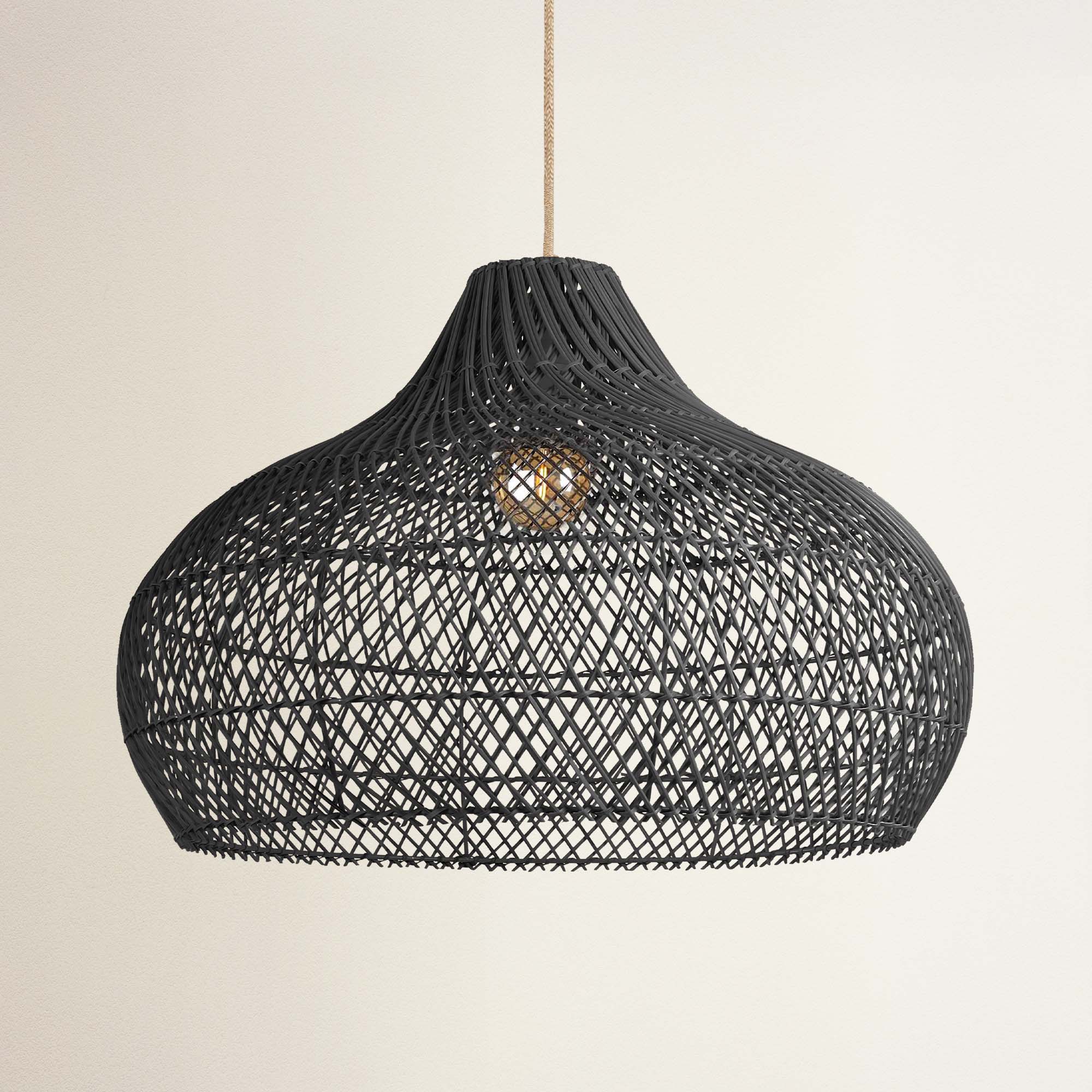
Hanging a pendant at the wrong height or choosing the wrong size disrupts a room's balance and sightlines. In open, airy homes, proper placement is crucial for setting the atmosphere, as demonstrated in this guide using Rowabi's natural rattan lights. Overall, this guide covers everything you need to know: pendant height, spacing, size, quantity, style, and installation safety for every room.
45-Day Return
45-Day Return
45-Day Return

45-Day Return
45-Day Return

45-Day Return

45-Day Return
45-Day Return
45-Day Return
45-Day Return
45-Day Return
45-Day Return
Quick cheat sheet for pendant lights
Use this table as your first reference. The numbers here reflect standard U.S. lighting design practice and are consistent with guidelines from Rejuvenation and Visual Comfort.
| Pendant placement | Standard U.S. measurement | Best use |
| Kitchen island pendant height | 30–36 inches above countertop | Island prep, seating, entertaining |
| Kitchen island pendant spacing | 24–30 inches apart, center to center | Multiple pendants |
| Distance from the island ends | 6–12 inches from each island end | Balanced island layout |
| Dining table pendant height | 30–36 inches above the tabletop | Dining focal point |
| Bedside pendant height | 24–30 inches above the nightstand | Bedroom lighting, table lamp alternative |
| Entryway pendant height | At least 7 feet of floor clearance | Walkways and foyers |
| Living room pendant height | At least 7 feet clearance if people walk under it | Open seating areas |
| Outdoor pendant over walkway | At least 7 feet clearance | Porch, covered patio |
| Outdoor pendant over dining table | 30–36 inches above tabletop | Covered outdoor dining |
| Pendant for 8-foot ceilings | Use compact pendants only over fixed surfaces | Kitchen island, table, nightstand |
| Pendant size rule | Choose fixture size based on surface width, ceiling height, and visual weight | Kitchen, dining, bedroom |
The basic rule: pendant lights should hang based on the surface below
Before deciding on cord length, fixture diameter, or ceiling height adjustments, the most important thing to establish is what the pendant is hanging over. Because that surface determines the correct reference point for every measurement that follows.
Measure from the countertop, tabletop, or floor
The right reference point depends on the room.
- Over a kitchen island, measure from the top of the countertop to the bottom edge of the pendant shade.
- Over a dining table, measure from the tabletop to the bottom of the fixture.
- For a bedside pendant, measure from the nightstand surface to the lowest point of the shade.
- In any open walkway, whether that is an entryway, a living room, or a covered porch, the measurement is from the floor to the lowest point of the pendant, and the minimum clearance there is 7 feet.
This distinction matters because mixing up reference points results in fixtures hung at technically "correct" heights above the floor that are completely wrong relative to the surface they serve.

The right reference point should be counted from the bottom of the pendant to the top of the countertop or tabletop.
For example, a kitchen island pendant measured 60 inches from the floor sounds high enough, but it puts the bottom of the shade only 24 inches above a standard 36-inch countertop, which is well inside the range where the fixture will block sightlines.
Why ceiling height still matters
Ceiling height does not change where a pendant sits relative to the surface below it. The 30–36 inch rule applies regardless of how high the ceiling is. But ceiling height does determine which fixture types are practical and proportionally correct in each room.
With an 8-foot ceiling, pendant lights work comfortably only above fixed surfaces like islands, dining tables, and nightstands, where the drop takes the fixture toward the surface rather than into a walking zone. A pendant dropping 18 inches below an 8-foot ceiling in an open room leaves only 6.5 feet of clearance, below the 7-foot minimum.
At 9 feet, longer drops become possible, and fixtures have more room to breathe. At 10 feet, the risk reverses: a pendant needs enough drop through an extended rod or cord to avoid looking stranded at ceiling level, disconnected from the room below. Vaulted or sloped ceilings require hardware specifically designed for angled installation (a sloped-ceiling canopy adapter or adjustable-length suspension system) to keep the pendant hanging plumb.
How high to hang pendant lights in each room
With the core measurement logic established, the room-by-room rules follow naturally. Each room has a specific surface or clearance condition that determines where the pendant should sit.
Kitchen island pendant lights
The standard height for kitchen island pendant lights is 30–36 inches above the countertop, measured from the countertop surface to the bottom of the shade. This keeps the light close enough to the work surface to feel purposeful while staying high enough not to interrupt the natural eye contact between someone standing at one side of the island and someone seated at the other.
For spacing, pendants over a kitchen island should be placed 24–30 inches apart, center to center, with the outer pendants kept 6–12 inches in from each end of the island. A 6–7 foot island typically suits two pendants; a longer island of 8–10 feet may work with three, depending on the shade's diameter.

For a more detailed breakdown of how ceiling height, shade size, and island length interact, see our guide on how high to hang pendant lights over a kitchen island.
Dining table pendant lights
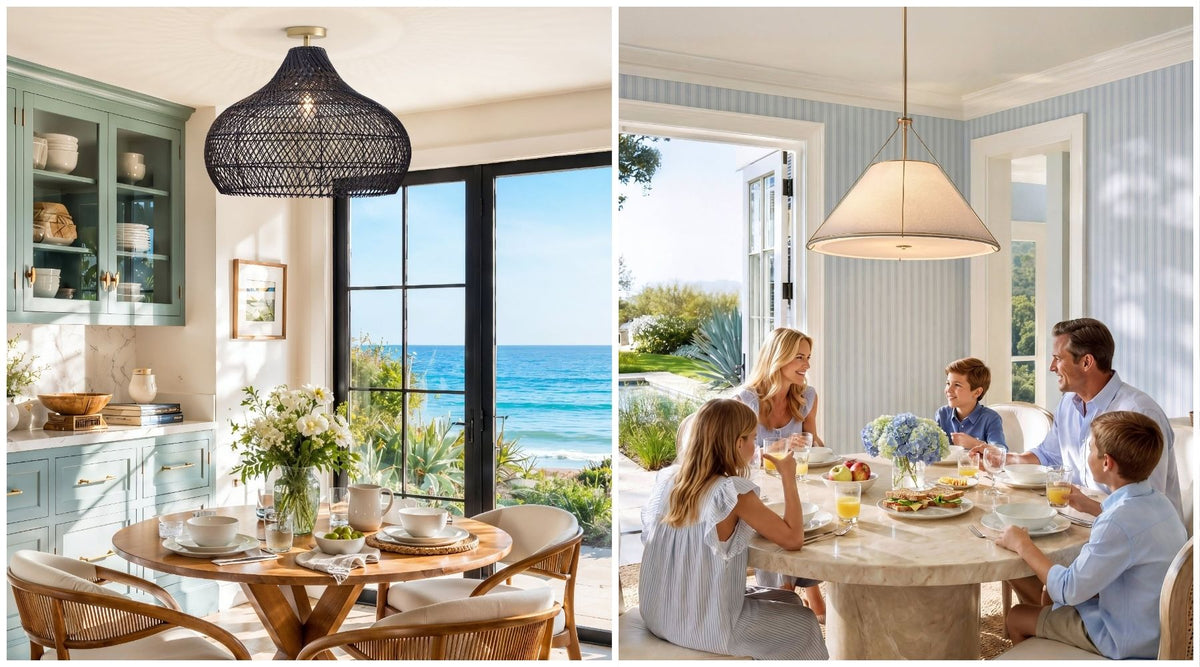
The same 30–36 inch rule applies over a dining table, measured from the tabletop to the bottom of the fixture. Where kitchen island placement emphasizes task function like food prep, sightlines, and counter access, dining placement emphasizes atmosphere. So the pendant needs to be close enough to the table to create the intimate, warm focal point that makes a dining room feel settled and welcoming, without hanging so low that it obscures the faces of people seated across from each other.
Center the fixture over the dining table itself, not over the room's geometric center. If the table is off-center relative to the ceiling junction box, the fixture should align with the table. For shape matching: a round table suits a dome, drum, basket, or globe pendant; a rectangular table tends to suit a linear pendant or a pair of smaller pendants placed in line.

Rattan pendant lights work particularly well in dining rooms with warm-neutral, coastal, Japandi, or organic modern material palettes, where the natural fiber adds handcrafted warmth at exactly the height where the room most needs it.
Bedside pendant lights
A bedside pendant should hang with its bottom shade approximately 24–30 inches above the nightstand surface. At a standard nightstand height of 24–28 inches, this places the pendant's lowest point at roughly 48–58 inches above the floor, high enough to be above a seated person's eye level yet low enough to direct light comfortably toward a book.

A pendant in this position replaces a table lamp without the footprint: the nightstand surface stays clear, the cord runs to the ceiling rather than across the surface, and the fixture itself becomes part of the room's design rather than just a functional accessory. Small rattan pendants work well here, creating a boutique hotel quality in coastal or organic modern bedrooms where the design intention is warmth and texture rather than precision.
Entryway pendant lights
In an entryway or foyer, the bottom of any hanging pendant must clear at least 7 feet from the floor. In an 8-foot-high entry, this leaves only 12 inches for the fixture itself, which is why a flush-mount or semi-flush-mount is often more appropriate than a pendant in smaller or lower-ceilinged entryways.
The fixture needs to be large enough in scale to act as a focal point, and at 7 feet it will be at eye level or slightly above, which makes proportion more consequential than in rooms where pendants hang above furniture.

In a two-story foyer with significant ceiling height, a larger chandelier or pendant hung well below the ceiling can fill the vertical space appropriately, but this kind of installation almost always requires a licensed electrician due to the ceiling height and the fixture's weight.
Living room pendant lights
Any pendant in a living room where people walk underneath it must maintain at least 7 feet of clearance from the floor. In an 8-foot-high living room, this effectively rules out most pendants in open areas. A flush mount or rattan flush mount is the more appropriate primary ceiling fixture.
If the pendant is positioned above a seating zone that people do not walk through, such as directly above a coffee table or conversation area with furniture on all sides, there is somewhat more flexibility, but the glare from a pendant at seated eye level remains a concern.

In living rooms where a pendant is not the right ceiling choice, wall sconces or rattan sconces add a layer of ambient light at the right height without any clearance issue, and they create the kind of layered, textured lighting that makes a room feel genuinely considered rather than evenly bright.
Bathroom pendant lights
Pendant lights in a bathroom require attention to moisture rating alongside the standard height considerations. The National Electrical Code prohibits any hanging pendant within 3 feet horizontally and 8 feet vertically of the edge of a bathtub or shower unless the fixture is specifically wet-rated and designed for that environment.

In the vanity zone, a pendant light can replace a side sconce as a mirror light if the room layout allows. But UL guidelines make it clear that damp locations require fixtures marked "Suitable for Damp Locations," and wet locations require fixtures marked "Suitable for Wet Locations." When the right rating cannot be confirmed, a wall sconce with the appropriate rating is the safer choice.
Outdoor pendant lights for porches and covered patios
Outdoor pendant lights in a walkway or on a covered porch should be at least 7 feet above the floor; pendants over an outdoor dining table follow the same 30–36-inch above-tabletop rule used indoors. The additional consideration outdoors is moisture: covered porches and patios typically require, at minimum, a damp-rated fixture, and areas exposed to direct rain, water spray, or coastal humidity require a wet-rated fixture.
Indoor-only pendants should never be used in any outdoor setting, regardless of how protected the installation position appears.

For covered patios and outdoor dining spaces in coastal and warm-weather homes, Rowabi's outdoor rattan pendant light is designed for covered outdoor use and brings the same natural warmth and woven texture to exterior dining spaces that rattan pendants bring to interior kitchens and dining rooms, provided the fixture is installed in a covered location appropriate to its rating.
How far apart should pendant lights be?
Once the height is established, spacing determines whether multiple pendants read as a composed, intentional arrangement or as a cluster of fixtures competing for the same space.
Standard pendant spacing rule
The standard spacing for multiple pendants is 24–30 inches apart, measured center to center. This range accommodates shades of different diameters while ensuring that the light from adjacent fixtures covers the surface evenly rather than creating bright spots separated by pools of relative shadow.
A shade with a small diameter can sit closer to the 24-inch end of the range; a wider, more substantial shade needs more distance, and pushing two large-diameter pendants into 24 inches of center-to-center space will make the island or table feel visually congested.
Beyond the center-to-center measurement, it is also worth evaluating the shade-to-shade gap, the actual visible distance between the edges of adjacent shades. Designers work in centers because they are easier to transfer to ceiling marks; homeowners making the final visual judgment should look at shade-to-shade spacing as well, since two pendants technically within the correct center-to-center range can still feel crowded if the shades are wide.
Spacing pendants over a kitchen island
For kitchen island placement, keep the outer pendants 6–12 inches in from each end of the island. An island of 6–7 feet typically suits two pendants; an island of 8–10 feet may support three, if the shade diameter allows correct spacing across the length.

Rattan basket pendants with a 14–18 inch diameter need more center-to-center space than a slim glass pendant with an 8-inch diameter because the visual weight of the shade affects how much breathing room the arrangement needs, even when the measurements technically permit a tighter placement.
Spacing pendants over a dining table
Over a dining table, the pendant should be centered over the table itself, not over the room. A single pendant centered over a round table creates a symmetrical focal point. While a rectangular table may suit a linear pendant, or a pair of smaller pendants placed in line across the table's length, with center-to-center spacing adjusted based on the table's width and the shades' diameter.

In either case, the fixture should feel like it belongs to the table, not to the room geometry.
What size pendant light do you need?
Correct height and spacing still produce a room that feels off if the pendant is the wrong scale for the surface below it. Size deserves the same consideration as position.
Match the pendant size to the surface below
The pendant shade should be proportional to the surface it serves, neither so large it crowds the island or table, nor so small it lacks the presence to serve as a focal point. For a kitchen island, a single pendant typically suits a shade in the range of one-third to one-half the island's width.
For multiple pendants, the combined visual mass of the shades should leave a clear margin on either side of the island. For a dining table, the fixture should be 6–12 inches narrower than the table's width so it does not visually crowd the place settings at each end.
Consider visual weight, not just diameter
Two pendants with identical diameters can feel completely different in a room depending on their material and opacity. A dark metal dome reads as visually heavy; a glass globe of the same size almost disappears against the ceiling. A rattan pendant with an open weave occupies the same physical space but filters light through the material, creating a softer, more diffused effect that feels lighter than its actual diameter suggests.

For coastal, warm-neutral, and organic modern kitchens, Rowabi's rattan pendant lights offer a way to add texture and warmth over a stone or wood island without the dense, weighty presence of a solid metal shade; the weave brings handcrafted quality without visual heaviness.
When a pendant is too large or too small
A pendant that is too large blocks sightlines, makes spacing difficult, and shifts the room's balance toward the ceiling rather than toward the people using the space. A pendant that is too small for the room fails to register as the focal point it was intended to be, and the island has a light above it, but not an anchor.
Before committing to a fixture, you can use a piece of painter's tape or a circle cut from paper to simulate the shade's diameter on the countertop: looking at the physical footprint in the actual space catches scale mismatches that photographs and product listings rarely reveal.
How many pendant lights should you hang?
Pendant count follows from island or table length and shade width, not from a preference for odd or even numbers alone.
One pendant light
A single pendant suits a small island, a breakfast nook, a round dining table, a bedside nightstand, or a compact entryway where one well-scaled fixture creates a stronger focal point than two smaller ones would. One large rattan pendant centered over a 4-foot island often reads as more considered than two pendants fighting for space in the same footprint.

Two pendant lights
Two pendants work best over a medium island of 6–7 feet, a paired bedside installation, or a rectangular dining table where the shades are wide enough to require clear breathing room between them. This count also suits a kitchen where the design intention is restraint because two substantial rattan pendants over a coastal kitchen island, spaced generously, can feel complete where three would feel crowded.

Three pendant lights
Three pendants are appropriate for a long island of 8–10 feet or a similarly proportioned dining surface, provided the shade diameter allows for the 24–30 inch center-to-center spacing that prevents the arrangement from looking jammed. Three narrow or slim pendants over a long surface create visual rhythm; three wide-diameter shades over the same surface create congestion.

Linear pendant vs multiple pendants
A linear suspension fixture, a long horizontal bar with multiple integrated light points suits a modern kitchen with flat-panel cabinetry, a waterfall island, or a rectangular dining table in a clean contemporary space.
Multiple individual pendants over the same surface suit a kitchen or dining room where texture, rhythm, and the visual variation of discrete shades are part of the design intention.
Rattan pendant lights in this configuration introduce a handcrafted, organic quality that a linear metal fixture cannot replicate; a modern linear light does the opposite, amplifying the precision and geometry of a contemporary interior.

Best pendant light styles for coastal and warm-weather homes
The placement rules are the same regardless of fixture style. But the character of the pendant, its material, form, and how it interacts with light, determines whether the correctly hung fixture feels right for the specific room it is in.
Rattan pendant lights for coastal kitchens and dining rooms
Rattan pendant lights belong in kitchens and dining rooms where the design language already includes natural materials: white oak, quartz or stone countertops, unlacquered brass hardware, zellige tile, linen textiles, or limewash plaster. The open weave adds warmth and texture at the height where those rooms need it most, softening the harder reflective surfaces below it without introducing any visual heaviness.
Brands like Rowabi offer rattan pendant lights that function as texture-layering pieces in coastal, organic modern, Japandi, cottage, and warm-neutral interiors, a way to bring the natural material story of the room all the way up to the ceiling, not just across the counters and walls.

Modern pendant lights for clean contemporary kitchens
Slim metal pendants, opal glass globes, and linear suspension fixtures suit kitchens built on contrast and precision as flat-panel cabinetry, waterfall islands, polished stone, and black-and-white or cool-neutral palettes.
The minimal form complements the kitchen's geometry rather than softening it. Height and spacing rules apply exactly as they do for rattan pendants; the fixture's restrained visual weight simply makes those decisions feel more forgiving.

Outdoor rattan pendant lights for covered patios
For covered outdoor dining and lounge areas in warm-weather and coastal homes, an outdoor rattan pendant brings the same natural warmth indoors-and-out. The material creates the resort-like, relaxed atmosphere that defines well-designed outdoor living in these climates.
Any outdoor rattan pendant must carry the correct damp or wet location rating for its specific installation position: always confirm the fixture's UL marking before installing it outdoors.

When not to use pendant lights
Knowing when a pendant is the wrong choice is as useful as knowing how to hang one correctly.
Low ceilings and tight walkways
In rooms with 8-foot ceilings and open walking areas, a pendant in the walkway almost certainly cannot achieve the 7-foot clearance minimum, which makes a flush mount or semi-flush mount the appropriate primary ceiling fixture. A rattan flush mount addresses this directly: it stays flat against the ceiling while still adding the texture and warmth that a hanging pendant would have contributed.
Where the pendant works, it goes over the island, the dining table, or the nightstand; where it does not, a flush mount picks up the same design intention without the clearance problem.
Kids rooms and bunk bed areas
Low-hanging pendants in a child's room, such as near bunk beds, cribs, climbing furniture, or active play zones, introduce clearance hazards that a flush mount or semi-flush mount avoids entirely.

Wall sconces hardwired into the wall, placed out of reach and without exposed cords, can provide focused bedside or ambient light in a kids room. A rattan flush mount on the ceiling gives the room warmth and natural material quality without any hanging fixture in the space where children move.
Bathrooms or outdoor spaces without the right rating
Indoor-only pendant lights should never be installed in bathrooms beyond the dry zone or in any outdoor setting, regardless of how protected the position appears.
UL guidelines are specific: damp locations require fixtures marked "Suitable for Damp Locations" or better; wet locations require fixtures marked "Suitable for Wet Locations." Installing a fixture without the correct rating is both a safety issue and a code violation.
Safety first before installing pendant lights
Pendant lights are typically hardwired ceiling fixtures, which means electrical safety considerations apply before any installation begins.
Turn off power at the circuit breaker
Always switch off the power at the circuit breaker before handling any wiring or electrical fixtures, rather than just at the wall switch. A wall switch only controls the circuit and doesn't completely power down the wiring in the ceiling box. Check for current with a voltage tester before you start working.
The Electrical Safety Foundation International (ESFI) recommends homeowners turn off the appropriate circuit at the main panel and avoid electrical tasks beyond their expertise.
Know when to call a licensed electrician
Replacing an existing pendant fixture at an established, properly rated junction box may be within reach for an experienced DIYer.
Beyond that, new wiring, moving a junction box, aligning multiple boxes for a row of pendants, installing a heavy fixture, working on a vaulted ceiling or stairwell, outdoor hardwired installation, or any situation where the existing wiring is uncertain, a licensed electrician is the right call.

Check canopy, cord length, and junction box placement
Before purchasing, confirm that the canopy is large enough to cover the electrical box in the ceiling, that the cord or chain is long enough to reach the intended hanging height with room to trim, and that the junction box is positioned over the island, table, or nightstand rather than off-center.
A box that does not align with the surface below should be repositioned before the fixture is installed, not compensated for by angling the pendant.
For guidance on managing a pendant cord once the fixture is in place, see our guide on how to hang a pendant light cord.
Bulb choice, brightness, and dimming for pendant lights
A pendant hung at exactly the right height with the wrong bulb still produces a room that feels uncomfortable to work in or gather around.
Choose the right color temperature
For kitchen island pendants, 3000K is the most versatile starting point, that is warm enough to complement natural materials, and bright enough for food preparation. For dining rooms, bedrooms, and coastal living spaces where the design intention is warmth and relaxation, 2700K produces a more amber, sunset-like light that pairs better with rattan, warm wood, and natural stone.
For areas that are primarily task-oriented, such as a prep-heavy kitchen, or a laundry room, 3500K–4000K provides clarity, but this range can feel clinical against organic or warm material palettes. Whatever temperature is chosen, matching it across pendant lights, recessed lighting, and under-cabinet strips keeps the kitchen from feeling visually fragmented.

Use dimmable bulbs and compatible dimmers
Pendant lights over a kitchen island or dining table benefit enormously from dimmer compatibility. The same fixture that illuminates food preparation at full brightness can shift to a warm, lower level for entertaining or a quiet dinner.
However, not all LED bulbs work with all dimmer switches: confirm "dimmable" on the bulb packaging and check that the dimmer switch is rated for LED loads before pairing them. A dimmable LED in an incompatible dimmer will flicker or buzz; a non-dimmable LED in a dimmer circuit will fail prematurely.
Common mistakes when hanging pendant lights
Even with accurate measurements, a few predictable errors consistently produce rooms that feel slightly off.
Hanging pendants too low creates immediate, practical friction that blocks sightlines across the kitchen island, glare at seated eye level in the dining room, and a general feeling of heaviness in spaces designed to feel open. In coastal and open-concept kitchens where airiness is central to the design, a pendant that interrupts the visual flow between kitchen and living space undermines the entire spatial intention.
Hanging pendants too high is less obvious but equally problematic: the fixture loses its connection to the surface beneath it, the light scatters rather than anchoring the counter or table, and the room ends up with a light source but not a focal point. The pendant should feel like it belongs to the island or table, not to the ceiling.
Choosing the wrong pendant size either removes the fixture from the room's visual hierarchy (too small) or dominates it uncomfortably (too large). A kitchen island with a substantial countertop needs a fixture with enough scale to read as the anchor it is meant to be; an oversized shade over a narrow island blocks the prep surface and crowds the sightline from every angle.
Ignoring ceiling height leads to pendants installed at heights that are technically correct by the measurement rule but impractical in the specific room. For example, a pendant 30 inches above a kitchen island counter in a room with an 8-foot ceiling can still feel cramped if the shade is large and opaque. The measurement is the baseline; the room's proportions determine where within that range the fixture actually belongs.
Centering pendants in the room rather than over the surface is a placement error that reveals itself the moment the fixture is installed. A kitchen pendant should align with the island, not with the room's geometry. A dining pendant should follow the table. If the existing junction box is off-center relative to the surface below it, repositioning the box before installation is the correct solution, not angling the pendant or living with a fixture that reads as misaligned.
Pendant light planning checklist before installation
Before calling an electrician or committing to a position, work through this list:
- Measure ceiling height: 8 ft., 9 ft., 10 ft., or vaulted
- Measure the surface below the pendant
- Choose pendant count: 1, 2, 3, cluster, or linear fixture
- Confirm pendant size and visual weight
- Mark center points on the ceiling with painter's tape
- Confirm 30–36 inches above countertop or tabletop where applicable
- Confirm at least 7 feet of clearance in walkways
- Confirm 24–30 inch spacing for multiple pendants, center to center
- Confirm 6–12 inches from island ends when applicable
- Check canopy size, cord length, and adjustable hardware
- Confirm fixture moisture rating for bathroom or outdoor placement
- Check LED bulb and dimmer compatibility
- Turn off power at the breaker before any electrical work
- Call a licensed electrician if wiring, box placement, or fixture weight is uncertain
Choosing the right pendant style for your space
| Situation | Best Fit | Why |
| Coastal kitchen | Rattan pendant lights | Warm, airy, textured |
| Contemporary kitchen | Modern light | Clean, minimal, architectural |
| Low 8-foot ceiling | Rattan flush mount / semi-flush | Keeps headroom |
| Bedroom accent | Small rattan pendant or wall sconce | Soft and cozy |
| Kids room | Flush mount / rattan flush mount | Safer than low pendant |
| Covered patio | Outdoor rattan pendant light | Resort-inspired, natural texture |
| Hallway / bedside | Rattan sconce | Ambient layer without low hanging fixture |
FAQs
How high should pendant lights hang?
- Over a countertop or tabletop, 30–36 inches above the surface. In any walkway, leave at least 7 feet of clearance from the floor to the bottom of the pendant.
How high should pendant lights hang over a kitchen island?
- 30–36 inches above the countertop, measured from the countertop to the bottom of the shade. Adjust within that range based on ceiling height, shade size, and whether the island is used primarily for prep or for seated dining.
How far apart should pendant lights be?
- 24–30 inches apart, measured center to center. Wider shades need more spacing; slimmer profiles can sit closer while still maintaining visual balance.
How many pendant lights do I need over a kitchen island?
- Small islands may work with one large pendant or two smaller ones; medium islands often look best with two; long islands may suit three if the shade diameter allows for correct spacing. The shade width and island function matter as much as the island's length.
Can pendant lights be used in bedrooms?
- A bedside pendant hung 24–30 inches above the nightstand replaces a table lamp while freeing up the nightstand surface entirely. Use a warm LED bulb and a dimmable setup where the fixture allows it.
Can pendant lights be used outdoors?
- Yes, but only with a fixture rated for the installation location. Covered patios typically require a damp-rated fixture; areas exposed to direct rain or water require a wet-rated fixture. Confirm the UL marking on the packaging before any outdoor installation.
Are rattan pendant lights good for coastal homes?
- The open weave adds warmth and natural texture at pendant height without visual heaviness, and the material complements the stone, wood, warm metal, and linen surfaces common in coastal interiors.
What pendant lights work best for 8-foot ceilings?
- Compact pendants used only over fixed surfaces: islands, dining tables, nightstands. In open walkways at 8-foot ceiling height, a flush mount or semi-flush mount is the more appropriate and safer choice.
Can I install pendant lights myself?
- Replacing an existing fixture at an established junction box may be manageable for an experienced DIYer. New wiring, moved junction boxes, heavy fixtures, outdoor hardwiring, or uncertain electrical conditions should involve a licensed electrician. Always turn off power at the circuit breaker before starting.
Conclusion
Good pendant placement is less about memorizing numbers and more about understanding why each number exists, and then trusting your eye to make the final call. Once the height is right, everything else tends to fall into place. If you are still choosing your fixture, browse Rowabi's full lighting collection, or reach out to the team if you want a second opinion on placement before you commit.



Leave a comment
This site is protected by hCaptcha and the hCaptcha Privacy Policy and Terms of Service apply.