

This guide from Rowabi is a specification resource for hospitality designers, architects, hotel developers, electrical contractors, and procurement teams working on coastal projects. It covers wet-location ratings, marine-grade material claims, woven shade durability, tree-mounted suspension systems, quick-disconnect cords, and the pool-deck electrical requirements that no product page can resolve on a project's behalf.
What should a coastal outdoor pendant include?
Before reviewing any product, confirm that the supplier can provide documentation for each of the following seven requirements.
| Project Requirement | What it should mean | Evidence to request |
| Wet-rated luminaire | Fixture is rated for conditions where water may drip, splash, or flow onto the equipment | Certification file, product marking, and installation instructions |
| Coastal corrosion resistance | Metals, fasteners, and finish are selected for salt-air exposure | Material specification, coating system, and corrosion-test report |
| Quick disconnect | Connection can be detached for maintenance while remaining suitable for the installation environment | Connector model, wet-location suitability, and system documentation |
| Outdoor-rated cord | Cable is suitable for moisture, UV, and the expected temperature range | Cable markings and technical data sheet |
| Tree suspension | Independent support system that does not damage the tree and accounts for outdoor movement | Mounting detail approved by engineer or licensed electrician |
| Pool-deck installation | Placement, voltage, wiring, and clearances comply with local code | Licensed electrician review and Authority Having Jurisdiction approval |
| Woven shade durability | Material withstands moisture, UV, mildew, and the project's cleaning cycle | Material identification, testing documentation, and maintenance instructions |
Hospitality designers, architects, and procurement teams working on qualifying projects can access specification support, product samples, and trade pricing through Rowabi's Trade Program. If your project involves multiple outdoor fixtures across a hotel, resort, or restaurant property, registering for the program is the most direct way to begin the specification conversation.
Wet-rated is the first requirement, not the only one
The wet-location marking addresses electrical safety in the presence of water. It is a necessary condition for any outdoor pendant over a pool deck, but it does not address corrosion resistance, shade longevity, or the mechanical performance of the suspension system in coastal wind.
Specifying a wet-rated fixture without evaluating the remaining components produces an assembly where the electrical system may be compliant while the hardware corrodes and the shade degrades within a single season.
What wet-rated means for a luminaire
UL describes a wet location as one where water or other liquids may drip, splash, or flow onto the equipment. Only luminaires marked "Suitable for Wet Locations" are designed for this condition. An "outdoor" label in a product name does not constitute a wet-location rating.
Many products described as outdoor fixtures carry only a damp-location rating appropriate for covered, sheltered installations. For fully exposed tree suspension above a pool deck, wet-location certification for the complete electrical assembly is the baseline requirement.

Outdoor line-voltage luminaires are typically evaluated under UL 1598, which includes wet-location requirements where applicable.
Wet-rated vs weather-resistant
These two terms describe entirely different properties and should not be used interchangeably in a project specification.
- Wet-rated describes the electrical safety performance of the fixture when exposed to water. It confirms the luminaire has been tested and marked for wet-location installations.
- Weather-resistant describes the durability of surface materials when exposed to outdoor conditions, such as UV, rain, temperature cycling, and oxidation.

A fixture can carry a wet-location electrical rating while its decorative finish corrodes rapidly in salt air. A fixture can have excellent material weather resistance while its electrical assembly is suitable only for dry or damp locations. Both properties must be confirmed independently.
What "marine-grade" should mean in a project specification
"Marine-grade" appears frequently in hospitality lighting marketing. As a specification term, it is only useful when supported by documented material choices, protective coatings, and test results that correspond to the actual exposure conditions of the project site.
Do not rely on the phrase alone
A specification that calls for "marine-grade hardware" without defining the alloy, fastener material, and coating system is not a specification. The materials that perform acceptably in a freshwater lake climate differ from those required for a direct oceanfront installation in a high-humidity, high-salt-spray environment.
Request the alloy designation for exposed metal components, the fastener material specification, and the coating system applied to each surface. If the supplier uses the term "marine-grade" without providing material documentation, treat it as a decorative claim rather than a technical specification.
ASTM B117 is a standard that creates a controlled salt-fog environment for accelerated corrosion testing. Passing ASTM B117 at a stated number of hours is more meaningful than a general "marine-grade" claim, but ASTM B117 results do not directly predict real-world coastal performance over multiple seasons.
Request the test duration and pass criteria, then evaluate those results against the project's actual exposure conditions with the electrical engineer and contractor.
Check every non-woven component
The woven shade is typically the most visible element of a decorative pendant, but it is rarely the first component to fail in a coastal environment. The canopy, socket housing, chain or cable, connector body, and mounting hardware are all exposed metal and polymer components that must be evaluated for the specific salt-air and moisture conditions of the installation.
A supplier who has tested the shade material but not the connector and mounting hardware has only partially answered the coastal durability question.
A better specification statement
Rather than specifying "marine-grade hardware," write the requirement as a performance outcome with supporting documentation. For example: All exposed metal components shall be documented with material designation, protective coating system, and corrosion-test results. Supplier shall provide material data sheets and test reports prior to submittal approval.
This language shifts the burden of proof from the project team to the supplier and creates a reviewable record for the Authority Having Jurisdiction.
Can a rattan pendant be used outdoors near a pool?
The answer depends on what the woven shade is actually made of, how the installation is configured, and which component of the system the question is being asked about. "Rattan" as a marketing term covers a wide range of materials with very different outdoor performance characteristics.
Identify the woven material first
Before any outdoor pool-deck specification, confirm the actual material composition of the woven shade. The options include natural rattan, synthetic resin weave, treated plant fiber, outdoor textile or rope, and composite woven materials. Each has different water absorption behavior, UV resistance, colorfastness, mold and mildew susceptibility, cleaning requirements, and expected cosmetic aging timelines.
Natural rattan is a plant fiber that absorbs moisture and degrades when repeatedly wetted and dried. It is not appropriate for fully exposed outdoor pool-deck installation. Synthetic resin weave, sometimes marketed as "all-weather rattan," is designed to resist moisture and UV, but the specific formulation and test data still need to be reviewed against the project's exposure conditions.

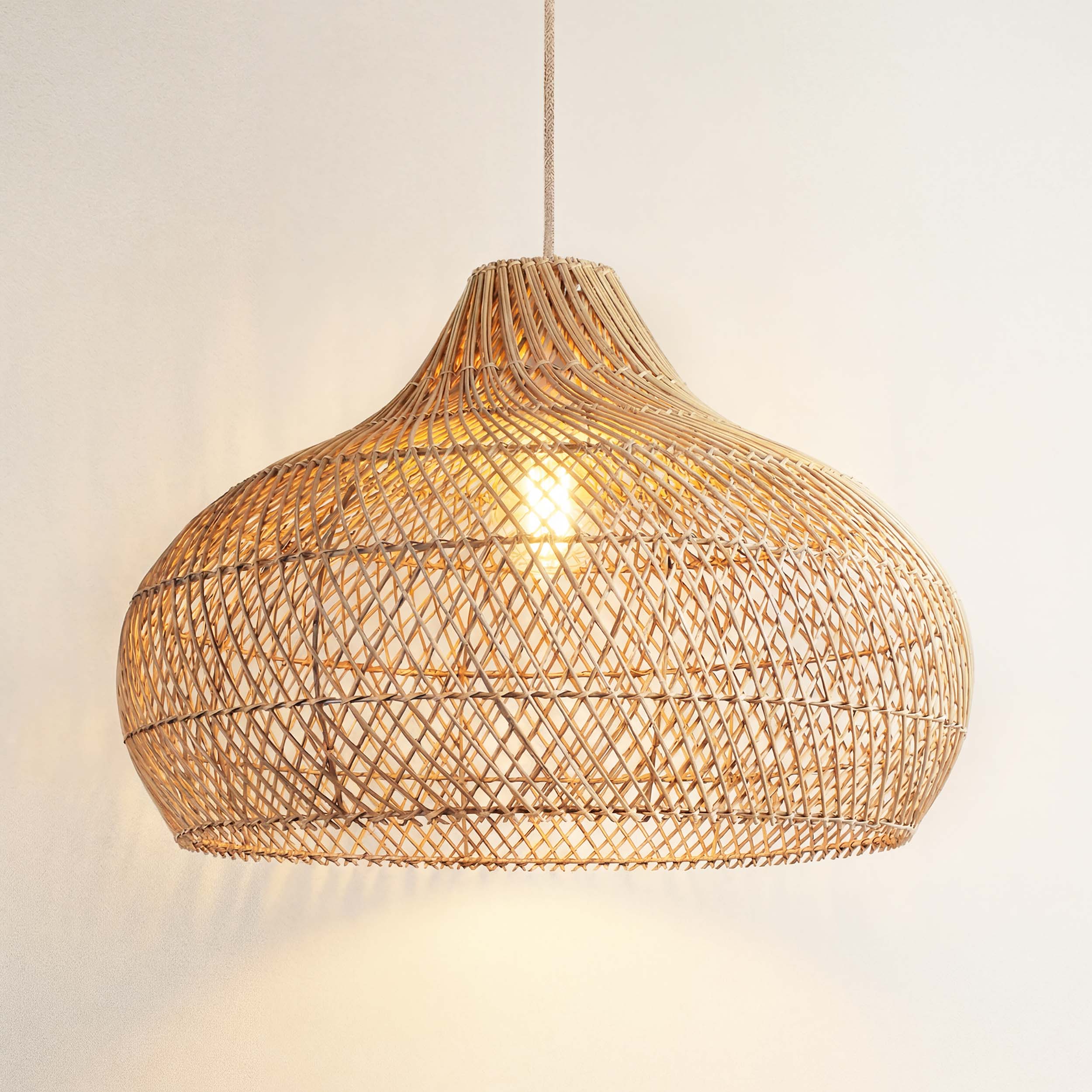
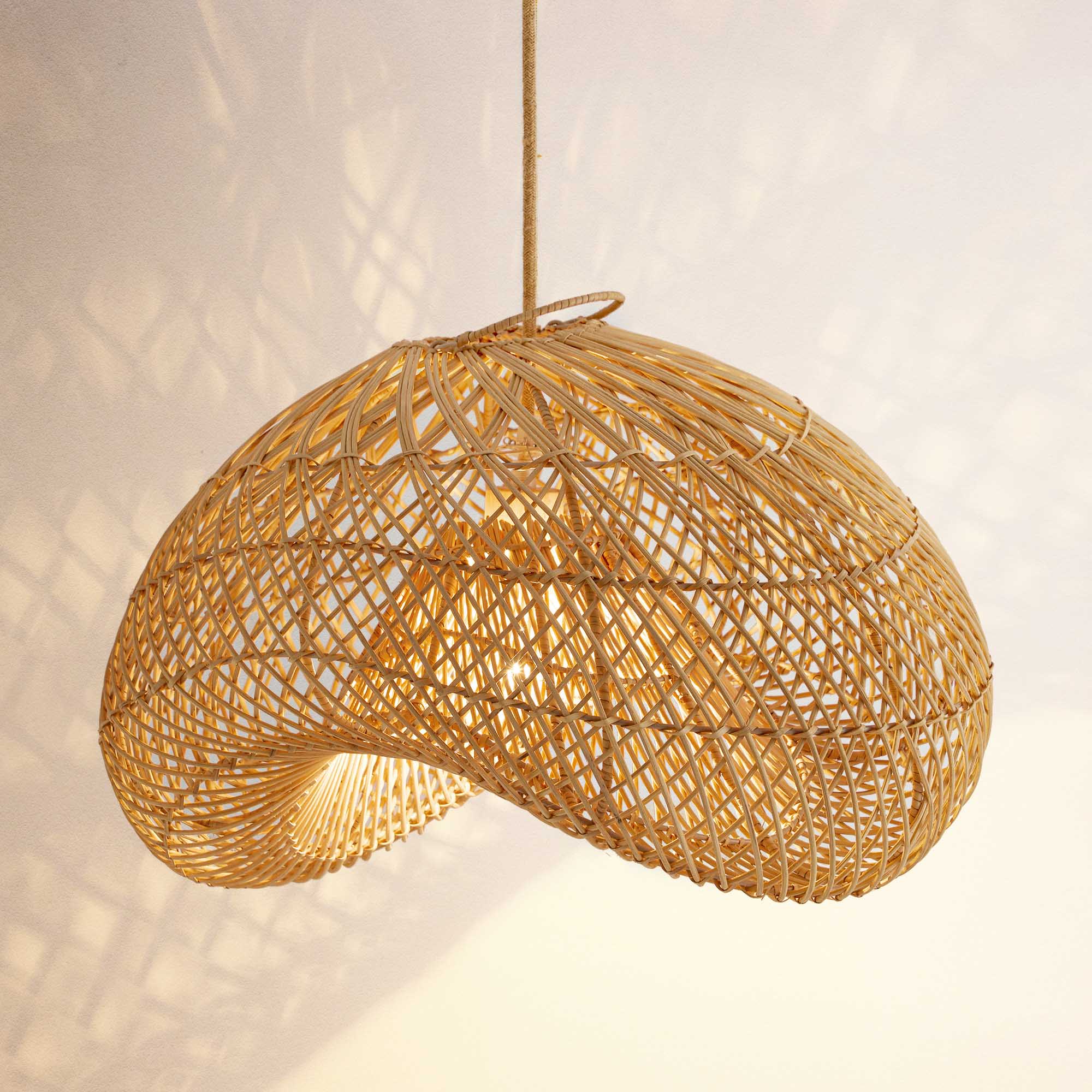
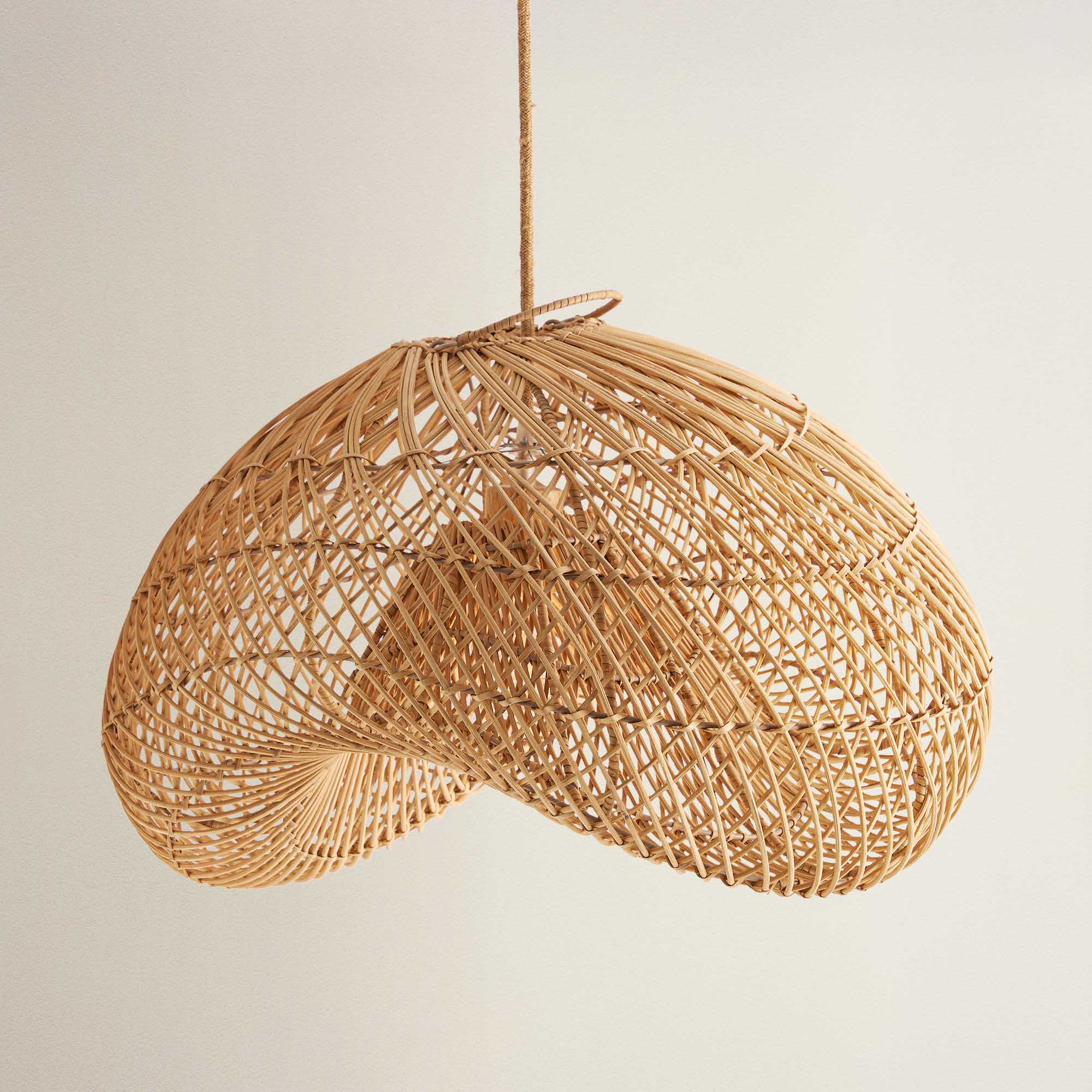
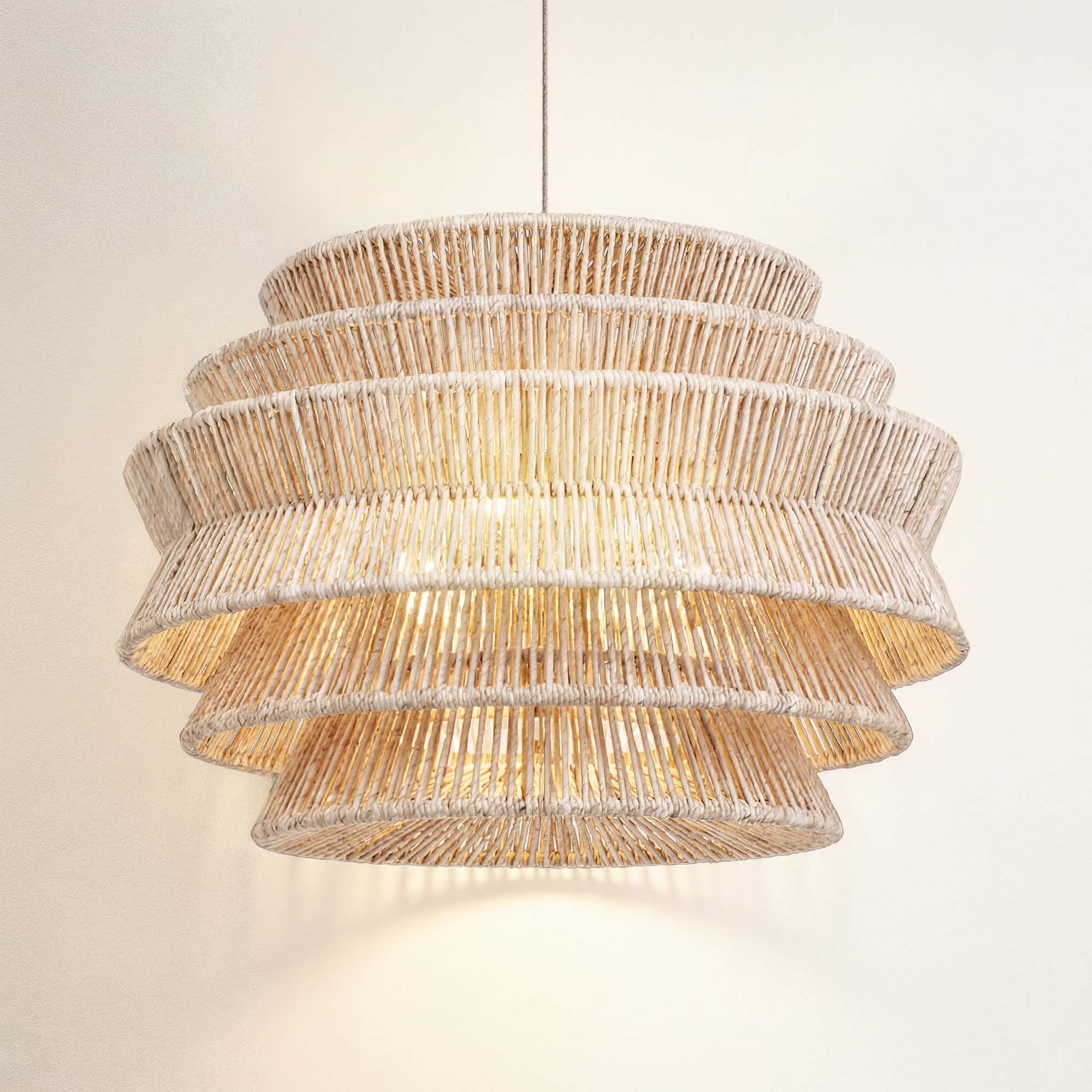
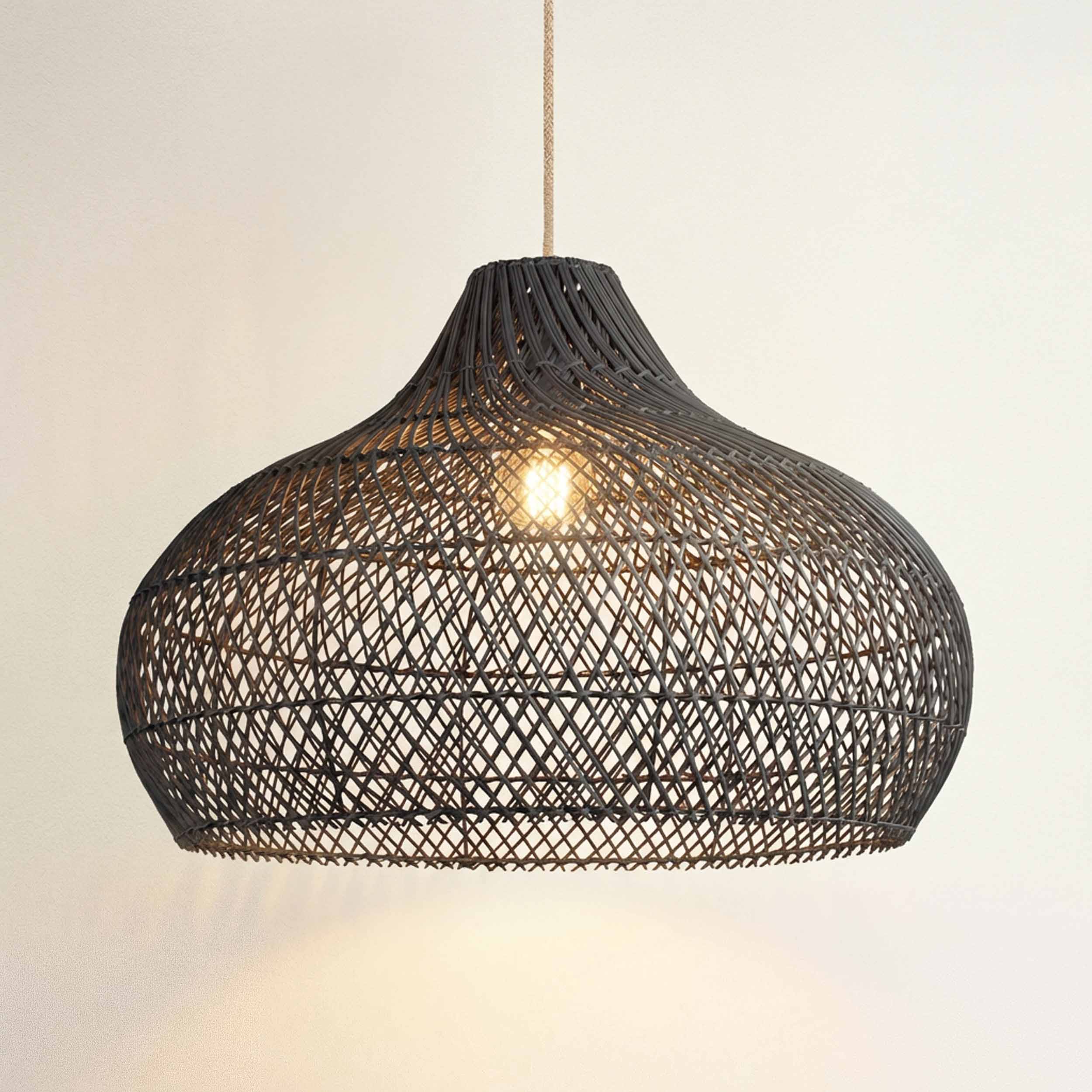
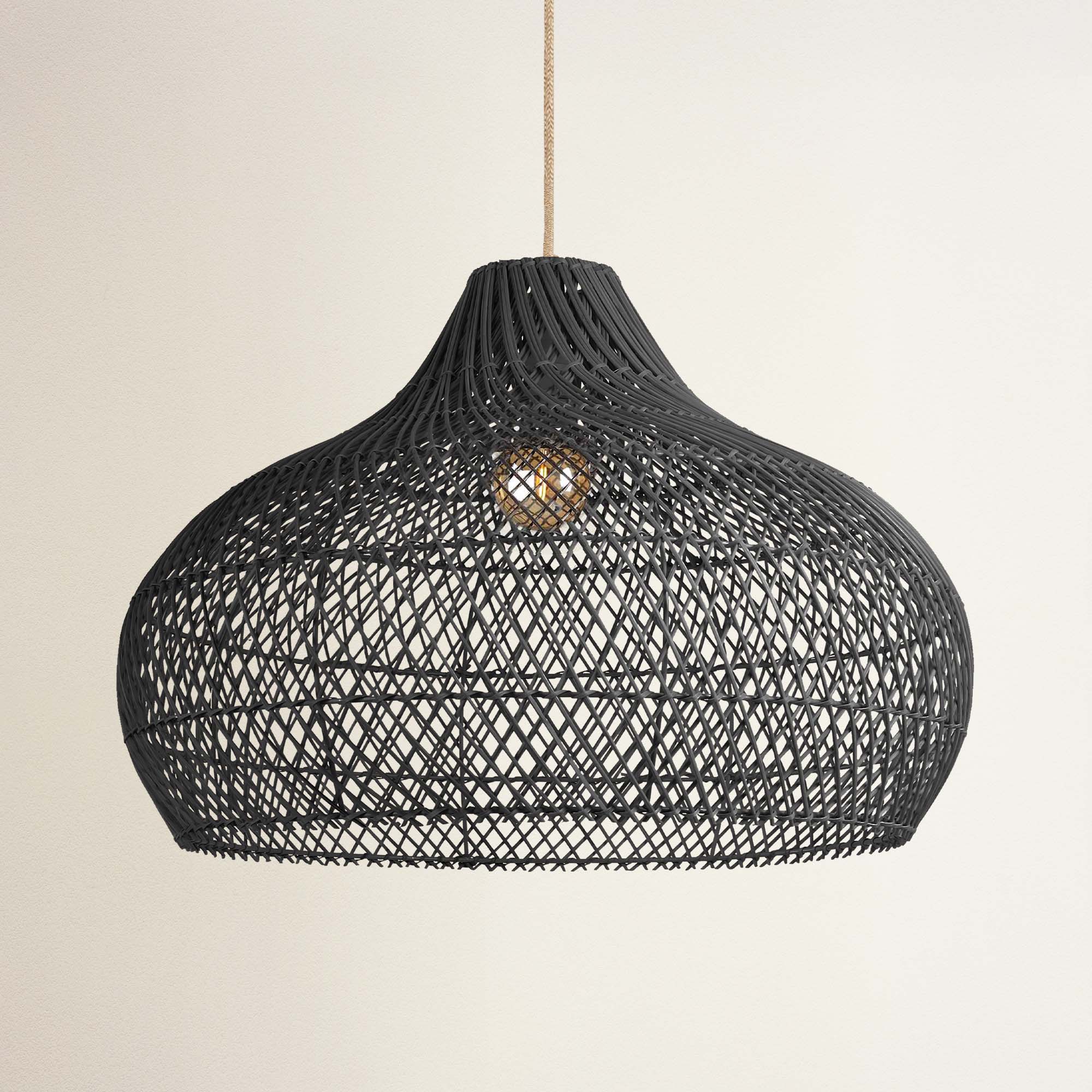
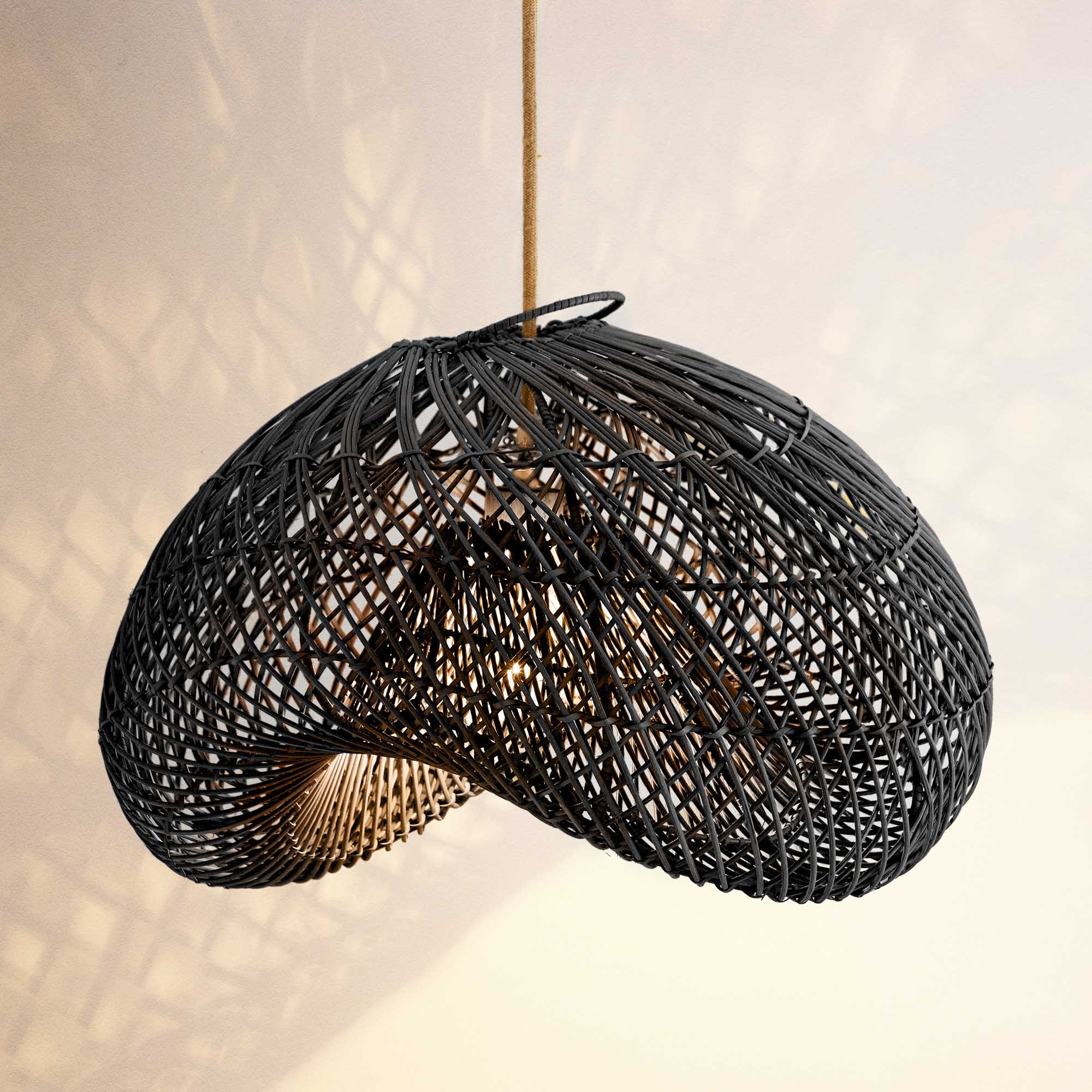
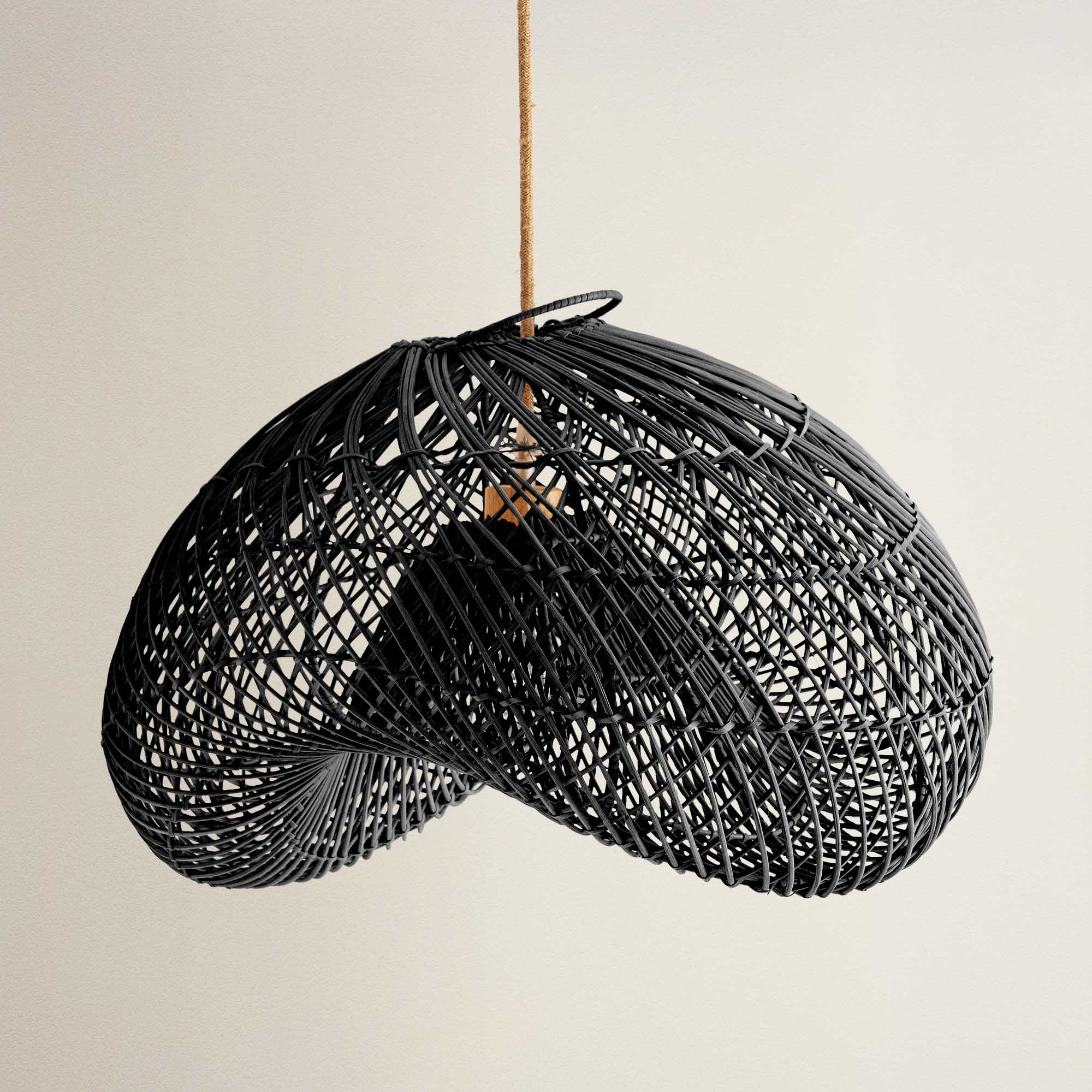
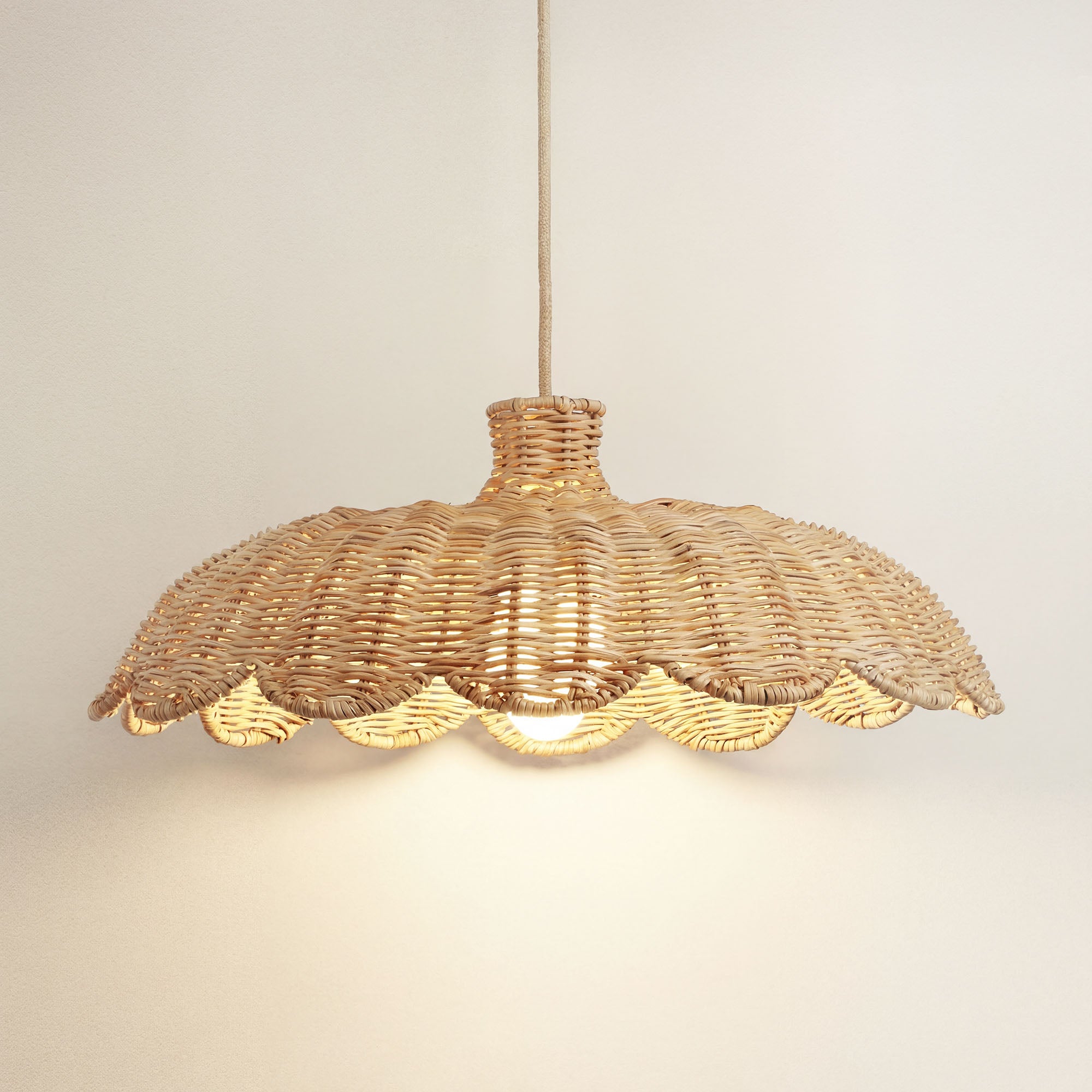
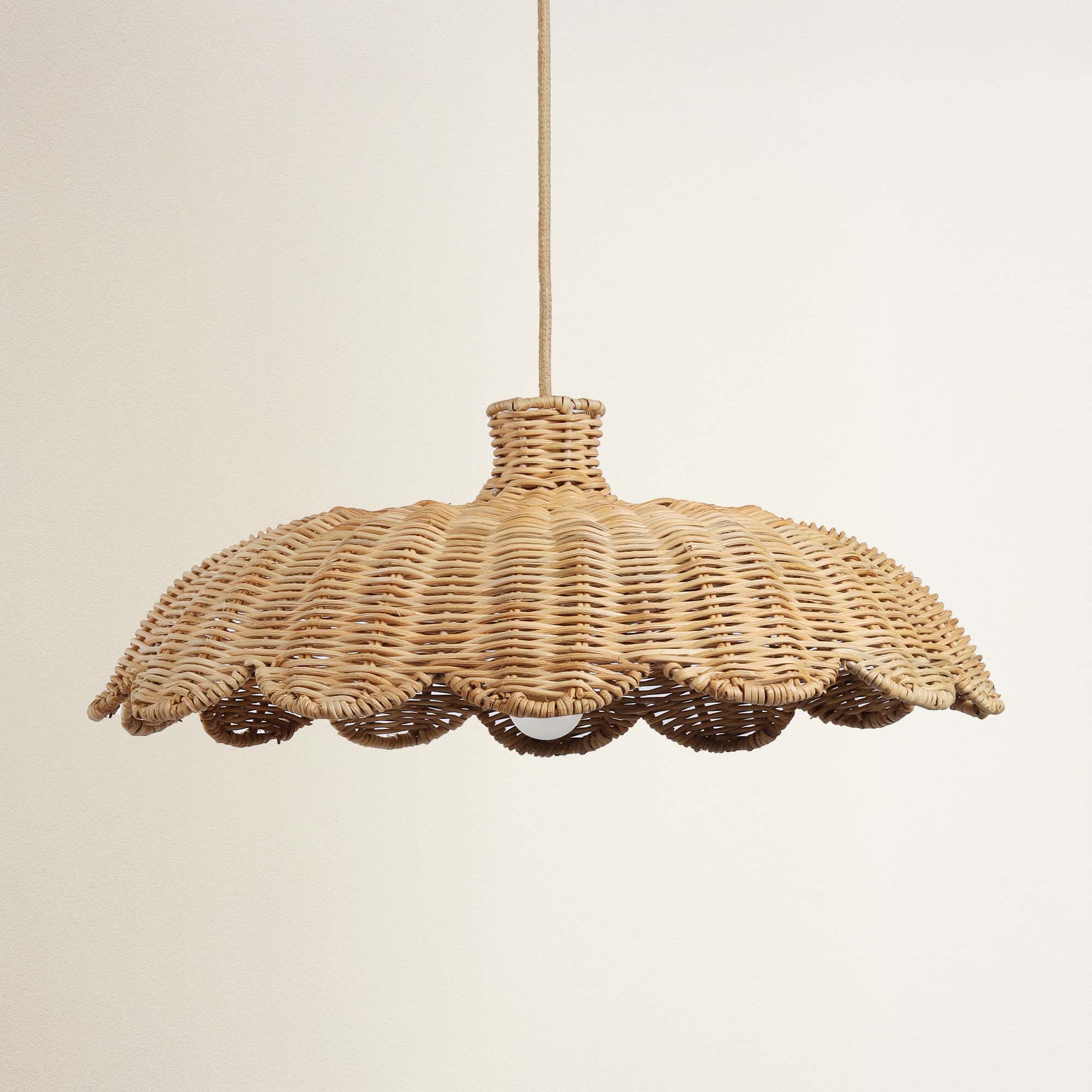
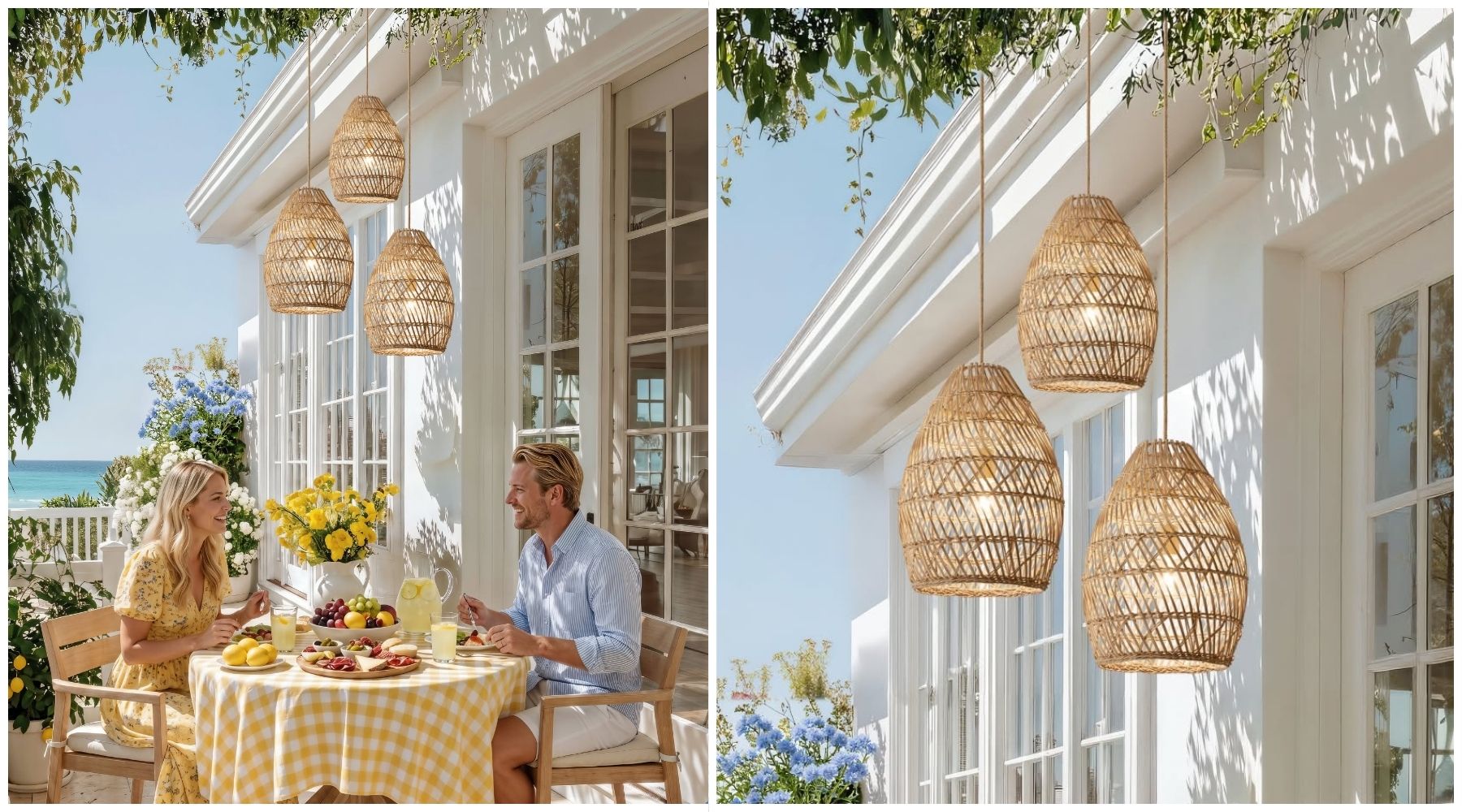
Rowabi’s Outdoor Rattan Pendant Collection is made from high-quality resin fibers.
Request the following from any supplier proposing a woven outdoor fixture: material identification (natural fiber vs. synthetic vs. composite), water absorption behavior, UV resistance and colorfastness data, mold and mildew resistance guidance, approved cleaning method, maximum exposure conditions, and expected cosmetic aging.
Separate shade durability from electrical safety
A shade that can withstand outdoor weather does not automatically mean the electrical assembly is wet-rated. A wet-rated electrical assembly does not automatically mean the decorative shade will survive direct rain and salt air over a commercial lifespan.
For a complete coastal pool-deck specification, these five components must each be evaluated independently: the electrical system and wet-location rating, the suspension hardware and mounting method, the exposed metal components and their coating system, the woven shade material and its outdoor durability, and the maintenance requirements for each component over the expected service life.
Direct exposure versus protected exposure
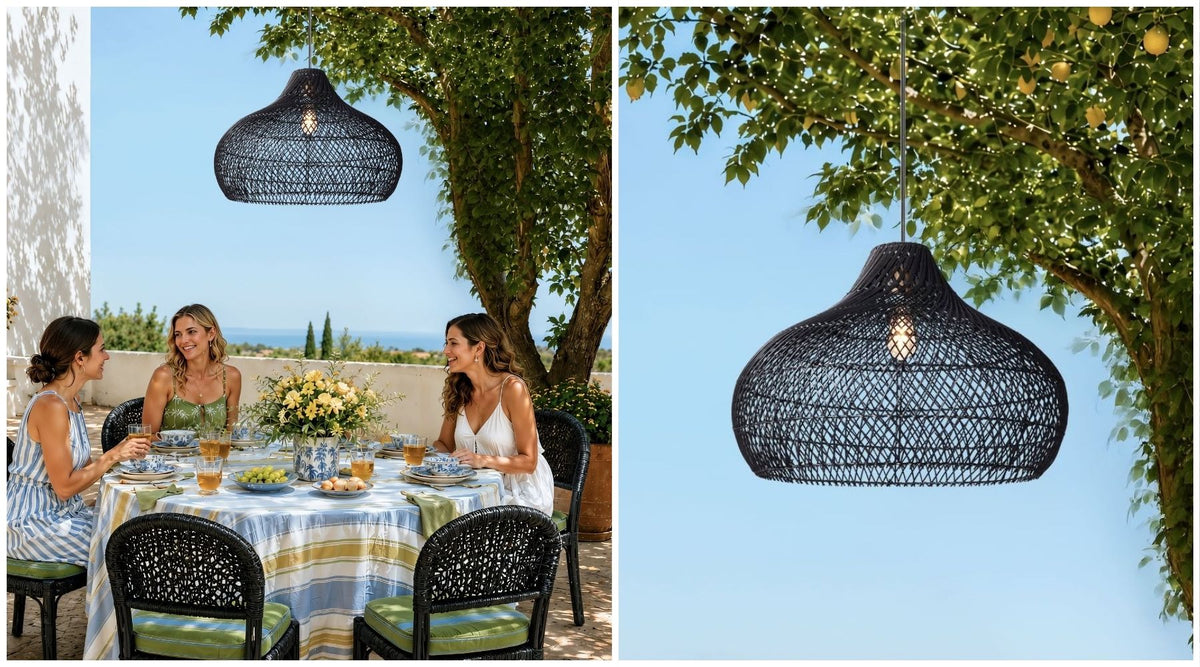
"Outdoor" is not a single installation condition. A pendant suspended from a tree above an uncovered pool deck is exposed to rain from above, salt spray from surrounding air, UV from multiple angles, and wind-driven movement. A pendant under a covered pool pavilion experiences humidity, condensation, and wind-driven moisture but typically not direct rain.
A deep covered terrace has lower moisture exposure but still encounters coastal air. An indoor coastal lobby may introduce salt carried indoors and elevated humidity without direct precipitation. Each condition calls for a different level of specification rigor.
| Installation Condition | Typical exposure |
| Fully exposed tree suspension | Rain, wind, salt mist, and UV from multiple angles |
| Covered pool pavilion | Humidity, condensation, and wind-driven moisture |
| Deep covered terrace | Lower moisture but persistent coastal air |
| Indoor coastal lobby | Salt carried indoors and high humidity, no direct rain |
Evaluate the complete product configuration
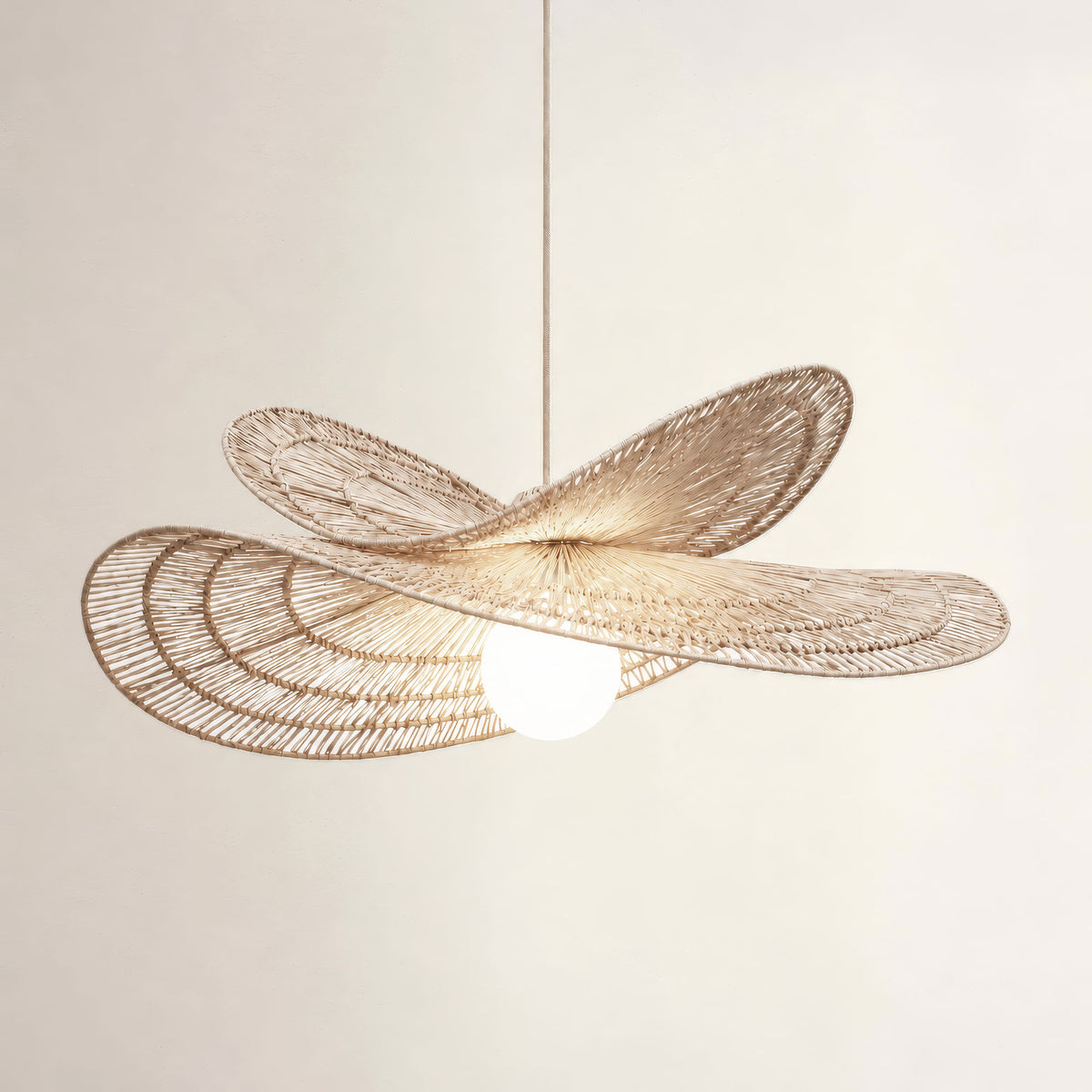
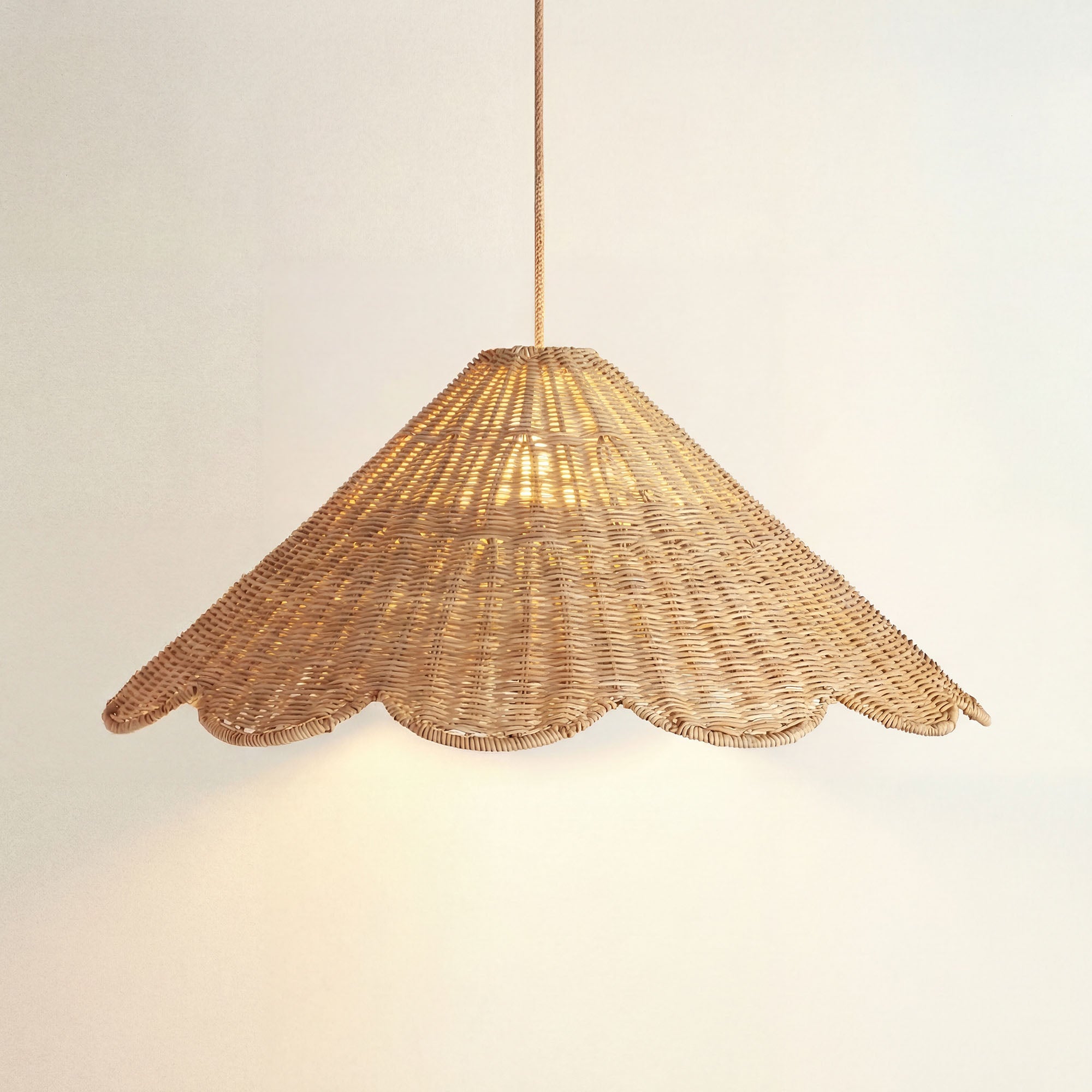
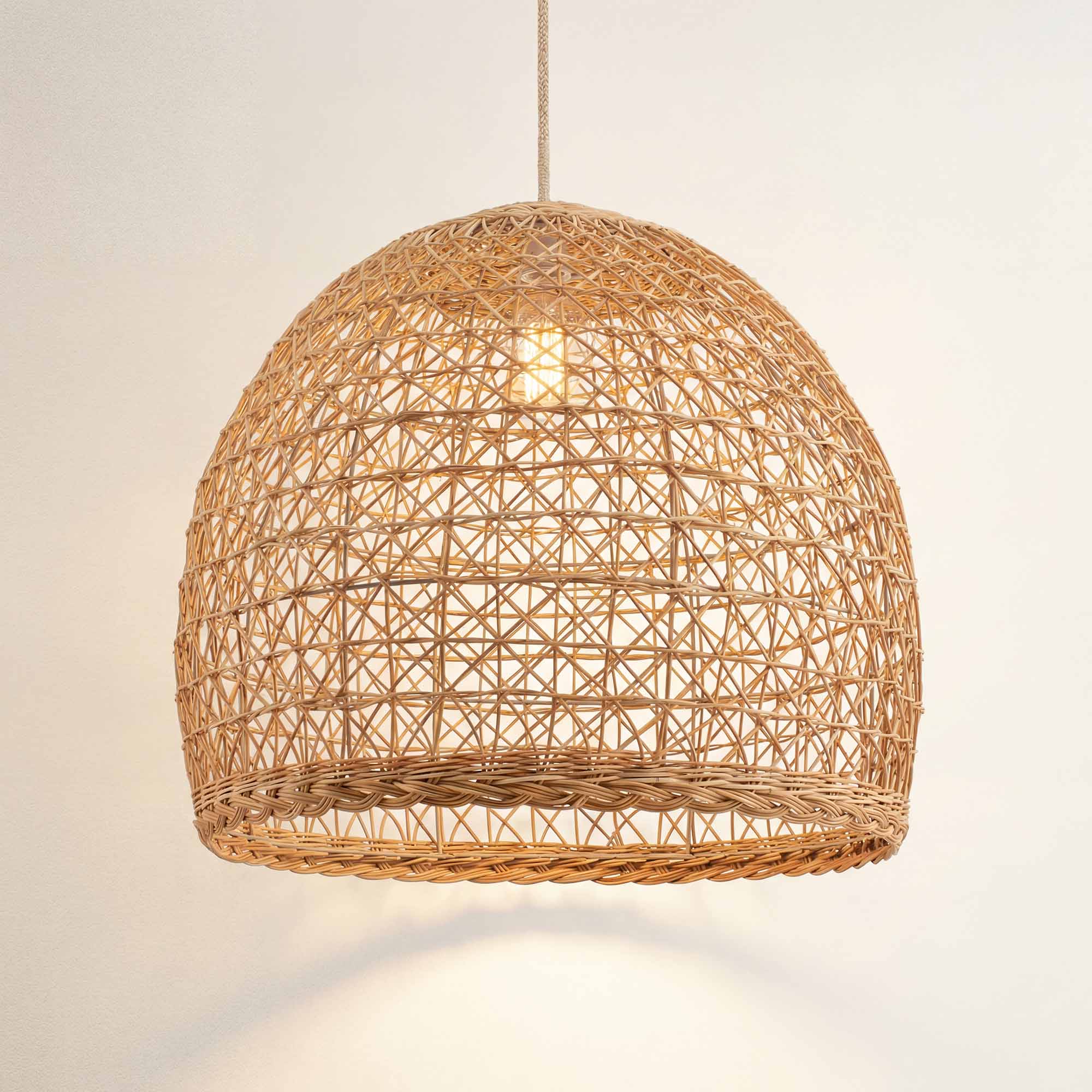
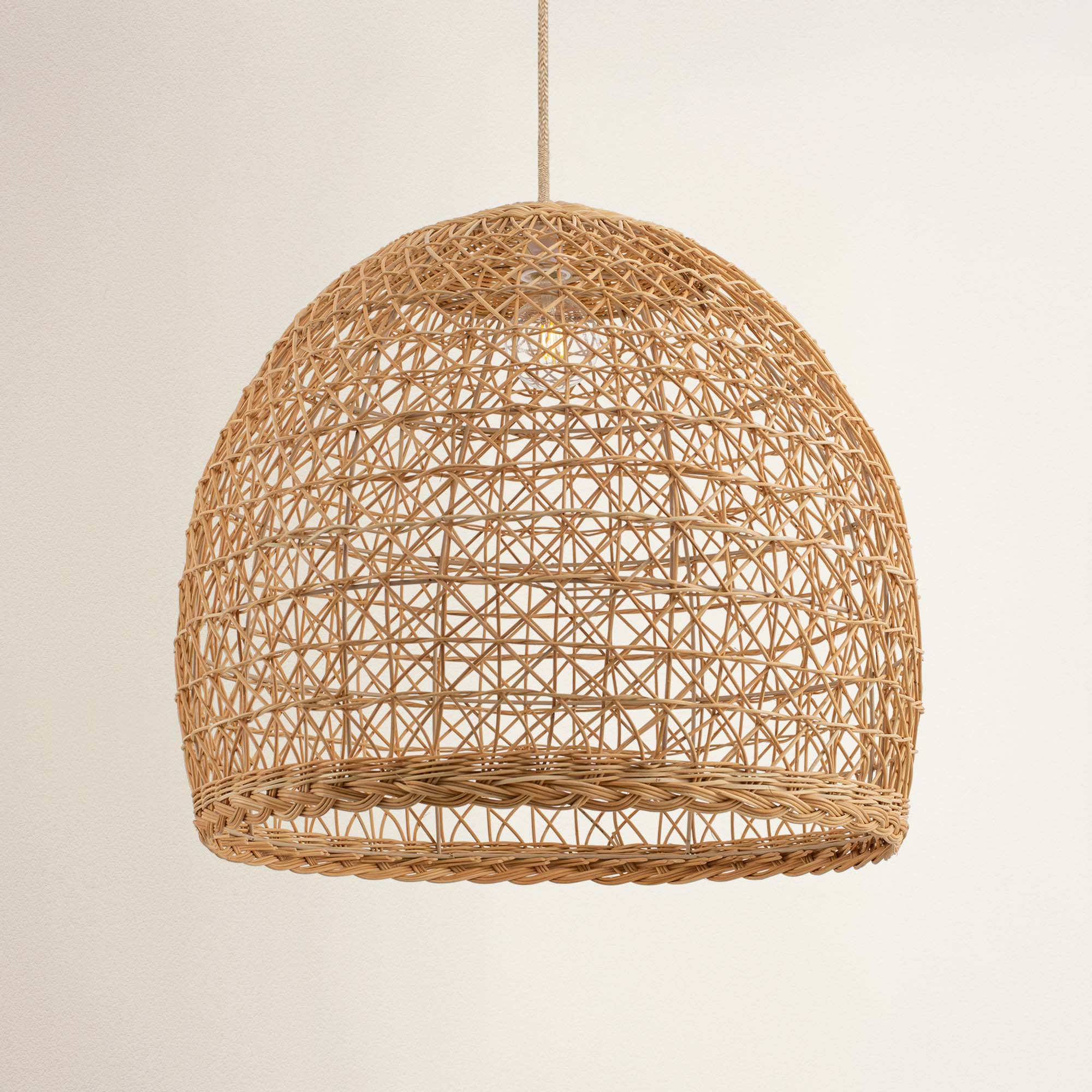
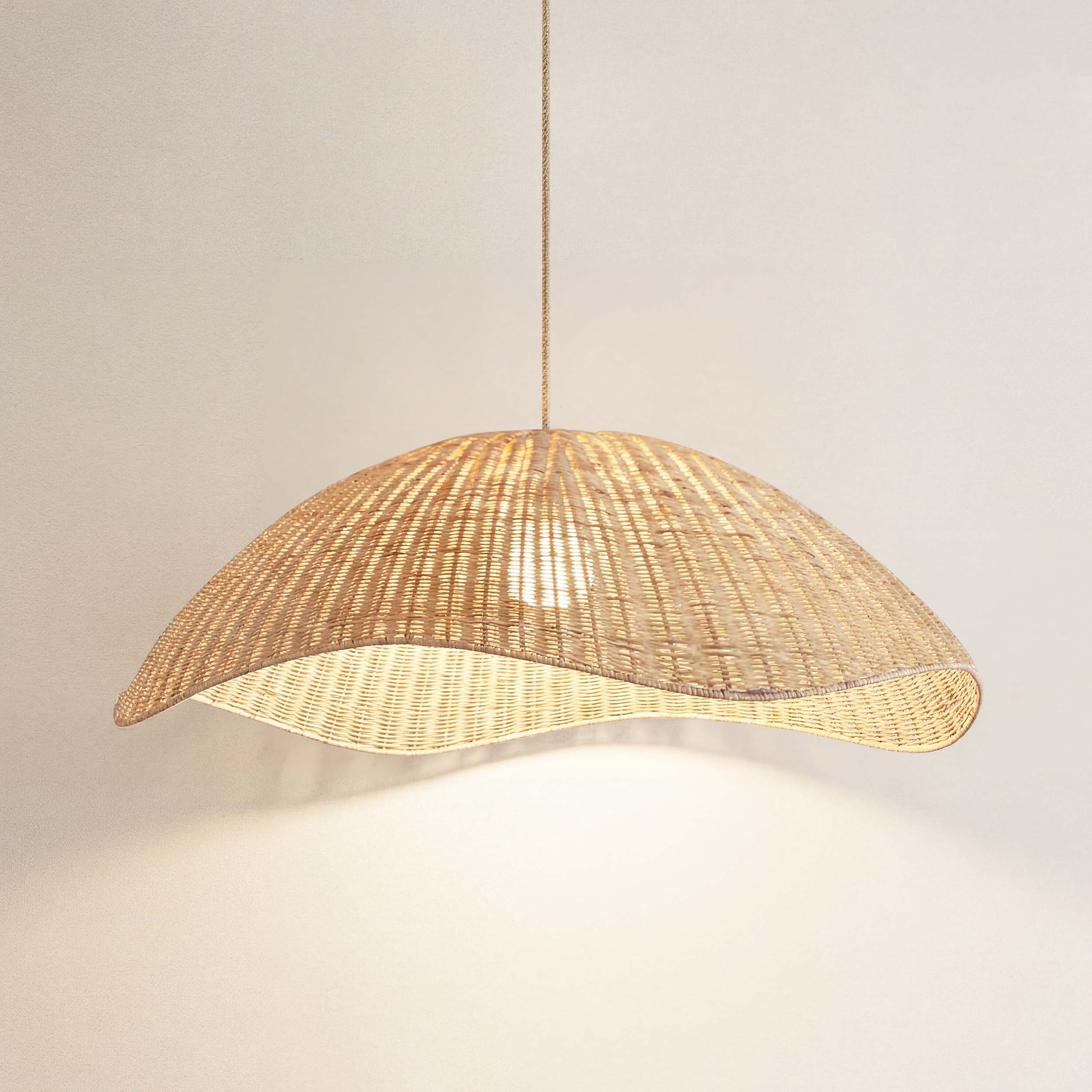
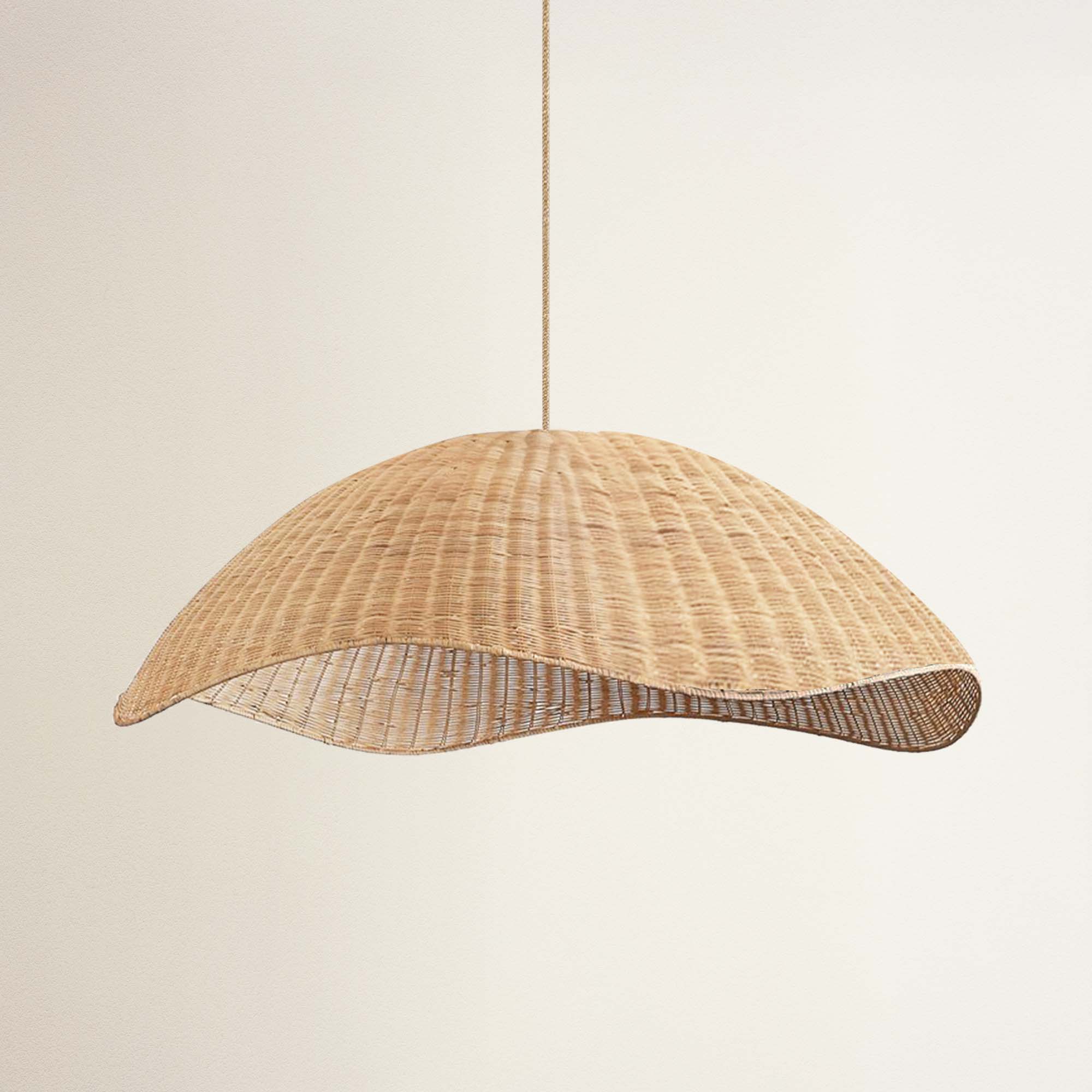
For a woven fixture such as the Callie Exterior Pendant, the project team should review the exact shade material, exposed metal components, cord construction, wet-location documentation, and approved mounting configuration before specifying it for a fully exposed coastal installation.
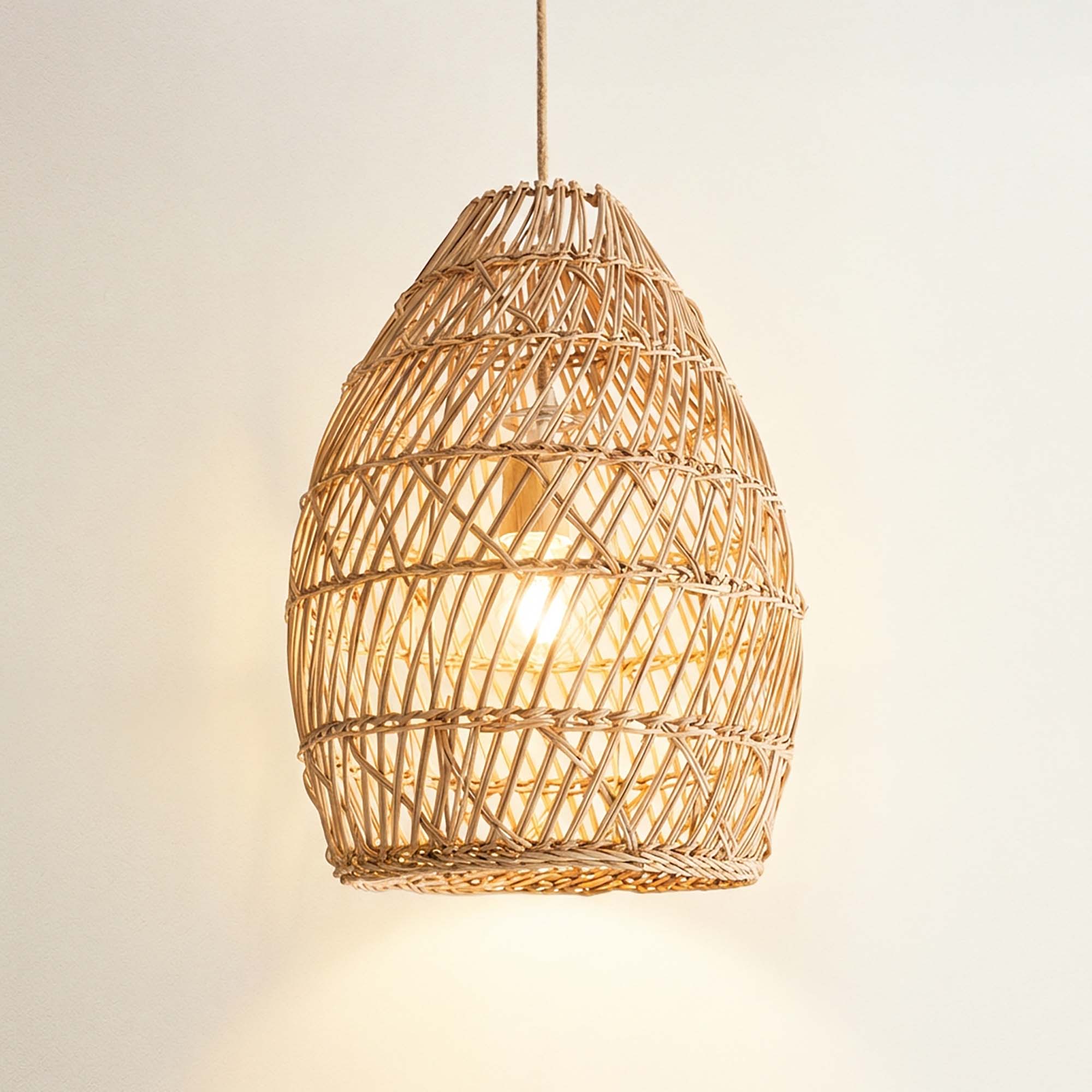
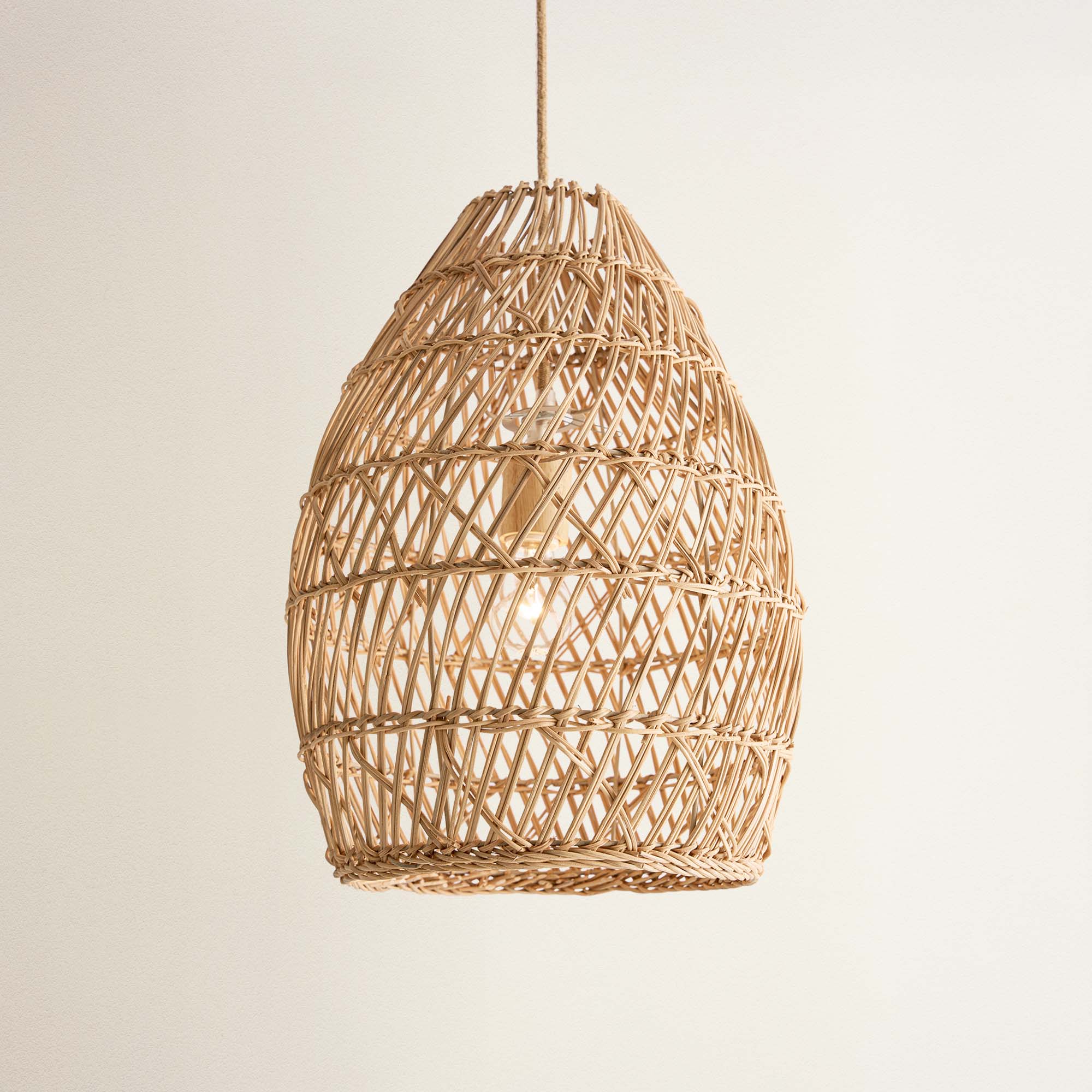
The questions to bring to Rowabi before any commercial specification include: What is the shade material, and what outdoor exposure conditions has it been tested for? What is the wet-location marking status of the complete electrical assembly? What cord and connector configurations are available? What customization, if any, can be made without affecting the original certification? The following table reflects the structure of that review; specific values should be confirmed with Rowabi directly.
| Requirement | Standard configuration | Custom project option | Documentation status |
| Wet-location rating | Confirm with Rowabi | Confirm availability | Request certificate |
| Exposed metal material | Confirm with Rowabi | Confirm upgrade options | Request material sheet |
| Quick disconnect | Confirm with Rowabi | Project-specific | Request connector documentation |
| Coastal finish | Confirm with Rowabi | Confirm upgrade options | Request test report |
| Tree mounting | Not standard | Engineer-designed | Project approval required |
What tree-hung lighting requires
Suspending a luminaire from a living tree introduces structural and maintenance variables that a fixed ceiling installation does not. The specification requirements are meaningfully different, and the project team's responsibilities are broader.
A tree is not a fixed ceiling structure
Trees grow, branches move, and wind loads create dynamic forces that a static ceiling mounting point does not experience. A branch that adequately supports the fixture load in still conditions may flex significantly in wind, introducing fatigue loading on the suspension hardware, cord strain, and potential contact between the cord and adjacent branches.
The mounting system must be designed to accommodate branch movement within the expected wind conditions for the site, not only the fixture's static dead weight. A landscape architect or arborist familiar with the specific tree species and site conditions should be part of the design team.
The tree should not function as an improvised electrical support
The electrical cord of the pendant should not bear the full mechanical load of the fixture. An independent suspension cable or structural attachment system should carry the weight of the luminaire and resist the dynamic loads introduced by wind. The cord routes the electrical connection; a separate strain-relief system carries the mechanical load.

For hospitality projects in hurricane-prone coastal areas, the specification should also address the storm removal plan: how the fixture will be detached, stored, and reinstalled, and whether the mounting hardware and cord connections are designed to support repeated seasonal removal without requiring professional electrical work each cycle.
Coordinate the tree, fixture, and electrical system
A tree-hung pool-deck lighting installation requires coordination between at minimum a landscape architect or arborist, a licensed electrical contractor, and the local Authority Having Jurisdiction. The arborist evaluates the tree's structural capacity and specifies the attachment method that will not damage the root system, bark, or branch structure over time. The electrical contractor designs the supply routing, GFCI protection, and connection method consistent with the applicable local code.
The Authority Having Jurisdiction reviews and approves the final installation plan. A product submittal from the manufacturer supports the process but does not substitute for the project-specific engineering and code review.
Quick disconnects must be specified as part of the system
A quick-disconnect cord allows the fixture to be removed without cutting or splicing wiring, a meaningful operational advantage for hospitality properties that need to secure outdoor lighting before seasonal storms, perform periodic maintenance, or replace damaged shades. The specification of the connector should be as rigorous as the specification of the luminaire itself.
Why hotels may need quick disconnects
Coastal hospitality properties have operational reasons to detach pendant fixtures that residential installations typically do not. Storm preparation requires securing or removing fixtures that could become projectiles in high wind. Shade replacement due to UV fading, impact damage, or end of cosmetic life requires disconnecting the electrical assembly without cutting cords.

Seasonal tree pruning may require temporarily removing fixtures from specific branches. Periodic inspection of the cord, connector, and mounting hardware is easier and safer when the fixture can be detached cleanly.
Verify every component in the connection path
A wet-location quick-disconnect system involves more than the connector body itself. The cord must be rated for the installation environment; cable marked with a "W" designation is typically rated for wet-location use and sunlight resistance, but the marking should be verified on the specific cable specified for the project.
The connector body, the strain-relief fitting where the cord enters the connector, and any weather seals or covers must all be appropriate for the expected moisture exposure. A connector rated for damp locations is not equivalent to a connector rated for wet locations in a fully exposed installation.
Custom changes may affect the original certification
Any modification to the cord configuration, connector type, or strain-relief method relative to the manufacturer's tested and certified assembly should be evaluated for its effect on the original electrical certification. A change that the manufacturer's engineering team confirms as within the tested configuration scope is very different from a field modification that departs from the approved assembly.
For commercial hospitality projects, field modifications that affect a luminaire's certification status introduce liability concerns that should be resolved before installation, not after.
Pool-deck lighting needs project-specific electrical review
The proximity of a luminaire installation to a swimming pool or spa introduces electrical safety requirements that vary based on placement, supply voltage, wiring method, grounding and bonding, GFCI protection, and the specific edition of the National Electrical Code adopted in the local jurisdiction. This guide cannot substitute for a licensed electrical engineer's review of the specific project conditions.
What the project team should know before beginning the electrical design review: The applicable NEC edition and any local amendments in effect for the jurisdiction. The intended placement of the fixture relative to the water's edge and the pool structure. The supply voltage and circuit type proposed for the installation. The grounding, bonding, and GFCI requirements that apply to the specific zone. The mounting height and method, which affect which code provisions apply. The AHJ's requirements for submittal and inspection of pool-area electrical work.
What this guide cannot provide: A single clearance distance that applies to every pool-deck installation. An interpretation of local electrical code that applies to a specific project. A confirmation that any particular luminaire or mounting method complies with an unevaluated installation condition.
For hospitality projects, the architect, electrical engineer, and electrical contractor should review the luminaire submittal package together, coordinate the mounting detail and electrical routing plan, and submit the complete package to the Authority Having Jurisdiction before installation begins.
Coastal hospitality lighting specification checklist
Before approving an outdoor pendant for a coastal hotel or pool-deck project, verify these five areas:
- Wet-location certification. Confirm the complete fixture configuration is approved for the expected water exposure, not just the socket or cord in isolation. Check the wet-location marking, the approved installation orientation, the supply voltage, and whether any customization of the cord or connector affects the original certification.
- Coastal materials and corrosion resistance. Request documentation for every claim of marine-grade or corrosion-resistant performance. Verify the alloy designation for the canopy and chain, the fastener material, the protective coating system and number of coats, salt-spray or corrosion test results with test duration and pass criteria, and warranty exclusions related to pool chemicals or salt-air environments.
- Woven shade durability. Evaluate the shade material separately from the electrical system. Confirm whether the woven material is natural or synthetic, whether it is tested for direct rain exposure, UV resistance and colorfastness rating, mold and mildew resistance guidance, approved cleaning method, and expected cosmetic service life under the project's actual conditions.
- Suspension and quick disconnect. The suspension system must carry the mechanical load safely and allow practical maintenance. Verify the total fixture weight, the outdoor-rated cord specification and markings, the strain-relief method, the wet-location suitability of the quick-disconnect connector and its seals, the protective cap or cover when the connector is detached, and the allowable movement range for wind or branch displacement.
- Operations and maintenance. Confirm the cleaning schedule and method, the salt and corrosion maintenance procedure, the storm removal and reinstallation process, the replacement-parts lead time for shades and hardware, and the commercial warranty terms and exclusions.
| Requirement | What to verify | Evidence to request |
| Wet-location suitability | Complete fixture is approved for expected water exposure | Certification and product marking |
| Coastal durability | Exposed metals and finishes are suitable for salt air | Material specifications and test reports |
| Woven shade | Shade matches the actual UV and moisture exposure | Material and maintenance documentation |
| Quick disconnect | Connector, cord, and seals suit the installation | Connector data sheet and system drawing |
| Tree suspension | Load support accounts for movement and maintenance | Project-specific mounting detail |
| Long-term operation | Fixture can be cleaned, removed, and serviced efficiently | Maintenance guide and replacement-parts list |
Recommended status labels for each item: Confirmed · Custom option · Project review required · Pending certification · Not available.
When a custom pendant is appropriate
A custom solution may make sense when...
The project scale justifies the lead time, cost, and engineering resources required. The manufacturer can supply technical documentation for the proposed modifications before fabrication begins. There is sufficient time in the project schedule for prototype fabrication, testing, and review before the specification is locked. The custom configuration does not require departing from a tested and certified electrical assembly, or a field evaluation process has been identified and budgeted.
A custom solution may not be appropriate when...
The modification cannot be accompanied by documentation of wet-location suitability for the altered configuration. The project schedule does not allow time for prototype evaluation. The connector or cord change is proposed as a field modification after the certified assembly leaves the factory. The supplier cannot confirm in writing whether the proposed modification falls within or outside the scope of the original certification.
Conclusion
A coastal hotel pool-deck pendant specification is a systems problem, not a product selection. Wet-location rating, coastal material durability, shade longevity, suspension engineering, and operational maintenance must all be confirmed before a fixture is approved, and each must be documented in a form that supports the Authority Having Jurisdiction's review.
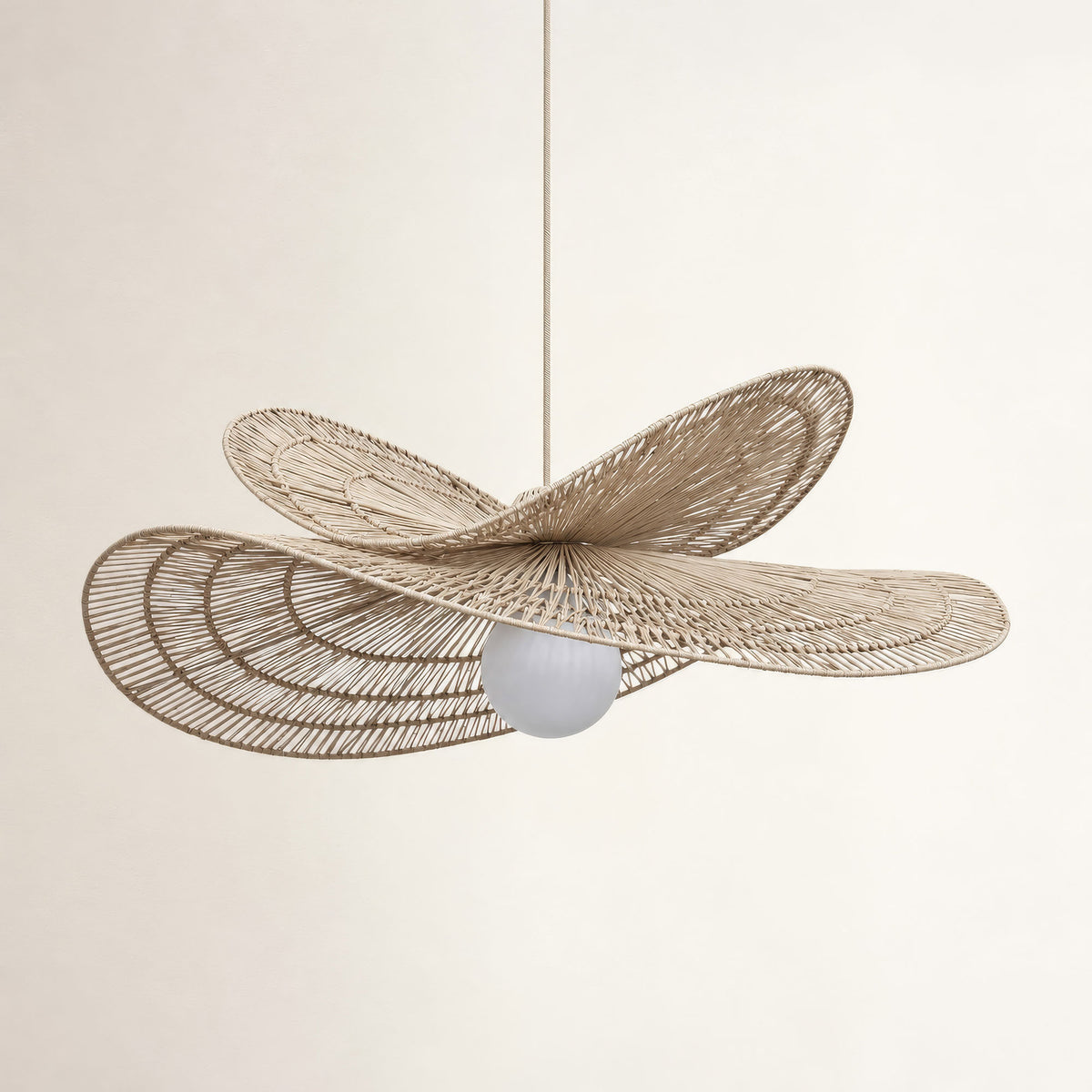
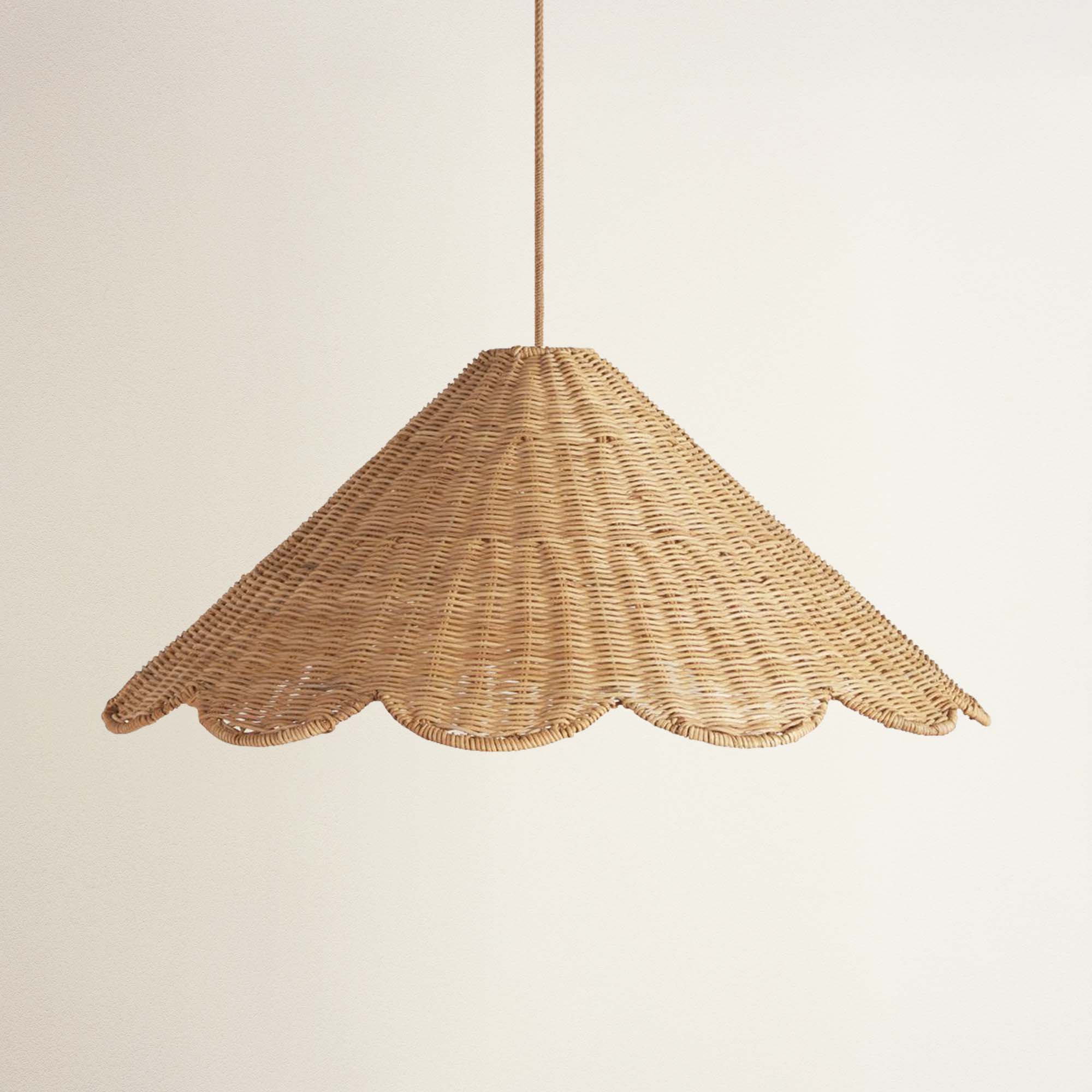
The Callie Exterior Pendant and Rowabi's outdoor rattan collection are a starting point for coastal hospitality projects where a woven decorative shade is part of the design intent. The next step is a direct conversation with the Rowabi team to confirm the documentation available for the specific project conditions, wet-location status, material specifications, cord and connector options, and any customization scope, before the submittal package is assembled. Contact Rowabi to begin that specification conversation.
Rattan pendant light outdoor collection:
45-Day Return
45-Day Return
45-Day Return
45-Day Return
45-Day Return
45-Day Return
45-Day Return
45-Day Return
45-Day Return
45-Day Return
45-Day Return
45-Day Return