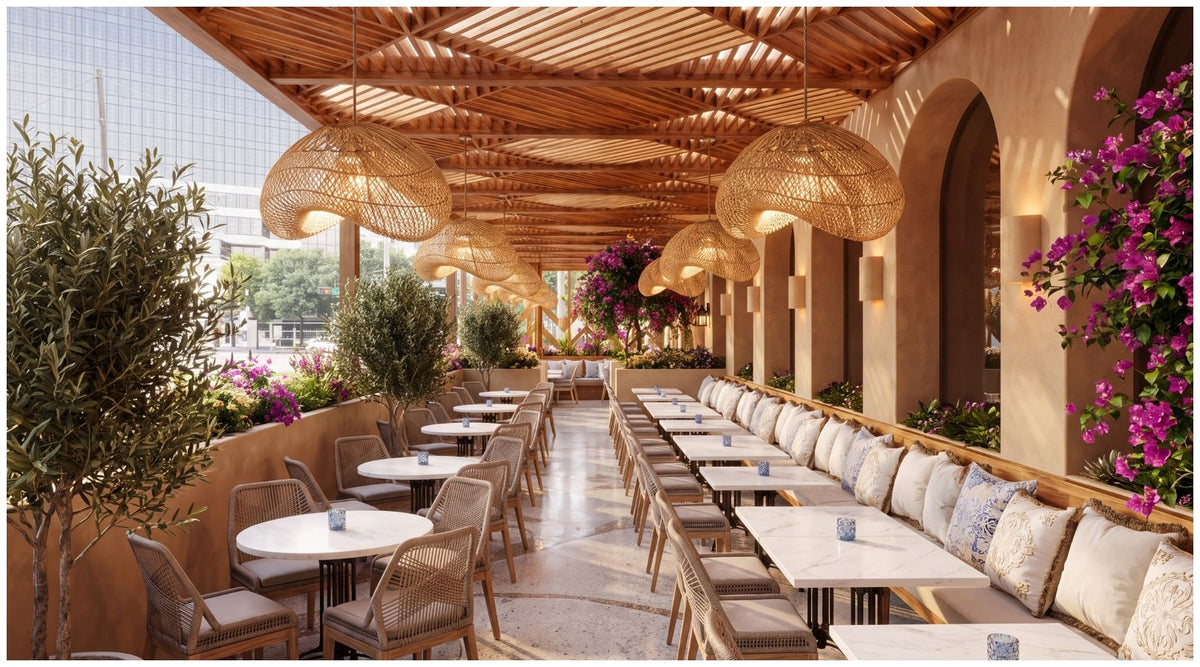
Organic modern lighting combines clean, contemporary silhouettes with tactile materials such as rattan, woven fiber, wood, linen, paper, ceramic, and plaster, using soft forms and warm, layered light to build a restrained, natural feel.
This guide is created for designers to clarify that choosing the right fixture means weighing aesthetics against scale, light behavior, installation, maintenance, and the project's specific requirements, not simply matching a look. It's worth stating plainly before going any further: organic modern describes an aesthetic based on natural forms, tactile materials, and restrained contemporary design; it does not by itself certify that a fixture is organic, natural, or sustainably produced.
Keep that distinction in mind throughout, because the two get confused constantly, and conflating them is one of the more consequential mistakes a designer can make on a client-facing claim.
Quick cheat sheet for designers
Before working through materials and sourcing in detail, use this cheat sheet as a fast reference for the decisions that come up on nearly every organic-modern lighting project.
| Design decision | Quick guideline |
| Light quality | Set CCT and CRI based on the space, visual task, and materials being rendered, not the organic-modern style alone. For hospitality projects, see our detailed [hospitality lighting specification guide] |
| Lighting approach | Treat the decorative fixture as one layer. Combine ambient, task, accent, and decorative lighting rather than expecting a single pendant or chandelier to light the whole space. |
| Pendant placement | For a pendant over a fixed dining table, roughly 30–36 in. above the tabletop is a useful starting point; adjust for fixture size, seated sightlines, ceiling height, and room proportion. |
| Multiple pendants | Size the layout from fixture diameter plus desired gap, center the composition, then inset the end pendants from the table or island ends. A 24–30 in. gap is a rough reference, not a sizing method on its own. |
| Low ceilings | On an 8-ft ceiling, keep suspended fixtures mainly over fixed furniture; use compact pendants, flush mounts, or semi-flush fixtures where circulation clearance is tight. |
| Texture balance | Let one tactile material dominate and use smoother, quieter finishes around it. Avoid repeating rattan, heavy wood grain, jute, and other strong textures at equal visual weight. |
| Commercial use | Verify intended use, mounting, light behavior, location rating, cleaning access, maintenance, replacement strategy, quantity, and lead time before specifying. |
| Sustainability | Treat sustainability as a separate verification step by checking material sourcing, durability, energy performance, and supplier documentation. An organic-modern look does not automatically mean sustainable. |
*A note on how to use this table: the heights, spacing, CCT/CRI ranges, and ceiling examples above are design starting points, not universal code requirements. The right number for any given project still depends on its specific fixture, room, and installation conditions.
What materials define organic modern lighting?
Rattan and woven fibers
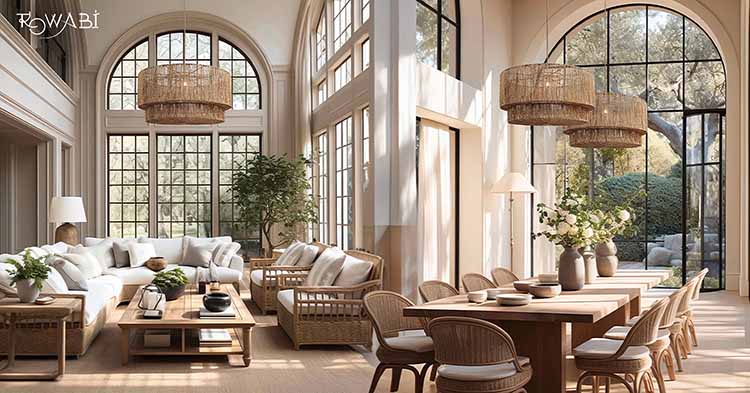
Rattan and other woven fibers are the materials most people picture when they hear "organic modern," and for good reason: a woven surface adds tactile depth and handcrafted variation that immediately softens clean, contemporary architecture. What often gets missed, though, is that weave density, opening size, shade depth, and the presence of an inner diffuser affect the final result as much as the material name does.

Credit: Rowabi
In reality, two rattan pendants can behave completely differently depending on how tightly they're woven and what sits inside the shade. It's also worth being precise with terminology, since these three words get used interchangeably even though they mean different things: rattan is the material itself, wicker refers to the weaving technique, and cane is the outer skin of the rattan stalk, often used for the tighter, more refined weaves.
Pieces from brands such as Rowabi can be a useful reference point here, not as a default recommendation, but as an example of a woven product line worth evaluating against the material, scale, installation, and project criteria covered throughout this guide.
How each material behaves as a light source
The material surrounding a light source shapes more than a fixture's appearance. Its opacity, thickness, surface finish, and construction all influence how light diffuses, how shadows form, how much glare reaches the eye, how easy the fixture is to maintain, and where it will ultimately perform best.
The table below breaks this down material by material, rather than relying on shorthand like "wood adds warmth", "linen softens light", which sounds accurate but doesn't tell a designer what to expect.
| Material | Light behavior & shadow | Cleaning & aging | Best suited for |
| Wood/wood veneer | Usually opaque, so it blocks, redirects, or reflects light rather than diffusing it. Slats, perforations, and gaps can create defined directional shadows. | Dust can collect around slats and joints. Color and finish may change with UV, heat, or age depending on the product. | Structured pendants, slatted shades, sconces, and fixtures where the material itself defines the form. |
| Linen | A lined linen shade can soften and diffuse the source, producing broad, low-contrast light with relatively gentle shadows. Results depend on fabric density and liner construction. | Fabric can collect dust and stains; color and tension may change over time. Confirm cleaning method with the manufacturer. | Drum shades, pendants, and fixtures where soft ambient light matters more than patterned shadow. |
| Paper | Thin or layered paper can create a soft, lightweight glow. Thickness, layering, folds, and perforations determine how much light passes through and how visible the shadow pattern becomes. | More sensitive to moisture, dust, creasing, and discoloration than most hard-surface materials. | Sculptural pendants and low-weight decorative shades in protected interior spaces. |
| Ceramic | Usually opaque. Light is typically reflected from the surface or released through openings, ranging from a soft wash to crisp perforated patterns. | Glazed surfaces are generally easier to wipe clean; porous or unglazed finishes may show dust, marks, or staining more readily. | Use sconces, smaller pendants, and sculptural accent fixtures when form and reflected light are the focus. |
| Plaster | Opaque and commonly used to bounce or wash light across walls and ceilings rather than transmit it. Produces broad architectural light with little patterned shadow unless the form creates it. | Pale matte finishes can show dust, fingerprints, and scuffs; cleaning and repairability depend on the specific finish. | Integrated-looking sconces, uplights, and architectural accents in restrained organic-modern interiors. |
The takeaway here is not to choose a material for its texture alone. First consider whether the project needs diffused light, reflected light, patterned shadow, straightforward cleaning, or a visually opaque sculptural form. Then select the material and fixture construction together as one decision rather than two separate ones.

The lighting shade material plays an important role in how light diffuses.
Balance natural materials with modern forms
Remember that organic modern is an aesthetic, not a purity test. Nothing about the style requires every fixture component to be entirely natural. A pendant can combine natural fiber with a metal frame, resin or composite components, or even a natural-looking synthetic finish, and still read as organic modern, provided the overall composition holds together.
Clean geometry, restrained hardware, and controlled material contrast are what keep the look contemporary rather than crafty or dated. One caution worth repeating throughout a project: any claim that a fixture is natural, handmade, eco-friendly, renewable, or sustainable must match what the supplier can document. The aesthetic doesn't automatically grant those claims.
In other words, a fixture can look organic modern without being made entirely from natural materials, and designers shouldn't feel boxed in by an all-or-nothing view of the style.
What design styles pair with organic modern lighting?
Organic modern pairs naturally with styles that already value clean forms, natural texture, restrained color, and material contrast, which is exactly why the same woven pendant can look right in a Japandi living room and completely wrong in a maximalist one.
Rather than reaching for the same fixture across every project, let the style direction shift the weave, silhouette, and finish, as shown below.
| Style | Why it pairs | Recommended fixture direction |
| Japandi | Both styles emphasize restraint, craftsmanship, natural materials, and visual calm. | Choose a tight or refined weave, a simple lantern, globe, or softly rounded silhouette, and pale/natural finishes. Use one fixture as a quiet anchor rather than several decorative statements. |
| Scandinavian | Scandinavian interiors share organic modern's light palette, functional simplicity, and preference for natural materials. | Favor fine weave, linen, paper, or light wood, with compact, uncomplicated forms. Keep the fixture visually light and mostly supportive rather than dominant. |
| Warm minimalism | Natural texture adds depth to minimal spaces without requiring more color or ornament. | Use medium-to-tight weave, sculptural but clean silhouettes, and restrained natural or monochromatic finishes. One strong tactile fixture can act as the main focal point. |
| Coastal | Both styles use light finishes and natural texture, but organic modern is usually more restrained and less decorative. | Use open or airy weave, simple dome, bell, or basket-inspired forms, and pale finishes. Avoid fringe, overly distressed finishes, or multiple beach-inspired textures that push the room toward boho/coastal décor. |
| Mid-century modern | Organic curves and woven texture can soften the strong geometry, wood tones, and graphic furniture common in mid-century spaces. | Choose a controlled weave with globe, cone, drum, or sculptural forms. Pair natural fiber with darker wood or refined metal details and use the fixture selectively as an accent or anchor. |
| Transitional | Organic texture can bridge traditional furniture with cleaner contemporary architecture and finishes. | Favor tight weave, balanced proportions, and simpler classic silhouettes. Keep hardware and finishes refined so the fixture adds warmth without making the room feel rustic. |
This comparison makes clear that material alone doesn't determine style. Weave density, silhouette, scale, finish, hardware, and how prominently a fixture is used together decide whether a room reads as Japandi, Scandinavian, coastal, transitional, or simply organic modern in its own right.
And a few current trends are worth noting as visual direction, not as rules to follow regardless of context: oversized sculptural fixtures, softer and more irregular forms, tactile woven shades, warm minimalism, a deliberate mix of natural and refined materials, and biophilic integration all show up frequently in organic-modern projects right now.
Treat them as inspiration rather than instruction because none of them should override function, scale, installation, cleaning, or the specific requirements of a project.
How to choose organic modern lighting for a project
Start with the space, not the fixture
Before opening a catalog, it's worth working through a short set of questions about the space itself:
- What the room is used for
- Who uses it
- For how long
- It has a genuine task-lighting or display-visibility requirement
- The ceiling height
- Daylight, furniture layout, and circulation look like
- The fixture needs to act as a focal point or as a quieter supporting layer
- The layout is fixed or likely to change.
The answers differ by space. For example, a dining room is mostly about ambiance and table visibility, a lobby or reception area needs both a statement moment and functional ambient light, and a retail or concept space has to let a decorative fixture add character without competing with merchandise visibility.

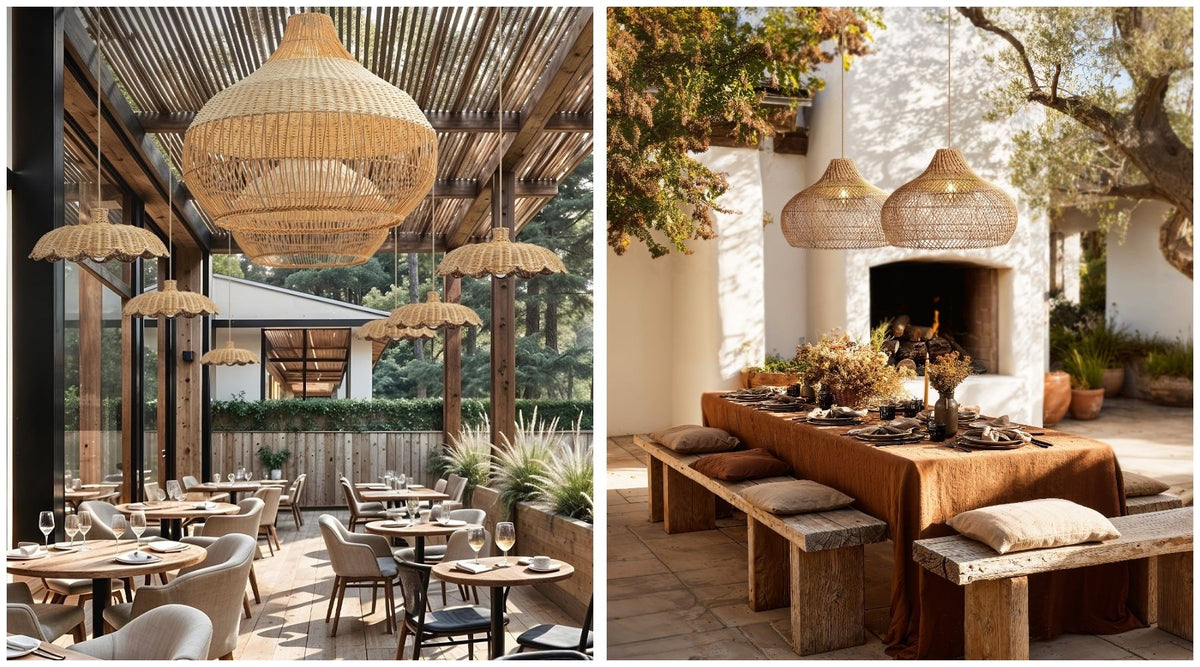
Choose the lighting role first, then choose the fixture. Reversing that sequence is one of the more common ways a beautiful pendant ends up in the wrong place. Credit: Rowabi
Build the lighting layers
Once the room's role is clear, the next step is deciding how to build light in layers rather than deliver it from a single source.
- Ambient light provides the overall base: recessed fixtures, flush mounts, or indirect light doing the quiet work of general illumination.
- Task light covers reading, bedside use, counters, and work surfaces where people need to see clearly.
- Accent light draws attention to artwork, planting, wall texture, or architectural detail.
- Decorative light, such as the pendant, chandelier, or sculptural sconce most people picture when they think "organic modern", is what adds character and creates a focal point.
A woven pendant can work well in that decorative layer, but plan it alongside the ambient and task layers already doing the functional work, not as the room's only light source. Decorative lighting should add character; it shouldn't be expected to carry all the functional light in a space on its own.
Choose the fixture type by space and function
With the lighting role and layers settled, fixture type becomes more about mechanics than style. In organic-modern interiors specifically, natural texture doesn't determine whether a fixture should be a pendant, chandelier, sconce, or flush mount. The space and function do.
It's worth drawing a clear line between a pendant and a chandelier here, since the two often get confused: a pendant is typically a single suspended fixture, or one repeated in a series, which makes it useful over tables, islands, counters, and other clearly defined zones. While a chandelier has more visual spread or multiple light sources and generally works better where the room can support more visual mass and a stronger focal point.
A large woven pendant, in other words, shouldn't automatically get relabeled as a chandelier just because it's substantial.
| Fixture type | Best suited for | Why choose it | Key checks |
| Pendant | Dining table, kitchen island, counter, bar, bedside drop, reception counter | Defines a specific zone and brings texture closer to furniture or the user. Can be used singly or repeated to create rhythm. | Fixture diameter, hanging height, spacing, seated/standing sightlines, bulb visibility, suspension range |
| Chandelier | Dining focal zone, entry or foyer, central seating area, stair volume, double-height space | Creates a stronger visual anchor and fills more horizontal or vertical volume than a typical pendant. | Overall visual mass, room and ceiling scale, suspension length, sightlines, mounting weight, cleaning/service access |
| Wall sconce | Bedside, corridor, lounge wall, vanity-side location, display or feature wall | Adds a supporting layer without using ceiling space; useful for highlighting material, architecture, or creating softer perimeter light. | Projection from wall, mounting height, glare, source visibility, wall surface, cleaning access. |
| Flush / semi-flush | Low-ceiling rooms, circulation zones, guestrooms, secondary ambient-light areas | Keeps more headroom while providing ceiling-level ambient or decorative light. Useful where a suspended fixture would interfere with circulation. | Overall drop, clearance, light distribution, diffuser, scale relative to ceiling/room, maintenance access |
One more distinction worth making explicit: statement lighting is a role, not a fixture type. A pendant, a chandelier, or even a sculptural wall sconce can become the room's focal point if its scale, silhouette, texture, placement, or repetition gives it enough visual priority; even the fixture category itself doesn't decide that.
The practical takeaway is to choose the fixture type based on where the light is needed and how the space functions first, and only then decide how expressive the material, texture, and silhouette should be.
Decide what should be the focal point
The last piece of the selection process is deciding, deliberately, whether the fixture is meant to be the room's visual anchor or a quieter layer supporting something else. If a space already has a strong stone wall, a piece of artwork, sculptural furniture, or dramatic architecture doing the visual work, the lighting should generally hold back rather than compete.
In a very clean, minimal envelope, on the other hand, one woven or sculptural fixture can reasonably carry the primary tactile contrast for the whole room. What to avoid either way is stacking multiple competing focal points; several unrelated woven statements in the same sightline read as clutter rather than intention.
As a rule of thumb, one clear visual anchor paired with quieter supporting layers tends to read as more considered than several fixtures all trying to be the star.
Getting scale, texture and light quality right
Get the scale and placement right
Scale should come from ceiling height, furniture size, room volume, and visual weight together, not from fixture diameter viewed in isolation. Over a fixed dining table, roughly 30–36 inches above the tabletop is a reasonable starting point for pendant height. You can find the full sizing and clearance logic, including how that number shifts in circulation areas, in our [pendant height guide].
When a project calls for multiple pendants, size the layout from fixture diameter plus a desired gap, center the full composition over the table or island, and inset the end pendants from the ends before fine-tuning visual spacing. For example, a 24-to-30-inch gap can serve as a rough reference point, but it isn't a sizing method on its own.

You can use this diagram as a reference, but it's best to base it on the actual situation to ensure the best proportions.
Ceiling height changes the calculation directly. In an 8-foot ceiling scenario, it generally makes sense to keep suspended fixtures over fixed furniture only, leaning on compact pendants, flush mounts, or semi-flush fixtures wherever circulation clearance is tight, while a 10-to-12-foot-plus ceiling allows more vertical expression but shouldn't simply reuse the same fixture and drop length that worked at a lower height.
In any circulation path, verify headroom and accessibility clearance separately from these design guidelines, since they're governed by entirely different requirements. Worth restating plainly: these are design starting points, not universal code requirements, and the right number for a given project still has to respond to its specific fixture, room, and installation conditions.
Use natural texture without the space feeling rustic
This is probably the single most common worry designers raise about organic modern lighting: how to bring in real texture without the room drifting toward rustic or boho. Six adjustments tend to make the difference, and they work together rather than as a checklist to apply piecemeal.
- Simplify the silhouette: Reach for clean dome, cone, globe, drum, or restrained sculptural forms rather than heavily ornamented shapes. The material can carry plenty of texture on its own without an elaborate outline competing for attention.
- Refine the weave: Tighter, more consistent weaving reads as more contemporary when the room already has strong texture elsewhere, while open or coarse weave is better reserved for spaces that genuinely need a stronger tactile anchor.
- Limit the number of tactile focal points: Let one woven fixture lead the room, and keep rugs, seating, wallcoverings, and accessories quieter so the texture doesn't stack up into visual noise.
- Pair texture with smooth contemporary surfaces: Plaster, honed stone, clean wood planes, glass, or matte metal keep a space feeling current better than distressed finishes applied everywhere.
- Control palette and hardware: Warm neutrals, natural fiber, and restrained metal details keep a fixture contemporary, while fringe, tassels, and over-layered motifs tend to pull a room toward boho unless that's the intended direction.
- Use repetition architecturally: When a project genuinely needs several fixtures, align them to tables, counters, structural bays, or circulation rhythm rather than clustering them decoratively without a spatial reason.
Any other mention of texture feeling "too rustic" elsewhere in this guide points back to these six levers rather than repeating them.
How woven shades shape light, shadow and atmosphere
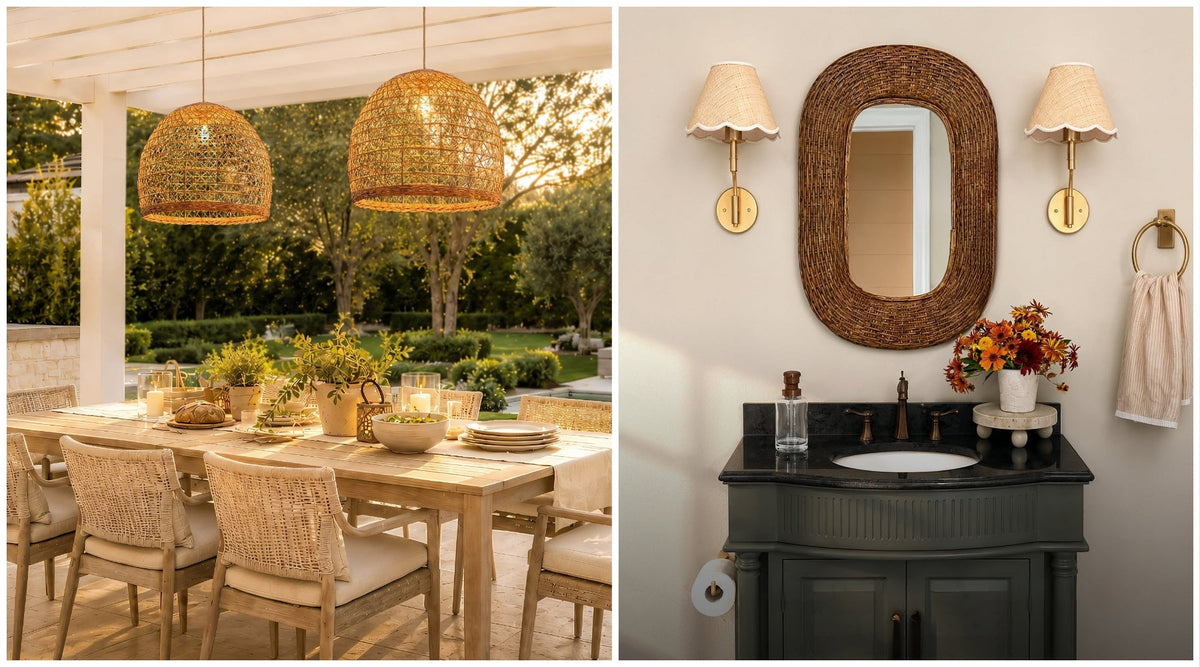
Weave density is the first thing to think through, because it directly controls the pattern a shade throws onto the room. A tight weave tends to produce a softer, more controlled light pattern, while an open weave can cast a much stronger patterned shadow depending on where the lamp sits and how far it is from the nearest wall or ceiling.

Credit: Rowabi
That relationship extends to how efficient the shade feels in practice: an open weave often looks visually "lighter," but it can actually need more lamp output to deliver the same usable light on a task plane, since more light escapes sideways or upward and shows up as contrast rather than delivered illumination on a surface. This is worth phrasing directionally unless a fixture has actual photometric data behind it, rather than treating it as a fixed rule.
Bulb visibility deserves a look from more than one angle, because a shade that hides the lamp from a seated eye level can expose it completely from standing height, or vice versa. You'd better check both before finalizing a fixture.
What sits inside the shade matters just as much as the weave itself: an inner diffuser or an opal-finish lamp usually softens glare and evens out the shadow pattern, while a clear filament lamp increases sparkle and shadow contrast but risks exposing the source more directly. And if dim-to-warm behavior matters for a project's atmosphere, confirm lamp, driver, and dimmer compatibility ahead of time rather than assuming every decorative LED source supports it; plenty don't.
Organic modern lighting by project type
The same organic-modern aesthetic can carry across residential and commercial projects with little visual compromise, but the fixture strategy underneath should change based on operating hours, cleaning frequency, who's responsible for maintenance, repetition, durability requirements, and layout flexibility.
| Project type | Lighting priority | Operations & maintenance | Organic-modern approach |
| Residential | Comfort, proportion, glare control, and layered light | Typically fewer operating hours; usually maintained by the homeowner. Prioritize intuitive cleaning, accessible lamps/components, and room-by-room scale rather than maintenance-heavy solutions. | Use woven pendants, sconces, and flush/semi-flush fixtures selectively. A dining fixture can act as the primary anchor, while bedrooms and circulation areas usually benefit from quieter supporting forms. |
| Restaurants & cafés | Warm ambiance, table visibility, brand identity, and visual rhythm | Expect long operating hours and more frequent dust/grease cleaning. Confirm who cleans and services fixtures, whether shades are reachable, and whether repeated units can be maintained without disrupting operations. | Repeated pendants can create rhythm over tables or bars when aligned with the furniture layout. Control source visibility and cleaning access rather than choosing open woven forms only for visual impact. |
| Boutique hotels | Guest experience, statement moments, durability, and replacement consistency | Longer daily operating cycles with housekeeping or engineering teams responsible for maintenance. Replacement consistency and service access become more important when the same fixture is used across multiple rooms. | Use larger sculptural fixtures in lobbies and lounges, with quieter and more repeatable fixtures in guestrooms or corridors. Prioritize products that can be serviced or replaced consistently over time. |
| Retail & concept spaces | Brand atmosphere, merchandise visibility, and adaptability | Displays and layouts may change more frequently than residential plans. Confirm cleaning frequency, maintenance responsibility, and whether the fixture layout can adapt to future merchandising changes. | Use decorative lighting as a visual anchor without compromising display/task lighting. If fixtures are repeated, align the rhythm with architectural bays, counters, or display zones rather than using repetition only as decoration. |
For restaurants, cafés, and boutique hotels specifically, our [hospitality lighting specification guide] covers the detailed performance, controls, and maintenance considerations beneath this table.
The broader point carries across every project type here, though: the same woven fixture might work as a residential focal point, a repeated restaurant rhythm, or a hotel statement piece, but it's the operating conditions and maintenance strategy, not the aesthetic, that should determine exactly how it gets specified.
Is organic modern lighting sustainable?
The direct answer is that organic modern is a design style, not a sustainability certification. A fixture can use natural-looking materials without necessarily being sustainably sourced or produced, and treating the two as the same thing is one of the easier mistakes to make on a client-facing claim. Getting this right means checking a few things independently rather than reading them off a fixture's appearance.
Material sourcing needs its own verification: where the material comes from, what it's composed of, and whether the supplier can provide documentation or certification where applicable.
Durability is another question: how the shade, frame, and finish are expected to hold up, whether components can be replaced individually, and what a realistic service life looks like. Energy use matters too, though it's worth remembering that delivered efficiency depends partly on shade geometry, not on lumens-per-watt alone (as we mention in the part of [how woven shades shape light, shadow and atmosphere] above for why that matters in practice).
And whatever specific language ends up on a spec sheet or a client presentation, sustainable, eco-friendly, renewable, or non-toxic; they should be used only when the supplier's evidence supports that exact claim, not a general impression of the product. Put simply: evaluate sustainability from verified materials, durability, delivered-light performance, and product documentation, never from appearance alone.
What designers should check before specifying a fixture
Core pre-specification checks
Before approving an organic-modern decorative fixture, run through a short pre-specification checklist, not a full electrical fixture schedule, but enough to catch issues that tend to surface after installation rather than before.
| Check | What to verify |
| ☐ Scale | Diameter, overall height, visual weight, and proportion relative to the furniture and room volume |
| ☐ Ceiling & mounting | Ceiling height, slope, junction-box/support conditions, canopy size, and mounting compatibility |
| ☐ Suspension | Cord, chain, or downrod type; minimum and maximum drop; whether the available range suits the ceiling height |
| ☐ Light behavior | Lamp/source position, useful output, glare, bulb visibility, diffuser, shadow pattern, and CCT/CRI where relevant |
| ☐ Controls | Dimming compatibility and dim-to-warm capability if the project requires it |
| ☐ Environment | Intended dry, damp, or wet location and the manufacturer's documented rating for that condition |
| ☐ Installation | Fixture weight, mounting method, access for installation, and future service access |
| ☐ Maintenance | Cleaning access, dust accumulation points, and whether the shade, bulb, driver, or other components can be replaced |
| ☐ Procurement | Required quantity, current stock, lead time, finish consistency, and replacement availability for repeat installations |
| ☐ Documentation | Spec sheet, installation guide, material details, electrical information, listing/rating documentation, and care instructions |
| ☐ Sustainability claims | Material sourcing, durability, energy performance, and evidence supporting any environmental or "eco-friendly" claim |
A fixture is ready to specify once it satisfies four things at once: design fit, light performance, installation suitability, and long-term project support. Before installation, confirm electrical requirements, structural support, voltage, mounting conditions, and location rating. A qualified electrician should complete or review hardwired and commercial installations, verifying applicable local requirements along the way.
What makes a woven fixture commercial-grade
"Commercial-grade" gets used as a vague quality adjective more often than it should, when it actually refers to a specific set of checks a fixture either passes or doesn't:
- Start with the listing itself: verify the fixture's UL listing or equivalent marking, and confirm that the intended application actually matches what the manufacturer's documentation covers, since a listing for one use doesn't automatically extend to another.
- Cleaning access comes next, and it's a practical rather than technical question: can staff reach and clean the weave, lamp, diffuser, canopy, and upper surfaces safely and routinely, or does the fixture's placement make that difficult?
- Duty cycle matters just as much: the source, driver, and fixture components must match how many hours a day the space actually operates, since a fixture built for occasional residential use won't necessarily hold up to a restaurant's daily hours.
- Shade replaceability is worth confirming early: can the shade or its key components be swapped out without replacing the entire fixture, which matters a great deal once a property has dozens of the same pendant installed?
- Aging is a related question that's easy to skip. Ask specifically how the woven material, finish, adhesive, frame, and color are expected to change with light, heat, dust, and handling over time, rather than assuming a natural material ages gracefully by default.
- Treat damp and wet locations as genuinely different conditions, each specified only to the rating the manufacturer has documented; one doesn't imply the other. And where a project or its Authority Having Jurisdiction requires fire-performance documentation for materials, request the applicable paperwork directly; don't assign a flame-spread class without product-specific evidence and AHJ review.
- As with any hardwired or commercial installation, confirm electrical requirements, junction-box and support capacity, fixture weight, mounting conditions, voltage, listing, and location rating before installation, ideally with a qualified electrician working to the applicable local requirements.
Before signing off, confirm that the design and scale fit the space, light behavior and source visibility are appropriate, mounting and clearance are settled, controls and location rating are compatible, cleaning and replacement are practical, and quantity, lead time, and project support are confirmed.

Credit: Rowabi.
Common organic modern lighting mistakes
A few mistakes come up often enough on organic-modern projects that they're worth naming directly, even though each one traces back to a section already covered above.
- Using too many natural textures at once, tipping the space toward rustic rather than restrained.
- Choosing texture before scale and function are settled, rather than starting from the space and its role.
- Relying on decorative lighting alone to light a room, instead of building it up in layers.
- Ignoring glare, bulb visibility, and shade efficiency.
- Assuming a natural-looking fixture is automatically sustainable.
- Overlooking installation and commercial suitability.
- Specifying a woven fixture without checking access for cleaning.
- Reusing the same fixture and drop length across different ceiling heights, instead of adjusting scale and placement.
How designers should source organic modern lighting
Evaluate the supplier, not just the fixture
Sourcing decisions hold up better when they're based on the supplier as a whole, not one fixture in isolation. Worth checking:
- How complete and consistent the documentation is across the supplier's range
- Whether commercial quantities are actually available
- What the minimum order quantity looks like
- Whether samples or material and finish swatches can be requested before committing
- Whether custom sizing, finishes, or full project-specific capability exist when a standard product won't quite work
- What the warranty terms look like for commercial use specifically
- How the supplier handles quoting, substitutions, coordination, and replacements once a project is actually underway → this is often the most telling factor in practice.
Decide between ready-made and custom
Whether a standard fixture is sufficient or a project justifies going custom usually comes down to a handful of trade-offs, laid out below.
| Factor | Ready-made | Custom |
| Lead time | Usually more predictable when the fixture is in stock or part of an active range | Typically longer and dependent on design approval, materials, production, and project quantity |
| Cost | Easier to estimate from published or quoted pricing | Usually higher and more scope-dependent, especially when size, finish, or construction changes |
| Flexibility | Limited to available sizes, finishes, materials, and suspension options | Greater flexibility in scale, finish, material, suspension, and other project-specific details |
| Consistency | Easier to repeat across multiple rooms or locations when the product remains available | Can be highly consistent within a project, but later matching may depend on retained specifications and production capability |
| Replacement | Usually easier if the product line remains active and replacement components are available | May require a remake, special order, or new production run |
| Specification effort | Lower; product documentation and installation requirements are usually already established | Higher; requires more coordination around drawings, samples, approvals, tolerances, and installation details |
| Best for | Standardized, repeatable applications where schedule, budget, and replacement predictability matter | Unusual scale, custom finish, branded environments, or signature focal installations where standard fixtures don't meet the design intent |
The decision, ultimately, should follow the project's actual needs rather than its budget tier. Choose custom because the project genuinely requires it, which a standard fixture can't provide, not simply because the project is high-end.
In fact, ready-made fixtures are often the better choice, specifically where repeatability, lead time, and replacement predictability matter more than uniqueness.
Compare brands using project criteria
"High-end" in this category shouldn't be read as a synonym for expensive. For a designer, it's more useful to define high-end organic modern lighting by stronger material execution and consistency, more refined proportion and finish, reliable project documentation, either genuine repeatability or well-controlled customization, commercial-appropriate support and warranty terms, and a service model that can actually support both specification and future replacement.
With that definition in mind, brands are worth comparing across aesthetic fit and design language, material execution and finish consistency, the quality of technical and project documentation, commercial and project capability, availability and replacement strategy over time, and how well they support samples, trade accounts, and custom requests.
For projects built around woven texture and natural warmth specifically, Rowabi Lighting can be one supplier worth evaluating against those same criteria, not as the automatic best choice, but as a reference point alongside whichever other lines a project is already considering.
FAQs
Can you mix organic modern lighting with existing traditional or transitional furniture? Yes, as long as the fixture's silhouette is simplified and its finish matches what's already in the room. Can woven fixtures be used in a bathroom or covered outdoor area? Only when the manufacturer's documented listing matches the space's actual damp or wet conditions; never infer suitability from a fixture's material or appearance alone. Do woven shades yellow or fade over time? It depends on the specific fiber, finish, and how much UV, heat, or moisture exposure the fixture sees, along with cleaning method and overall construction. No universal lifespan applies across all woven fixtures. Ask the supplier directly for product-specific care and aging information rather than relying on a general assumption. What's the difference between organic modern, Japandi, and coastal lighting? Organic modern is defined by tactile, natural materials paired with restrained contemporary forms. Japandi narrows that further toward quiet, refined craftsmanship with a distinctly minimal palette. Coastal leans lighter and airier, with more open weave and paler finishes, and is generally more decorative than organic modern's restraint would allow. What lead time should designers expect for woven fixtures? There's no universal number here. Lead time depends heavily on whether the fixture is ready-made or custom, the quantity needed, current stock levels, finish, freight, and the level of project support the supplier provides. How do you specify a woven fixture when the client wants an easy-clean surface? Prioritize an accessible or more open geometry, a documented care method from the manufacturer, a shade or components that can be replaced individually, an appropriate finish and material choice, and genuinely safe cleaning accessConclusion
Successful organic-modern lighting is never just "natural-looking lighting" chosen for its texture. It's a coordinated decision that runs through material behavior, scale, layered light, maintenance responsibility, project use, and supplier capability all at once. Skip any one of those, and the fixture that looked perfect in a showroom can become a maintenance problem, a glare complaint, or a sustainability claim nobody can actually back up.
For designers sourcing on behalf of a client or a commercial project, the decision should end with physical and technical verification: samples, documentation, and a real conversation with the supplier, not a retail-style call to action.
If you're evaluating Rowabi's woven lighting line against a specific project, our trade team can provide spec sheets, samples, and documentation to support that verification step.