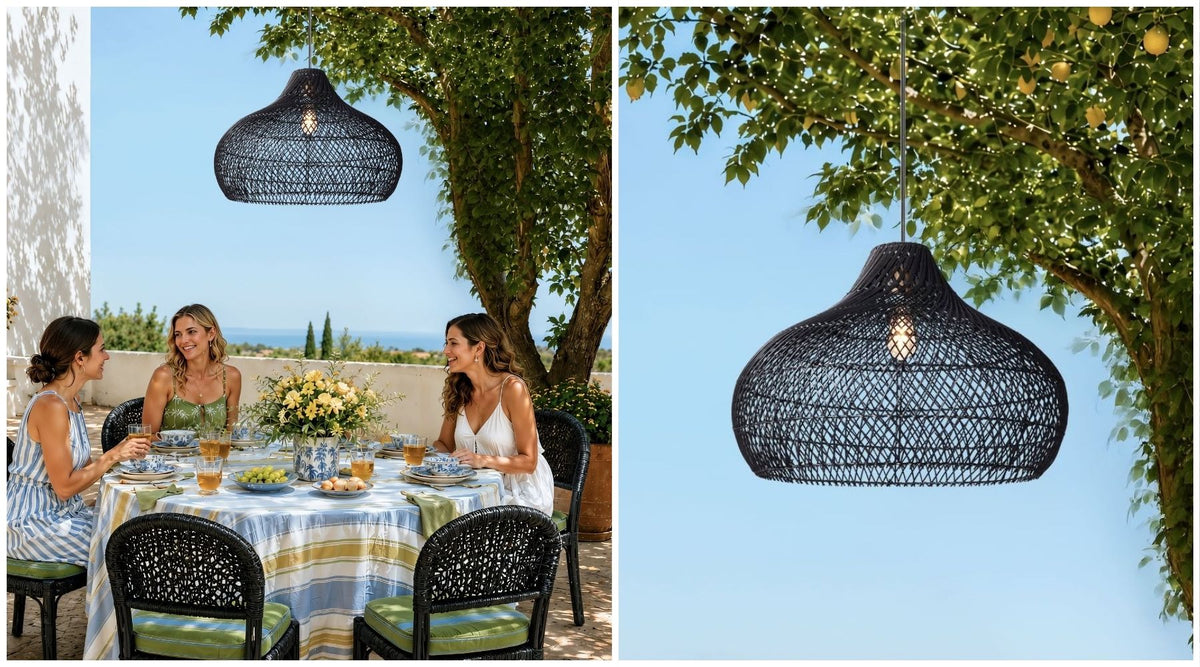
A better kids room lighting plan combines a safe ceiling light, focused task lighting, and softer accent lighting that can be adjusted throughout the day. For low ceilings or active rooms, a flush mount or rattan flush mount is usually more practical than a low pendant. For reading nooks, a wall sconce or rattan sconce can add soft side lighting without taking up floor space.
Let Rowabi break it down and help you easily understand that:
Quick answer: What are the biggest kids room lighting mistakes?
The most common mistakes, in order of how often parents make them:
- Relying on one harsh overhead light as the room's only source
- Choosing fixtures that hang too low for the ceiling height or bed layout
- Ignoring glare from exposed bulbs or poorly placed lights
- Using the wrong color temperature - typically too cool for a bedroom
- Forgetting task lighting for reading, homework, or crafts
- Leaving cords exposed and within a child's reach
- Skipping dimmers and losing flexibility across different times of day
- Choosing unstable floor lamps in active play zones
- Picking overly themed fixtures that the child will outgrow in two years
- Ignoring safety clearances around cribs, bunk beds, and play areas
10 critical kids room lighting mistakes parents need to avoid
Most parents spend hours choosing the right paint color, the perfect crib, or the softest rug, and then leave lighting as an afterthought. It is understandable: lighting feels like a finishing touch rather than a foundational decision. But wrong lighting in a kids room does not just look off. It causes eye strain, disrupts sleep, creates physical hazards, and produces a room that children find uncomfortable in ways they cannot always articulate.
The ten mistakes below are the most common, and each has a straightforward fix.
Mistake 1: Relying on one harsh overhead light
A single bright ceiling fixture, what many families call "the big light", is one of the most common and most harmful lighting setups in a kids room. The problem is not just that it looks uninviting. It is that a single high-intensity source pointed straight down creates a severe contrast between the brightly lit center of the room and the darker edges and corners.

A child's pupils must continuously adjust as their eyes move between bright and dark zones, as a tiring, involuntary process that the U.S. Department of Energy identifies as a primary cause of visual fatigue and glare-related discomfort.
The fix: Replace single-source overhead lighting with layered lighting spread across the room. The standard approach uses three layers working together: ambient light from the ceiling to fill the room generally, task lighting (a sconce or lamp) for reading or homework, and soft accent lighting for winding down. This distributes light evenly enough that no single zone is dramatically brighter than another, and the eyes can relax rather than continuously readjust.
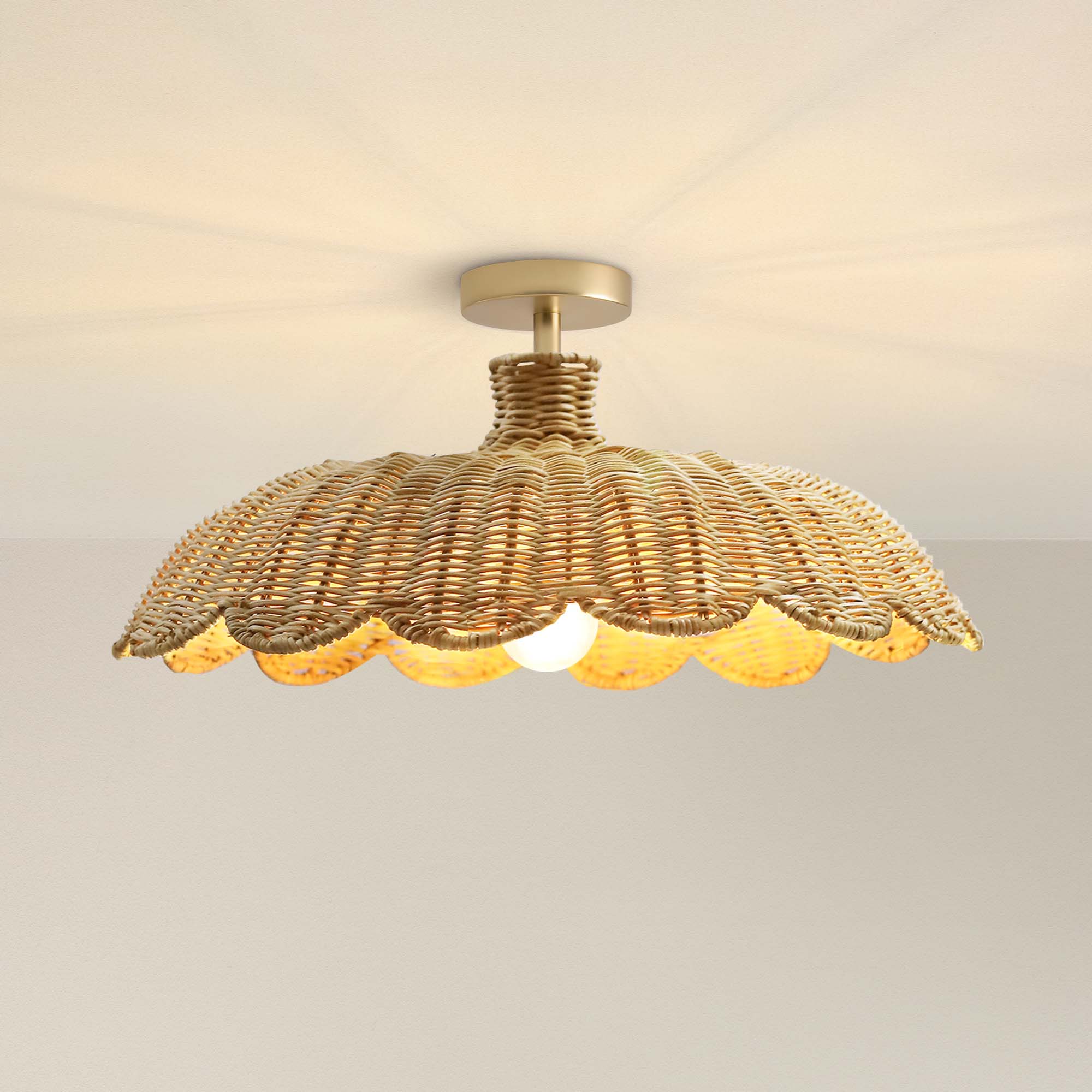
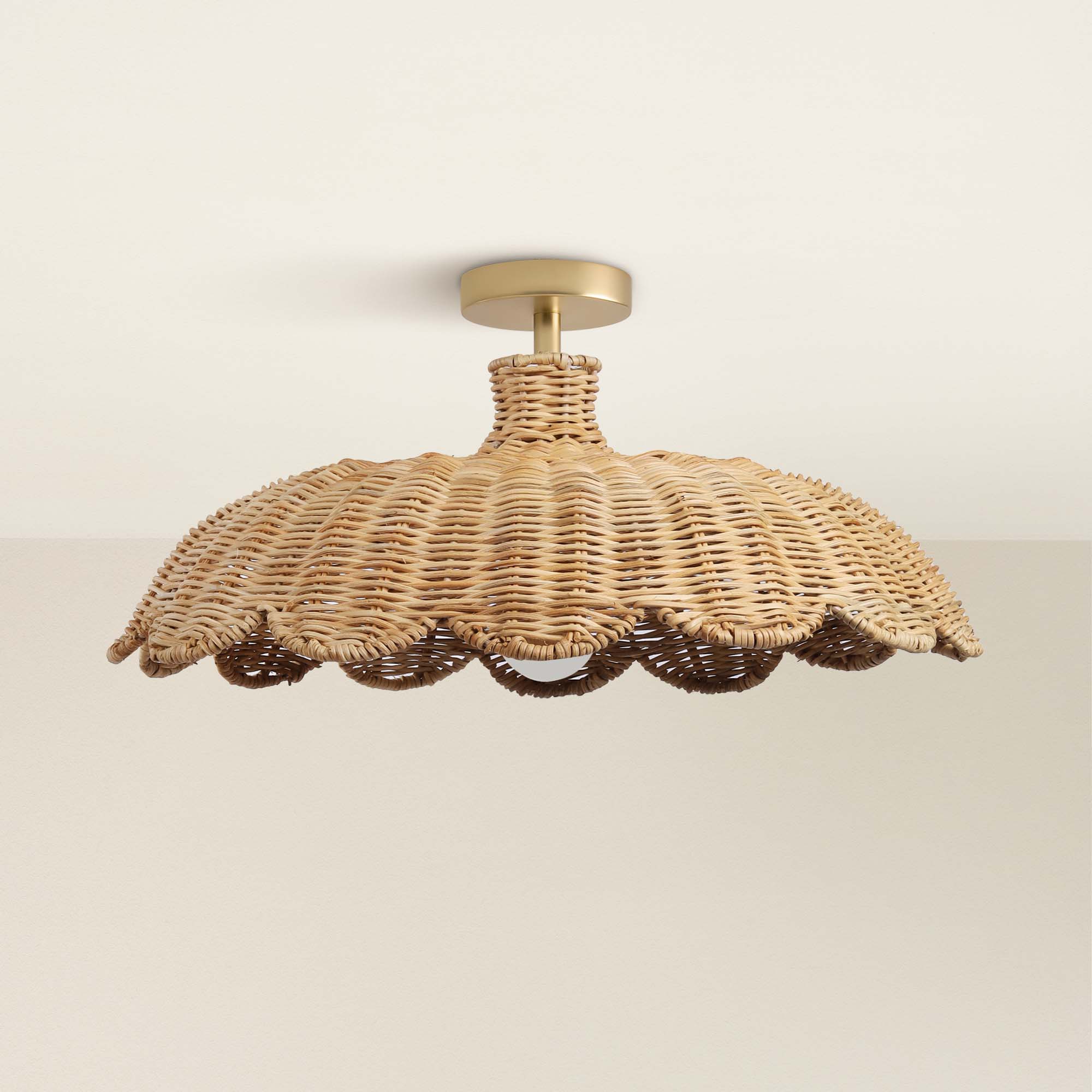
For the ceiling layer specifically, the fixture choice matters as much as the bulb. A bare bulb or exposed spotlight produces a harsh downward beam. A diffused, shaded ceiling fixture spreads light softly in all directions. A rattan flush mount does this particularly well because its woven, natural surface filters light as it passes through the weave, producing even, softened ambient coverage throughout the room.
For parents who want warmth alongside diffusion, the material itself contributes to the overall atmosphere in a way that a plain frosted glass fitting cannot.
Mistake 2: Choosing fixtures that hang too low
A pendant or chandelier that hangs too low in a kids room is not just a style problem, it is a safety problem. Children jump on beds. They throw pillows. They stand on furniture. They do all of this with enthusiasm and without looking up. A fixture that hangs within reach of a standing child is one that will be grabbed, swung from, bumped into, or knocked loose, not if, but when.
The U.S. standard recommends that the bottom of any hanging ceiling fixture be at least 7 feet from the floor in areas where people move. In a standard 8-foot ceiling room, that leaves only 12 inches for the fixture itself, ruling out most pendants entirely.
In a room with bunk beds, the situation is more urgent: a child standing on an upper bunk may have their head within 2–3 feet of the ceiling, which means any fixture hanging more than an inch or two below the ceiling surface enters the danger zone.

Flush mount is the best fit for kid room because it stays close to the ceiling, keeping a safe space for the kids’ area.
The fix: For rooms with 8-foot ceilings, bunk beds, loft beds, or any active play zone, choose a flush mount as the primary ceiling fixture. A flush mount sits flat against the ceiling with no drop, entirely eliminating the clearance concern.
When you want the warmth and texture of a more decorative fixture without the risk of hanging, a rattan flush mount is the practical answer. It brings visual interest and the warmth of natural materials to the ceiling while remaining safely close to it. Pendants and short chandeliers can work in rooms with ceilings at 9 feet or higher, provided they are installed carefully and positioned away from beds and play zones.


Mistake 3: Ignoring glare and harsh shadows
Glare in a kids room does not look like obvious brightness. It often presents as a child squinting, rubbing their eyes, avoiding a reading chair, or complaining that a room feels uncomfortable without being able to say why.
The U.S. Department of Energy defines glare as light that is bright enough relative to its surroundings to make seeing more difficult, and it typically results from a light source that is either too intense, unshaded, or positioned at the wrong angle relative to what the child is looking at.
Exposed bulbs are the most common cause. A bare filament bulb, a clear glass pendant with a visible bulb, or a downlight that shines directly into a child's eyes when lying in bed all create the kind of direct-source glare that causes discomfort over time. Shadows are the companion problem: a ceiling light positioned directly above a reading area casts a shadow that obscures the reader's head and shoulders, leaving the page in partial darkness.

It’s better to use a lighting fixture with shade instead of an exposed bulb.
The fix: Use shaded, diffused, or woven fixtures throughout the room, never an exposed bulb as a primary source. For the ceiling, a fixture with a frosted glass, fabric, or woven shade completely diffuses the bulb's light. For task lighting near a reading nook, position the light source to the side of and slightly above the reader, so it falls over the shoulder and onto the page from a glare-free angle.
The over-the-shoulder placement eliminates both the shadow and direct-glare problems simultaneously.
Mistake 4: Using the wrong color temperature
Putting a cool white or daylight bulb in a kids bedroom is one of the most common and most overlooked mistakes in kids room lighting, and its effects go beyond aesthetics. The U.S. Department of Energy classifies light sources by color temperature in Kelvin.
Lower temperatures (2700K–3000K) produce warm, amber-toned light. Higher temperatures (3600K–5500K) produce cooler, bluer light similar to daylight or office fluorescents. In a bedroom, the difference matters physiologically: blue-spectrum light suppresses melatonin production, the hormone that signals the body to prepare for sleep. A child reading or playing under cool white or daylight light in the hour before bed is working against their own biology.

The fix: Match the color temperature to the space's function and the time of day it is used most.
- 2700K–3000K (warm white): For any bedroom ceiling light, bedside lamp, or wall sconce used during evening and bedtime routines. This range minimizes blue light exposure and creates the golden, calming atmosphere that helps children wind down naturally.
- 3000K (neutral warm white): A solid choice for general ambient lighting in a kids room used primarily during daytime.
- 3500K–4000K (cool white): Appropriate only for a dedicated homework desk or craft table where alertness matters, used as a secondary, switchable source, not the room's main light.
- Above 4000K: Avoid in any bedroom context. The cool, clinical quality of daylight-temperature light undermines everything that makes a child's room feel comfortable and safe at night.
Mistake 5: Forgetting task lighting for reading and homework
A ceiling light positioned above a child who is reading at a desk or sitting in a reading chair does not illuminate the page, but the child's back. The reader's own head and shoulders block the overhead light, casting a shadow directly onto the book or worksheet.
The child then leans closer, hunches their shoulders, and strains their eyes to read in the shadow they themselves are creating. This is not a minor inconvenience. It is the specific physical setup that leads to headaches, poor posture, and shortened attention spans, which parents often attribute to the child rather than to the lighting.

While the ceiling light provide lighting for the whole space, a table lamp or wall sconce for the study desk is a must to protect your kid’s eyes.
The fix: Add a dedicated task light positioned to the side of the reading area. The goal is a light source that sends light over the child's shoulder and onto the page, not from above, and not from directly in front, where it would create glare. A wall sconce mounted at the right height (approximately 60–68 inches from the floor for a seated older child, lower for floor-level reading setups) naturally achieves this.
A Rowabi rattan wall sconce works well in this position thanks to its woven shade that prevents direct glare while still casting warm, directed light toward the reading surface, and it takes up no floor or table space. For older children with a homework desk, a gooseneck desk lamp with a stable base is an equally effective task light.
Mistake 6: Leaving cords exposed
Accessible electrical cords in a child's room are a documented safety hazard, not a theoretical one. The U.S. Consumer Product Safety Commission's "Go Cordless" campaign specifically addresses the strangulation risks posed by looped, trailing, or accessible cords in spaces where children sleep and play. This applies to window blind cords, but it applies equally to the trailing cords of plug-in lamps, nightlights, and sconces in a kids bedroom.

A cord that runs across the floor from an outlet to a lamp, hangs along a wall without a cover, or loops near a crib or sleep surface is a hazard that requires action, not acceptance.
The fix: Hardwired ceiling fixtures and wall sconces are the gold standard which are all electrical connections are behind the wall, nothing is accessible at floor or child level, and the fixture is secured in a rated wall or ceiling box.
For renters or rooms where hardwiring is not possible, plug-in fixtures can be used safely with strict cord management: route every inch of visible cord through a plastic cord concealer fixed flush against the wall, tuck all excess cord behind heavy furniture that cannot be moved, and ensure no cord is accessible from any surface where the child sits, stands, or sleeps, specifically for nurseries.
Mistake 7: Skipping dimmers or lighting controls
A kids room without a dimmer is a room with only two modes: fully lit and off. Neither setting is right for every moment of the day, and forcing parents to choose between them creates a real problem at the critical transition from active time to sleep.
A bright overhead light at full power during bedtime routines sends the wrong biological signal to a child's nervous system: signaling wakefulness rather than rest. Turning it off entirely and replacing it with a small nightlight creates the sharp contrast that drives the eye strain discussed in Mistake 1.

The fix: Install a dimmer switch for the main ceiling fixture, and use dimmable LED bulbs throughout the room. Note the compatibility requirement: not all LED bulbs work with all dimmer switches, and using a non-dimmable bulb with a dimmer can cause flickering, buzzing, or premature bulb failure.
Check that the bulb packaging specifically states "dimmable" before purchasing. Dimming the room lights gradually in the 30–45 minutes before a child's bedtime creates a visual and biological cue that sleep is approaching one that requires no parental enforcement once the habit is established.
For older children, a smart bulb with a programmed schedule can automate this transition entirely, shifting from full brightness to a warm dim at a set time without any adult intervention.
Mistake 8: Choosing unstable floor lamps in active rooms
A tall floor lamp with a lightweight base in a toddler's room or active play zone is not a matter of if it gets knocked over, but when.
Young children move freely, enthusiastically, and unpredictably in spaces they love. They run, jump, roll, and throw things without thinking about what is in the room around them. A top-heavy lamp with a small base is easily toppled by a child running past, sitting down heavily nearby, or simply misjudging a turn. When it falls, it takes the bulb, the shade, and the cord with it, all of which can cause injury or create a cord hazard on the floor.

Floor lamp with the stable base is a must to ensure children’s safety.
The fix: Remove floor lamps from active play zones and replace them with wall-mounted or ceiling-mounted alternatives that cannot be knocked over. A wall sconce provides task or accent lighting at the right height without any floor footprint. While a flush-mount fixture provides ambient coverage with no moving parts.
For older children, typically eight and above, a table lamp placed on a stable surface (a bookshelf, a desk, a dresser) can work, provided the base is heavy enough to resist tipping and the cord is routed immediately behind furniture rather than across open floor space.
Mistake 9: Choosing fixtures that are too childish
A light fixture shaped like a rocket ship or a cartoon character is charming for approximately two years. At four, a child who had enthusiastically loved space may have moved on to dinosaurs, then horses, then a strong opinion that their room should look "not like a little kid's room." The fixture, meanwhile, is still screwed into the ceiling, now an awkward reminder of a design decision that once felt timeless.

The fix: Choose fixtures in materials and forms that grow with the child rather than being defined by a specific age or phase. Rattan, natural linen, brushed brass, matte white, and warm wood tones read appropriately in a newborn nursery, a school-age bedroom, and a teenager's room in a way that novelty fixtures never will.
A rattan ceiling light, in particular, suits a calm nursery at one end and a considered, modern teenager's room at the other. It is one of the few fixture choices that genuinely does not need to be replaced as the child grows. Investing in a well-made, timeless fixture costs less in the long run than replacing a themed one every few years.
Mistake 10: Ignoring safety zones and clearances
Every kids room has zones where lighting decisions carry safety implications beyond aesthetics, and ignoring those zones is one of the most consequential mistakes a parent can make.
Around cribs and sleep areas, the rules are clear: no accessible cords, no hanging fixtures within reach of a standing infant, and no loose elements that could enter the sleep space. The American Academy of Pediatrics recommends keeping the sleep environment free of loose items, and the same logic applies to lighting within the child's reach.
For bunk beds, the key measurement is clearance from the upper bunk mattress to the ceiling fixture. In an 8-foot ceiling room with a standard bunk bed, a child standing on the upper mattress may have their head within 2–3 feet of the ceiling. Any fixture that drops more than a few inches below the ceiling surface is within that zone, which is why a flush mount is the only appropriate choice for the primary ceiling light in a bunk bed room.

For active play areas, the consideration is breakage. Glass shades, crystal pendants, and fragile fixtures positioned in zones where children throw pillows, balls, or toys are not a safe material choice, regardless of how high they are hung. A woven rattan shade, a fabric drum, or a metal fixture is a meaningfully less breakable alternative to glass in a high-activity zone, and if contact does occur, far less likely to create sharp fragments.
For reading nooks, mount wall sconces at approximately 60–68 inches from the floor, high enough to be out of reach when a child is standing, and correctly positioned for over-the-shoulder task lighting when the child is seated.
Quick kids room lighting safety checklist
Before considering a kids room complete, run through these checks:
- The Cool-Touch Test: Are all fixtures using LED bulbs? According to the U.S. Department of Energy, LEDs use at least 75% less energy than incandescent bulbs, last up to 25 times longer, and emit very little heat, making them significantly safer in spaces where children may touch fixtures or shades.
- The 3-Foot Cord Rule (CPSC standard): Are all cords from plug-in sconces, nightlights, and table lamps fully hidden behind furniture or secured to the wall with cord covers? Are they completely inaccessible from cribs, play mats, and sleep zones?
- The Wobble Test: Have all tall, unstable floor lamps been removed from active play zones? Is every remaining lamp on a surface stable and heavy enough to resist tipping?
- The Shatter-Safe Check: Are active play areas and bunk bed zones free of glass pendants or crystal fixtures? Where a more breakable fixture is not avoidable, has it been positioned well above reach?
- The Glare-Free Guarantee: Do all ceiling fixtures and reading lights have a shade or diffuser that fully covers the bulb? Is no light source positioned to shine directly into a child's eyes from their usual positions in the room?
- The Bunk Bed Clearance: If the room has bunk beds or a ceiling at 8 feet or below, is the main ceiling fixture a low-profile flush mount with no pendant drop?
- The Bedtime Bulb Check: Are the lights used for evening routines rated 2700K–3000K (warm white)? Is a dimmer installed or planned?
FAQs
What is the most common lighting mistake in a kids room?
- Relying on one harsh overhead light as the room's only source. A single bright ceiling fixture creates high contrast between lit and dark zones, forces the eyes to continuously readjust, and provides no flexibility for reading, homework, or bedtime routines.
Is one ceiling light enough for a kids bedroom?
- Not usually. A ceiling light provides useful general brightness, but it creates shadows when used for reading, offers no directed light for a homework desk, and cannot be easily adjusted for bedtime routines without a dimmer. A ceiling light paired with a wall sconce and a dimmable bulb gives a kids room the flexibility it actually needs.
Are pendant lights a bad idea for kids rooms?
- Not inherently, but placement matters significantly. A pendant hung at a safe height in a room with ceilings at 9 feet or above, positioned away from bunk beds, play zones, and cribs, can work well. In rooms with standard 8-foot ceilings, or anywhere near bunk beds or active play, a flush mount is the safer and more practical choice.
What color light should I avoid in a kids bedroom?
- Cool white and daylight bulbs (4000K and above) should be avoided as the primary bedroom light source, particularly for evening use. These color temperatures produce blue-spectrum light that suppresses melatonin and makes it harder for children to fall asleep. Warm white at 2700K–3000K is the most appropriate choice for bedroom ambient and task lighting.
Are floor lamps safe for kids rooms?
- Not for toddler rooms or active play zones. A tall floor lamp in an area where young children run and play is a tipping hazard. For older children (generally eight and above) with a dedicated desk, a table lamp with a heavy, stable base on a secured surface is manageable, but wall-mounted alternatives are always safer in spaces where children move freely.
How do I fix harsh lighting in a kids room without remodeling?
- Four changes make the biggest immediate difference. Replace existing bulbs with warm white LEDs at 2700K–3000K. Add a dimmer switch compatible with dimmable LED bulbs. Add a wall sconce for reading or task lighting. And if the ceiling fixture has an exposed bulb, replace the shade with a diffused or fabric alternative.
Conclusion
Lighting a kids room well is less about finding the prettiest fixture and more about avoiding the handful of mistakes that make a room uncomfortable, unsafe, or difficult to use as the child grows. One harsh overhead light, a pendant hung too low, cords within a toddler's reach, the wrong bulb temperature at bedtime, each of these is easy to overlook, and genuinely consequential to fix once a room is in use.
The good news is that most of these mistakes are correctable without a full remodel. If you are building or updating a kids room and want lighting that is safe, warm, and designed to grow alongside your child, browse Rowabi's rattan flush mounts, wall sconces, and rattan pendant lights, or reach out to the Rowabi team if you want guidance on what works for your specific ceiling height, room layout, and design style.